Sunday, May 31, 2026

THE ANCIENT RENAISSANCE MAN IMHOTEP
SET THE EGYPTIAN PRECEDENT
FOR ANTINOUS TO BECOME A GOD


SOME 3,000 years before Antinous, the Egyptians deified another mortal commoner ... the ancient "Renaissance Man" Imhotep ... Egyptian magician, physician, scribe, sage, architect, astronomer, vizier, and priest.

Imhotep's many talents and vast acquired knowledge had such an effect on the Egyptian people that he became the first individual of non-royal birth to be deified ... setting a precedent for Antinous to attain the status of a god.

 Imhotep, or "he who cometh in peace," was born in Ankhtowe, a suburb of Memphis, Egypt. 


The month and day of his birth are noted precisely as the sixteenth day of Epiphi, third month of the Egyptian harvest (corresponding to May 31) but the year is not definitely recorded. 


It is known that Imhotep was a contemporary (living in the same time period) of the Pharaoh, or king of Egypt, Zoser (also known as  Neterikhet) of the Third Dynasty. But estimates of the era of his reign vary by as much as three hundred years, falling between 2980 and 2600 B.C.E.

Imhotep's father, Kanofer, a celebrated architect, was later known to be the first of a long line of master builders who contributed to Egyptian works through the reign of King Darius the First (522–486 B.C.E. ). His mother, Khreduonkh, who probably came from the province of Mendes, is known today for having been deified alongside her son, an Egyptian custom.


Vizier under King Zoser


The office of the vizier in politics was literally described as "supervisor of everything in this entire land." Only the best educated citizen could handle the range of duties of this position that worked closely with the Pharaoh, or king of Egypt.
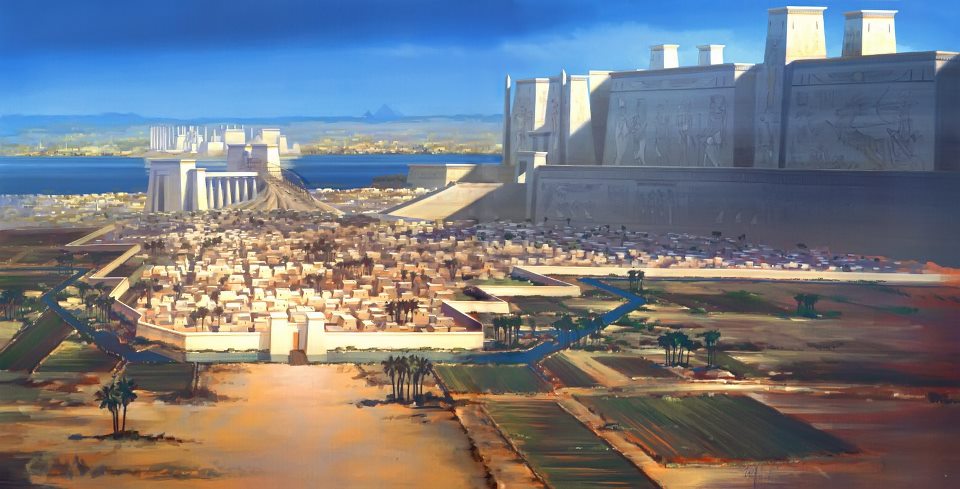

The capital city was Mennefer (Memphis) called the city of the "White Walls" for the enormous walls around the Temple of Ptah compound (right).


As vizier, Imhotep was chief advisor to Zoser in both religious and practical matters, and he controlled the departments of the Judiciary (court system), Treasury, War, Agriculture, and the General Executive.

There are no historical records of Imhotep's acts as a political figure, but his wisdom as a religious advisor was widely recognized after he ended a terrible famine (a severe shortage of food) that dominated Egypt during seven years of Zoser's reign. It is said that the king was failing in his responsibility to please the god Khnum, and his neglect was causing the Nile to fall short of a flood level which would support Egyptian farms. 


Imhotep, having a vast knowledge of the proper traditions and methods of worship, was able to counsel Zoser on pleasing Hapi, the the god of the inundation, allowing the Nile to return to its usual flood level.


The first miracle attributed to Antinous was a bountiful Nile inundation in the year 131 AD. 


Architect of the famous pyramid at Sakkara


 The Step Pyramid at Sakkara is the only of Imhotep's achievements that can still be seen and appreciated today. Its reputation is largely based on Imhotep's accomplishments as the pyramid's inventor and builder. 


This pyramid for King Djoser, also called "Netjerikhet" (Incarnation of the Gods), was the first structure ever built of cut stone, and is by far the oldest of the Seven Wonders of the World, the seven structures of the ancient world that were astonishing accomplishments for their time. 


It took twenty years to complete—not very long, given the newness of the idea and the state of structural science in the Bronze Age (between 3000 B.C.E. and 1100 C. E.), the period of development where metals, particularly bronze, were used for the first time.

Imhotep wanted the tomb to accommodate the Pharaoh's rise into the heavens. To do this, he planned to improve upon the flat, rectangular mastabas, or built-in benches, which were the traditional tombal structures. 


The pyramid was raised on top of the base mastabas in five smaller steps, one on top of the other.


He added a passageway on the north side issuing upward within the structure from a sarcophagus chamber (where the stone coffin holding the mummy is kept) seventy-five feet below ground. 


The total height of the pyramid and base is just under two hundred feet, unimaginably large for a single structure before Imhotep's design.

The project at Sakkara was designed in its entirety as a way for the deceased to perform the rituals of the jubilee festival, or Hebsed. The complex consisted of many other buildings, as well as ornamental posts some thirty-seven feet high. 


The protection of the king and his burial gifts—about 36,000 vessels of alabaster, dolomite, aragonite, and other precious materials—was the other primary function of the burial site.

The entire complex was enclosed within a stone wall about thirty-five feet high. Imhotep added several false entrances to throw off possible tomb raiders. As a final measure, the king's treasure was lowered through vertical shafts around the tomb into a long corridor one hundred feet below ground. The digging of just this corridor without machines of any kind is an amazing accomplishment by modern standards.

When Antinous and Hadrian visited Egypt in the year 130 AD, they stood atop the plateau at Sakkara and marveled at the achievements of Imhotep.

It is likely that Imhotep was the architect and master builder of many other projects completed during a forty-year period of the Third Dynasty, though none of them compare in size or stylistic influence to the burial site at Sakkara. 


Imhotep was also the author of an encyclopedia of architecture that was used as a reference tool by Egyptian builders for thousands of years.
 

Physician-magician, God of medicine


As a god of medicine, Imhotep was beloved as a curer of everyday problems who could "provide remedies for all diseases," and "give sons to the childless."


Members of the cult of Imhotep in the Twenty-sixth and Twenty-seventh Dynasties (between 525 B.C.E. and 550 C. E.) would pay tribute to the God at his temple just outside Memphis. 


The temple also contained halls devoted to the teaching of medical methods, and to the preservation of the materia medica, which details the entirety of Egyptian medical knowledge which may actually have originated with Imhotep.

Imhotep's name was often grouped with such powerful deities as Thoth, God of Wisdom, Isis, the wonder-worker, and Ptah, a healer and the ancient God of Memphis. 


Although royal individuals were deified by the Egyptians, Imhotep is unique as the first non-royal man to be known by his own name as a god inferior in power only to Re (chief Sun-God). With that precedence in mind, the Egyptians had no objections to accepting Antinous as a God.


Imhotep was also a member of the great triad of Memphis, with Ptah, Imhotep's father among the gods, and Sekhmet, a goddess associated with childbirth.

It is a matter of debate today how much of Imhotep's reputation as a curer of disease stems from medical skill and how much comes from his command of magic and healing rituals.


More than 3,000 years before Antinous died in the Nile ... Imhotep set the precedent for deification of mortal non-royals in Egypt.

Saturday, May 30, 2026

THE SAGITTARIUS FULL MOON
THE DENARIUS MOON OF ANTINOUS


TONIGHT's Sagittarius Full Moon is the Lunar Phase which we call the DENARIUS MOON in Antinous Moon Magic.

This the classic "Money Moon" of ancient lore. This is the best time to fulfill dreams for achieving the riches you have always sought ... and remember that "riches" are not counted in terms of money, but in terms of the wealth of love and warmth you give to others.

The Sagittarius Full Moon is the "lucky" moon of jovial excess and exuberant spending.

Each Lunar Phase represents a Divine Spirit or Archetype. The Spirit of the Denarius Moon is the Spirit of Wealth and Abundance. It is the embodiment of largesse and of all material and spiritual riches. It is the Spirit of Richness in all its many meanings.

It is symbolized by a Roman coin bearing the profile of Antinous. In ancient times, Antinous coin/medallions were prized by his worshipers as a sort of portable Sacred Token or Pocket Shrine.

In ancient times many followers of the Blessed Youth felt it was necessary to have a tangible representation of Antinous with them at all times for protection and for blessings.


The rich had small, light-weight traveling busts or bronzes made to accompany them on their journeys. Poor people made do with more crudely made representations, such as coins and figurines and medals made of lead, clay and other base materials.

People of modest means who were lucky enough to get their hands on one of his commemorative coins would carry it with them for protection, often even wearing them.

Many were pierced by holes and hung from the neck as talismans: Antinous' image offering protection against evil, sickness and death. Other such medallions were mounted in frames to adorn household altars, and others were buried with the dead to invoke the god's aid on the perilous journey into the unknown.

Meditations and rituals tonight are best suited for delving into matters concerning material wealth, as you might expect. But on a far more sublime level, this is an ideal night for delving into the true treasures in your life ... the things you value most.

GOLDEN CITRINE
FOR THE DENARIUS MOON

By Our Crystal Meditation Advisor Martin Campbell


OUR astrology advisor Hernestus has reminded me that today's moon is the Antinous Denarius Moon (Sagittarius Full Moon).

With its focus on finding wealth in your pocket, life, experience, health and people, I would recommend that you meditate using the following crystals:

Aventurine - These beautiful stones are typically pale blue but can be found in other colours/colors. They have many attributes but, for this full moon,  the key aspect is that they are very positive stones for prosperity. They also bring mental clarity to help you achieve your prosperity.

Citrine - These beautiful yellow/gold crystals have been well known for centuries as stones of abundance. They help you achieve the wealth you seek in any aspect of your life. A joyful crystal, Citrine also helps you to share your wealth thus bringing other aspects of wealth to you such as the trust, love and friendship of those you help but also building an abundant respect and love of yourself for doing so.

Place a Citrine in the left corner of every room in your home and allow it/ trust it to bring wealth/abundance into your life.

In Light and Life,
MARTIN

To get more advice from Martin Campbell and to find out how to contact him CLICK HERE.

JOAN OF ARC, SAINT OF ANTINOUS


ON MAY 30th the Religion of Antinous honors Saint Joan of Arc who was burned as a heretic on this day in 1431.


She was a peasant girl who led the armies of the King of France against the occupying forces of the English. She claimed to have been chosen by God to drive the English from France and deliver the country to her King.

Joan of Arc said that she conversed daily with Saints Catherine and Margaret and St. Michael the Archangel. Her greatest victory was the liberation of Orleans, where Charles, then Dauphin, was crowned as King of France.

She was later captured by the English and subsequently tried by the Church and burned as a heretic. The focus of her trial was upon the nature of her visions, which the inquisitors condemned as Demonic, and upon her refusal to wear women's clothing.

Joan of Arc was in essence the most courageous of all transvestites, whose insistence upon male dress and hair style, and occupation as a warrior was the excuse used by the Church for her condemnation and subsequent burning as a heretic. The Church however reversed this decision in 1909 by beatifying her, and then finally consecrating her as a saint in 1920.

Though she is a saint of the Catholic Church and a devoted Christian, it is for her courage as a transvestite and possibly as a sacred lesbian that she is included as a Heroic Martyr Saint of the Religion of Antinous.

Friday, May 29, 2026

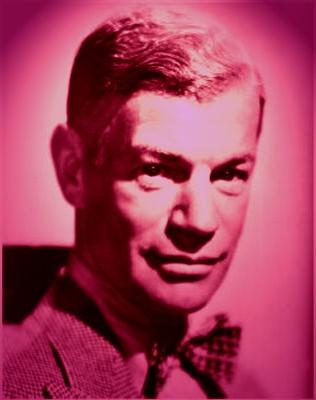
JAMES WHALE, SAINT OF ANTINOUS


ON MAY 29th the Religion of Antinous celebrates the life of Saint James Whale (22 July 1889 — 29 May 1957), the openly gay British-born director of such films as Frankenstein, The Old Dark House, Bride of Frankenstein and The Invisible Man.

His movies were modern parables about the cruelty of "normal" people towards "monsters" in their midst. 


All of those 1930s films are recognized as classics of the genre. Whale directed over a dozen films in other genres, including what is considered the definitive 1936 film version of the musical Show Boat.

He became increasingly disenchanted with his association with horror, but many of his non-horror films have fallen into obscurity. Whale was openly gay throughout his career, something that was very unusual in the 1920s and 1930s.

He tended to use gay actors who were friends of his, including Colin Clive, Ernest Thesiger, Charles Laughton and Laughton's wife Elsa Lanchester, who played the "Bride". Thesiger has tea (below) in mad-scientist garb. 

Bride of Frankenstein, in particular, is widely interpreted as having a gay subtext and it has been claimed that Whale's refusal to remain in the closet led to the end of his career.

James Whale's true genius was in making movies which made the audience sympathize with the "monster" instead of the "normal" people, who invariably were portrayed as ridiculous, comic fools.

James Whale's soaring career was dashed by homophobic studio bosses who objected to having a "pansy" directing major movies. He spent the last decade of his life as an outcast in Hollywood.

He "accidentally" drowned in his own swimming pool in the mid-1950s after having become a chronic depressive following a stroke.

His life was brought to the screen in the award-winning movie Gods and Monsters, which is a masterful adaptation of a very wonderfully written gay novel entitled Father of Frankenstein by Christopher Bram.

The book and the movie are about his final weeks of life with flashbacks to his childhood in poverty in northern England and his traumatic experiences during World War I and to his heyday as the toast of Tinseltown, and his plunge into obscurity — and his final plunge into the watery arms of Antinous.

It is a great irony that the only out-and-proud Hollywood director of the 1930s is remembered as a man whose name is equated with monsters.

Thursday, May 28, 2026

ASTRO FORECAST: MAY 28th—JUNE 7th, 2026

Antinous is a Moon God. He is, of course, many other things and he wears many hats. But one of the ways he was worshiped in Antiquity was as ANTINOUS THE MOON GOD.

His worshipers looked skyward and saw His beautiful face perpetually turned towards the Earth. The Man in the Moon was actually the Blessed Boy in the Moon for the ancient priests and worshipers of Antinous. Swiftest and most youthful of all the Zodiacal deities, Antinous speeds through an entire year's worth of Astrological signs in just 28 days.

ANTINOUS THE MOON GOD represents our deepest personal needs, our basic habits and reactions, and our unconscious gay selves. Where Hadrian the Sun acts, Antinous the Moon REACTS. How do we instinctively react or respond to problems? What do we feel we need for a sense of security? Look to ANTINOUS THE MOON GOD for answers.

ANTINOUS THE MOON GOD is both our inner boy child and our inner lover. His ever changing phases, as he sweeps past all the other Planets in all the Signs, make us at turns responsive, receptive, and reflective. Eternally youthful, ANTINOUS THE MOON GOD represents our childlike spontaneous and instinctual reactions.

ANTINOUS THE MOON GOD beams down on us to make us imaginative, creative, intuitive, sentimental, adaptable, introspective, and protective. On the negative side, and depending on where he is in the Zodiac, he can make us moody, restless, and irrational.

Antinous Astrology Forecast


MAY 28th
to JUNE 7th, 2026


THURS-FRIDAY, MAY 28th-29th, 2026

This week, Venus and Saturn spawn relationship challenges. Venus is in a 90-degree right-angle square to stubborn Saturn. Venus-square-Saturn means that relationship discussions are fraught with stumbling blocks. And because Venus and Saturn also have a role to play in money and business, you can expect problems in that area as well.

SAT-SUNDAY, MAY 30th-31st, 2026

This weekend, we come to the SAGITTARIUS FULL MOON which we call the DENARIUS MOON because it focuses its light on treasures in your life. This Full Moon is the best time of the year to use ANTINOUS MOON MAGIC to open your heart to ancestral spirits, guardians, spirit guides or past-life soul mates. They have a "treasure" of experience which they will lovingly impart to you.

MONDAY, JUNE 1st, 2026

This week, Mercury leaves its home base of Gemini and enters emotion-oriented Cancer, so that your Conscious Mind will find itself engulfed in emotions during an extended visit until August 10th. This is the time to give voice to your emotion.

TUES-WEDNESDAY, JUNE 2nd-3rd, 2026

This week, the Sun forms a brilliant and glowing sextile aspect with Saturn which empowers you with perseverance and clear vision to make some serious long-term plans for the future.

THURS-SUNDAY, JUNE 4th-7th, 2026

This week, Mercury is in a 90-degree square aspect to dreamy Neptune. The bad news: beware of tricksters and con-men. The good news: trust your intuition. Dive into the depths of your intuition.

SNEAK PREVIEW OF NEXT WEEK:

Another exciting week lies ahead between June 8th and 14th, 2026, when we come to the Pisces Third Quarter Moon, which is what we call the THE LOTUS MOON in Antinous Moon Magic. The LOTUS MOON means the week will be a time of joyous anticipation of something big which is just beyond the horizon. It is perhaps the most spiritual of all the Lunar Phase Spirits because it knows that its wait will not be in vain. It is waiting for something it knows must and will come to pass. It is a perfect night for casting the Antinous Moon Magic "Lotus Moon Spell" to obtain your heart's desire ... More details next time ....


ANTINOUS IN SMYRNA


PROCEEDING down the coast of Asia Minor, Antinous and Hadrian arrived in the port city of Smryna in May of 129, which was a major trading port between the interior and the Aegean sea.

The city was a major source of the incense myrrh from which it is believed to have been named.  The incense was obtained from the sap of a tree said to have once been a maiden named Myrrha daughter of Cinyras who was the son of Venus.  Myrrha was turned into the tree which sheds the incense tears, and it was from this tree, like the incense, that the boy Adonis was born.

It is believed that the cult of Myrrha, also called Smryna, of Adonis her son and his tragic love affair with Venus were originally brought from Phoenicia to the port city and from Smyrna was spread to the Greeks.

Smyrna was one of the places where the wandering Homer is said to have lived and a temple of Homer was located in the city.

Their host in Smyrna was the sophist Polemon, one of the foremost intellectuals of the age, who was Hadrian's trusted advisor.  Polemon organized a Bull Hunt, or Tauromachy in the Hispanic style which he knew would delight Hadrian.

A bull ring was constructed, and a rare wild Aurochs bull was fought by beautiful young men.  Hadrian and Antinous may have entered the ring to fight the bull.

Hadrian being from Spain, where the bull has always been a sacred animal, introduced Antinous to the sacred Bull Fight where a young warrior must prove his courage against the wild ferocious beast.

Hadrian delighted in fast paced conversation with Polemon in archaic Greek and Antinous was expected to respond accordingly when addressed, and he seems to have made a good impression on Polemon because after the deification, Polemon was one of the earliest and most ardent proponents of the New Religion, one of our greatest advocates.

Polemon organized the Cult of Antinous in Asia Minor and instituted the building of temples and priesthoods.

He issued Antinous coins which show Antinous on the front and a bull on the reverse, each coin bearing his own name.

The symbolism of the bull on the coins is mysterious but may have a connection to the cult of Dionysus or may also suggest the Cult of Mithras which originated in Asia Minor and was at its greatest strength when Polemon issued his sacred Antinous coins.

It may also have been a commemoration of the bullfight held for Hadrian where Polemon first met the young man, soon to become a god, in which Antinous bravely fought the Aurochs bull. We remember Polemon as a Saint of Antinous who not only knew Antinous in life but was one of the foremost advocates who advanced our religion from the inception. 

Ave Antinous!

Wednesday, May 27, 2026

WE CELEBRATE THE FEAST OF COMUS
GREEK GOD OF DRAG QUEENS


MAY 27th is the Greek festival of Comus ... the god of drag queens! 

Comus is the son of Dionysus which means that he is the son of Antinous, because Antinous is often depicted as Dionysus.

During his festival, the worshipers of Comus would dress in clothes of the opposite sex and have fun dancing all night. He is the god of cross-dressing, partying, comedy and comedians. 

Art above by Edmund Dulac shows Comus in red wig and green frock leading his followers in a wild dance in his role as the god of festivity, revels and nocturnal dalliances. 

He is a son and a cup-bearer of the god Bacchus. Comus represents anarchy and chaos. His mythology occurs in the later times of antiquity. During his festivals in Ancient Greece, men and women exchanged clothes. 

He had a wreath of flowers on his head and carried a torch that was in the process of being dropped. 

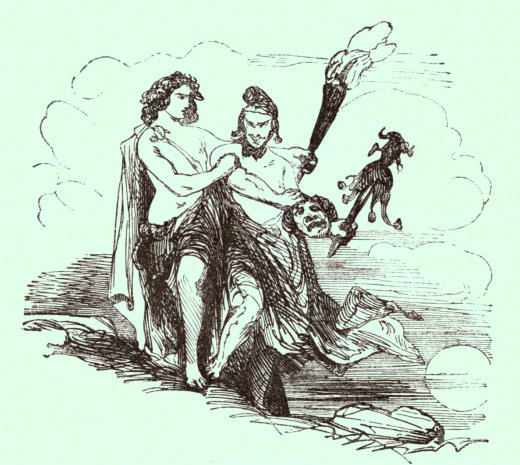
Comus was often depicted with Momus (illustration left), who was the deity of satire and mockery and who later became the familiar court jester.

Unlike the purely carnal Pan or purely intoxicated Bacchus, Comus was a god of excess. 

He is the god of drunken revelry, merrymaking, the source of jokes and comedy, especially anything which provokes a huge belly laugh. He is the god who makes a party go with a swing. 

His festival was a time of fun and frolics, with men dressed in drag and women sauntering about in male garb.

27 de maio é o festival grego de Comus ... o deus dos travestis! Comus é o filho de Dionísio. Durante seu festival, os adoradores de Comus vestir-se-iam nas roupas do sexo oposto e dariam o divertimento dançar toda a noite. Ele é o deus do travestismo, da festa, da comédia e dos comediantes. A arte por Edmund Dulac mostra Comus na peruca vermelha e no vestido verde que conduz seus seguidores em uma dança selvagem.

27 de mayo es el festival griego de Comus ... el dios de los travestis! Comus es el hijo de Dionisio. Durante su fiesta, los adoradores de Comus se vestirían con ropas del sexo opuesto y se divertirían bailando toda la noche. Él es el dios del travestismo, fiesta, comedia y comediantes. El arte de Edmund Dulac muestra a Comus en la peluca roja y el vestido verde que lleva a sus seguidores en una danza salvaje.

Tuesday, May 26, 2026

EMPRESS REGINA FONG
BELOVED SAINT OF ANTINOUS


ON MAY 26th the Religion of Antinous celebrates the life of Reg "Regina Fong" Bundy, a blessed saint of Antinous, who was born on this day in 1941 and died on April 15, 2003. A brazenly gay cabaret artiste — she disliked being called a drag queen — she was a well-known AIDS charity host who  influenced a generation of post-Stonewall gays in Britain with acerbic send-ups of politics and popular culture.

Regina Fong was not just a "queen", she was an "empress" — the last of the Russian Imperial Dynasty of the Romanoffs. Forget Anastasia (and Ingrid Bergman in a '50s film), Regina Fong was the REAL heir to Russian nobility. Like so many Russian aristocrats, she sought asylum in monarchical Britain after the Russian Revolution. There were indeed members of the Russian Imperial family who lived (albeit rather modestly) on the grounds of Windsor Castle during the 20th Century. Empress Regina lived (albeit rather immodestly) in London's West End.

Her Imperial Highness (HIH) Regina Fong did in fact become an Iconic cult figure on the European Cabaret stage. Known to friends as Reg (pronounced "Redge"), she lost her battle to cancer April 15, 2003.

But Reg, by creating Her Imperial Highness Regina Fong, a flame-red-wigged champion of gay rights, was insistently committed to being the knight in shining red armour who carried the banner of charities involved in transforming the AIDS epidemic from mortal tragedy into spiritual triumph. She reminded us all that gay cabaret, especially in London at that time, was (and continues to be) a central part of gay life.

After the "Gay Liberation" in the late '60s and '70s, drag queens and cabaret artistes were pushed to the back of the room, to more mainstream, homogenized images of gay life.

Regina Fong, and other Gay pioneers like Lily Savage, changed this forever and brought Gay Cabaret back to its rightful spot in the London Gay Scene. The Cabaret Tent at London Gay Pride events as the epicenter of Gay culture in good times and bad is the direct legacy of this valiant drag queen — er, ahm — cabaret artiste!

Our own Knight Stephanos personally knew Empress Regina Fong and conferred with her often in the legendary Black Cap gay bar in the heart of the Camden Town District of London. And so it is fitting that KNIGHT STEPHANOS (pictured right with Her Imperial Highness) explains her Sacred Significance to us:

"Happy Birthday Regina Fong even though you and the Black Cap are now gone.

"What can one say in this current day except to pay a tribute to the one and only Reg...Regina Fong, Queen if them all….

"Regina Fong the Empress of Camp. Queen of the Black Cap.


"You Reigned supreme. Sage of the rejected, muse to all that were affected.


"Daily she held court at the corner of the front bar, vodka and tonic, laughter, dialogue quite chronic. Nightly you drew the crowds: shaking us from the  melancholy of the expected life, denial waking strife.

"Cabaret Artiste beacon of hope, torch carrier of all who could but strive to such heights.

"Black cap memories to be had everyday at the end of the front bar at 11:00 am. Sitting to Michael Jeffries swapping war stories giving advice...in comes Steffens and Camp David...last of the Polari...Vada, Vada, Naff, Convo...Laughter, drinks, and scams galore.

"Always aching for the next adventure of days gone by…. If you could smell and hear the wonder of the front bar of the black cap...nicotine stains and morning shakes...characters and creatures of a world gone by...but not forgotten...bastions of an age of defiance, survival, and overwhelming urge to be fabulous.

"Happy Birthday H.I.H. Regina Fong ... the likes of you could never be wrong."

Monday, May 25, 2026

ANTINOUS WITH MITHRAS


AFTER what receiving the power of Homotheosis, Antinous ascended beyond the celestial sphere to the spine of the cosmos where he came into the presence of Mithras, the god of light, who advances the heavens with the turn of his hand.

Serpent entwined, he is the lion-headed god of endless time. 

The bull slayer, arisen from stone, with crown of stars, who holds the sky beneath his starry cloak, who sets time in motion, turning the clockwork of the cosmos, stands before Antinous illuminating the ascending youth with his light.

Antinous is greeted by the ascended fathers of the mysteries, because he is among the initiated through the tauromachia where he received the blood of the bull.

An initiated raven escorts him into the cavern of the sky, he passes between two mighty torch bearers who mark the turning of the sun.

A majestic table is set within the celestial dome, where Mithras sits enthroned, together with Sol Invictus and Lunus the Moon by his side.

All around are the ascended initiates, charioteers and fathers and the sacred soldiers of Rome who serve the god of light.

Antinous is given a seat in the presence of the gods.  He is served the sacred meat of the Bull of Heaven.  His cup is filled with the libations of those who know the mysteries.

The great god Mithras bestows his blessing upon Antinous who is illuminated with rays of shining light, becoming as one with the unconquered sun, becoming the bull-slayer, the savior of all those who enter the sacred mysteries.

Ave Antinous-Mithras

We pray to the Unconquered Sun, Pater Saturnus, serpent entwined, leontocephalus
Who walks across the spine of the cosmos
Here, now, always in darkness, 
The blood of the bull is my cup
The stars are my crown
The lotus-rose is my heart
My hooves are cloven among the tombs
Rising from stone by night I am Bacchus, Capricornius returned, 
For the semen of the first god truly is in my body!

Ave Antinous-Mithras

Sunday, May 24, 2026

WORSHIPERS WORLDWIDE VIA ZOOM
CELEBRATE THE SACRED BULL HUNT


WORSHIPERS worldwide tonight celebrate The Sacred Bull Hunt of Antinous in ceremonies originating from the Hollywood Temple of Antinous and uplinked globally via Zoom.

The commemoration marks the end of Taurus, the death of the Bull of Heaven ... and the coming of Gemini, the Divine Twins ... or shall we say The Lovers ... Hadrian and Antinous.

The Cycle of the Sacred Hunts are of course a recognition that Antinous was a God of the Hunt, that in his life-time, he is recorded in verse to have participated in a Lion Hunt, and in stone relief, his image has been identified as one of the participants, along with Hadrian in the hunt of the Bear and the Boar, and also the Lion on the tondos of the Arch of Constantine.

We might call this cycle "Hunt Spirituality," an awareness of the active element of Antinous.  

From his images we are given to understand him as a melancholy, day-dreaming, slightly self-involved, yet gentle and radiantly peaceful boy...but this is only part of the beautiful story.

Another part, which is in the ancient record and therefore can be regarded as biographical, is that he was a hunter...on horseback...and perhaps on foot...able to chase down wild animals, and kill them with a spear.

The Sacred Hunts commemorate the nature of the animals which then become part of who Antinous is, and by extension, who we may become, or find ourselves to be.

Whether we see ourselves as the Hunter Antinous, or the Hunted Animal...or a mingling of the two...the significance is always through our own personal essence...animalistic...the Sacred Hunts, therefore are one of the significant forms that Animalism has taken up in the New Religion of Antinous.

Antinous was never historically said to have hunted a Bull...so for historical accuracy, this is not a Sacred Hunt with historical precedence...this would be my own invention....but I will try to explain the essence of what I feel it means, and perhaps will you understand and even add your own meaning..or detract from it, or have no opinion at all.

But as I feel now...the Bull Hunt is probably one of the more meaningful and powerful understandings of Antinous that I have discovered.

There is an ancient connection between Antinous and the Bull that has remained unexplained, or unobserved because the meaning is unclear.

If there is no historical precedent to prove that Antinous participated in the bullfights, there is evidence to show that the bull was sacred to Antinous.

There are a number of coins from Asia Minor, that portray Antinous standing by the side of a bull, or have a Bull on the reverse. A coin from Antinous's home town Bithynium-Claudiopolis is among this type.

The majority are of the type that read "Fatherland of Antinous the God"...they were minted in cities where the Religion of Antinous was strongest and most heart-felt, where he was openly proclaimed to be a God of the Country...and so from the coins, we can know that the bull, among other animals, was considered to be a sacred symbol of Antinous.

The Bull, therefore, is an ancient, stone-age and early Bronze age symbol for a King, and it is from this connection that the notion of the Bull of Heaven is derived.

The Egyptians believed that the Ka of Osiris would take the form of a perfect young Bullock...when one of these perfect bulls was discovered, it was treated with deep reverance, and allowed to live in splendor like a living god...because it was a living god...it was Osiris.

When the bull reached the age of 28, the age when Osiris was murdered, the bull was sacrificed.

Certain parts were eaten by the Pharaoh, while the body of the bull was mummified and given a tomb at Saqqara.

Plutarch said "The Apis should ever to be regarded by us, as a fair and beautiful image of the soul of Osiris."

The Apis Bull was the Spirit of Osiris in living form...eternal and ever-present. Antinous was of course first compared to Osiris because he drowned in the Nile.  In ancient antiquity when a King died, his Ka and his Ba...soul and spirit, were said to join and take form as Osiris in the underworld, so as to circle the cosmos in the Boat of Millions of Years.

In later history, any person who could afford to have the elaborate ceremonies associated with mummification and the recitation of the Book of the Dead could also join Osiris.

It would seem to be highly probable to suppose that Antinous may have undergone the most elaborate Egyptian burial that Hadrian could arrange....that Antinous was very likely mummified and entombed in or near his temple in Antinoopolis...if he was not bought home and entombed at Hadrian's Villa.

Mummification seems very likely, though there is no proof or evidence that it occurred...but that he was first and very closely identified with Osiris seems to hint that perhaps his association with Osiris would have been elaborated, and not merely allegorical.

Antinous and Osiris were united in one being...known as Osarantinous.

Our sacred Obelisk Text repeatedly mentions him as "The God, Osiris-Antinous the Justified"...because among several other gods, one of the most important elements of the divinity of Antinous was his connection to Osiris.

The living symbol of Osiris was the Apis Bull...therefore, as the Coins of Bithynia seem to suggest...the Bull was likewise, the living symbol of Antinous...the Ka of Antinous...the Spirit of Antinous in living form.

The Bull can therefore be viewed as a symbol of our spiritual connection to Antinous...the living spirit of Antinous, the consumption of which, like the flesh of the sacred Apis Bull is in essence the consumption of the Spirit of Antinous.

There is a strong likelihood that Antinous and Hadrian may have hunted Bulls.

We must therefore wonder what the Bull Hunt means to us, in what of so many contexts we may choose to view the brutal combat between a man and a bull...which is in a sense, a parable of man against nature...against the world (earthquakes for example)...the ferocious forces that are greater and able to destroy us, over which we can only triumph with excessive courage, at the risk of our very existence.

The Bull Hunt, therefore, is a sacred observance of how with intensities of inner strength, we can overcome all those forces that would destroy us.

And so it is, in the Name of Antinous, that I offer you the Sacred Bull Hunt, in observance of which I recommend that you take a moment to think upon the obstacles of your life, those which seem overwhelming, or on the verge of destroying you, or breaking you down, those from which you seek to flee...that you may find the courage to face them, even at the cost of everything that you count as dear and of value.

It is these wild forces that we must face, if we are ever to regard ourselves as Men.

In Commemoration of the End of Taurus,


May Antinous, the Spirit of Osiris give you strength.

~ANTONIUS SUBIA

ROSE PETALS CASCADE THROUGH OCULUS
OF HADRIAN'S PANTHEON IN ROME


AT noon this Sunday, red rose petals cascade through the oculus of Hadrian's Pantheon in Rome.


The event commemorates the ancient Roman spring festival as well as Christian Pentecost.

Rome firefighters scaled the 43-meter-high dome to pour the rose petals through the 9-meter-wide oculus "eye opening" at the top of the historic building.

The ceremony, suspended for many years, was revived in 1995. It dates back to the earliest days of Christianity when the falling rose petals symbolized flames of Pentecostal enlightenment showering down on the faithful.


Saturday, May 23, 2026

WHY ANTINOUS LOOKS SO SAD
ON SUCH A 'LUCKY' DAY


TONIGHT's Virgo First Quarter Moon is the Lunar Phase we call the MOON OF MELANCHOLY ... but don't worry ... it can be your "lucky" moon.


Each phase of the Moon represents a Divine Spirit or Archetype in ANTINOUS MOON MAGIC. The Spirit of the Moon of Melancholy is the Spirit of Despondency and Despair. It is the worrier, the pouter, the Spirit which feels guilty and inadequate.

It is the negative side of Virgo, not the caring and dutiful side, but rather the side which frets and mopes and feels inadequate for the task at hand. It is sadness for the sake of sadness, without cause. It is the Spirit of Chronic Depression.


In English-speaking countries, "Melancholy" is almost a dirty word.  Puritan upbringing has conditioned us to grin and bear it, to adopt a stiff upper lip attitude. But suppressing this feeling is as bad as wallowing in it. 


Other cultures are not so uptight about acknowledging this feeling of sadness. They realize it is a necessary part of life. It is what the French call "larmoyant" a lovely word which rolls off your tongue so languidly. It describes a lack of joy, a vague feeling that life is not what it should be. It is Peggy Lee singing that minor-key ballad "Is That All There Is?" 


This moon signals those areas of your life where things are not going well and you have a right to sing the blues. But it also signals those moments when we wallow in self-sorrow and almost enjoy brow-beating ourselves for no good reason.  


Don't suppress this sadness, but don't wallow in it. Instead, savor it for a moment and discern what your gay spiritual heart is trying to tell you. 


ANTINOUS THE MOON GOD uses this lunar phase to invite you to reflect on those parts of your life or your living and job environment which may be making you sad. 


You may come to the realization that the sadness you are feeling is not coming from within yourself, but rather that it is originating elsewhere ... coming from someone else or from some other situation.


As you know, many gay people are highly sensitive to the emotions of others, and to the "vibes" of a location or situation. You know how you can enter a space, such as a room or a house, and you immediately sense whether it is a cheerful or a sad place. You know how the sadness of others can affect you — even at great distances.


You may be feeling sadness and then the phone rings and it is a special person who needs consolation, and you realize that the melancholy you were feeling had its origins with that person, not with yourself.


Most people ignore such "coincidences." But this sensitivity is an integral part of ANTINOUS MOON MAGIC. That is why the "Moon of Melancholy" is important. It is the best time of the year for meditation and rituals concerning sadness ... in yourself and in others.


Examine your own life and see if where the source of your sadness lies.


If you find the source of sadness in your life, then this Lunar Phase provides you with the energy to effect changes which will move you out of melancholy into the next lunar phase.

RED RUBIES FOR THE MELANCHOLY MOON
By Our Crystal Meditation Advisor Martin Campbell


PUT on your ruby slippers because our astrological expert Hernestus tells me that this moon phase is the Moon of Melancholy. Don't despair though, sadness can be lessened in many ways ... and red rubies help. 

This Moon will help you to identify your sadness and find solutions to it. Crystal mediation will definitely help you to achieve this.

We all experience sadness even if it is over something trivial. Don't be afraid to embrace the emotion. Each emotion is the gate to a different emotion. 

If you constantly block out your sadness how can you ever expect to open the door to happiness? Observe your sadness and understand it. 

I suggest using any of the following crystals to assist and guide you as you meditate on your sadness:

Red Jasper - these stones will help you see problems before they affect you too directly. They also help you to be insightful about your current situation/s.

Sodalite - these dark blue stones are sometimes flecked with white and have a strong intensity. They will help release you from the emotional conditioning that you have imposed upon yourself (I am too fat, too skinny, too old, too ugly etc. etc.). They will help to bring you to the objective truth about yourself and will help you to communicate that truth to yourself and others.

Ruby - these much prized crystals (top photo) can help you to reach a positive and creative state of mind. It will protect you during times of conflict or dispute.

Love and Light
MARTIN

To get more advice from Martin Campbell and to find out how to contact him CLICK HERE.

WE JOYOUSLY CELEBRATE
PANSEXUAL VISIBILITY DAY


MAY 24th is Pansexual Visibility Day. Much like Bi Visibility Day, when bisexual people remove their invisibility cloaks and instead don their beautiful bi vis jackets, Pan Visibility Day is a day to celebrate and recognise those who identify as pansexual. 

To help you do that, here are five things you should know.

1. The word pansexuality originally comes from Greek ... just like the Greek god Pan in the poster here. 

Pan means ‘all’, and is related to words like panorama. Pansexual people aren’t attracted to all other people, but they are attracted to people of all genders. This is different from being attracted to everyone; in the same way that a heterosexual woman will not be attracted to all men and a lesbian woman will not be attracted to all women, pansexual people will experience attraction to specific people and not others.

2. It’s nothing to do with saucepans or frying pans. Pansexual people have nothing against old jokes but the one about being sexually attracted to pans isn’t just old, it’s also just not funny.

3. Pansexuality is different from bisexuality but the two aren’t mutually exclusive. Being bisexual means being attracted to more than one gender, while being pansexual means being attracted to people regardless of gender. Pansexuality and bisexuality are not in conflict. In fact, some bisexual people also identify as pansexual, and vice versa. Pansexuality is included under the bisexual umbrella, which covers anyone who experiences sexual or romantic attraction to more than one gender.

4. There are lots of famous pansexual people! Recently, the fabulous Janelle Monáe came out as pansexual, saying ‘I’m open to learning more about who I am’. Other notable pansexual people include Miley Cyrus, Angel Haze, Laci Green and of course the not-quite-superhero Deadpool.

5. Being pansexual is just one part of who someone is. A pansexual person may also be trans, or disabled, or a person of colour, or all three. Pansexual people come in all ages and sizes and enjoy a range of activities and hobbies. On pansexual visibility day it’s important to remember that we’re celebrating pansexual people from all backgrounds and all walks of life.

Happy Pansexual Visibility Day! 

Friday, May 22, 2026

HARVEY MILK, SAINT OF ANTINOUS


ON May 22nd the world honors Harvey Milk ... his birthday (22 May 1930) is commemorated as Harvey Milk Day around the world. 

Champion of the early gay rights movement, in 1977 Harvey Milk became the first openly Gay person to be elected to the Board of Supervisors in San Francisco.

He advocated the liberation of homosexuality for the benefit of society in general, and jokingly claimed to be a gay recruiter. He was instrumental in passing the Gay Civil Rights Bill in San Francisco, which was to be his undoing.

On November 27, of 1978, Milk was murdered City Hall along with Mayor George Moscone by former City Supervisor Danny White who had resigned his office after the enactment of the bill. Dan White was acquitted of murder but sentenced to only seven years on manslaughter charges.

Following his acquittal on May 21st, 1979, riots broke during a demonstration in front of City Hall, and later, 100,000 people marched on Washington in support of Gay Rights chanting "Harvey Milk Lives!" He became the first gay saint and martyr following the movement that began at the Stonewall.

In a tape recording made one year before his assassination, as if in prophecy, Harvey Milk said, "If a bullet should enter my brain, let that bullet destroy every closet door."


For his actions, for his life, for the changes that he effected, and for the love that continues to burn for him in the memory of his gay, lesbian and transgender children, we priests of Antinous recognize and sanctify Harvey Milk as a Heroic Saint and Martyr.