THE 16th of June is the Egyptian "Night of the Teardrop" festival.
On this night, when the moon rises into the sky, Isis sheds one blessed and mournful tear for her beloved, Osiris, as the breeze from her wings fans the breath of life into him ... so that he is reborn to eternal life.
That precious tear is then collected by intersex Nile inundation deity HAPI, signalling the start of the build up to the inundation in July.
Similarly, Hadrian wept for Antinous after he died in the Nile in late 130 AD, and subsequently proclaimed Antinous a god.
Divine Antinous called upon HAPI to bring forth a bountiful flood in the summer of 131 AD to end a famine.
It was the first miracle of Antinous!
The mystery teaching: Even in tears of grief, the divine miracle of life comes forth.
Tuesday, June 16, 2026
WE REMEMBER THE NIGHT OF THE TEARDROP
WHEN WEEPING ISIS WORKED A MIRACLE
Monday, June 15, 2026
THE FESTIVAL OF MAAT
AS ALL DEITIES INCLUDING ANTINOUS
THE 15th of June is the Egyptian festival when Ma'at unites as one with all the deities of the heavens. This is when all the gods take on the principle of Ma'at ... including Antinous as the final god of Egypt and ultimate Classical deity. Ma'at is often thought of as representing justice, but her true function is balance. If something has been pushed off kilter, then Ma'at embodies the power that restores equilibrium. This means that she can be appealed to if you are the victim of an injustice, and she will ensure that harmony is restored. However be very sure that you are the victim, because Ma'at is impartial, and will restore balance whoever has been at fault - this is the reason that justice is often shown as blindfolded.
Sunday, June 14, 2026
ANTINOUS SEES THE SEVENTH WONDER
OF THE WORLD IN EPHESUS
ANTINOUS and Hadrian may not have seen all Seven Wonders of the Ancient World (they didn't make it to Babylon), but they definitely visited most of them ... including the Temple of Artemis at Ephesus in June of 129 AD.Antinous and Hadrian visited TEMPLE OF ARTEMIS in June of 129 AD.The temple honoured a local goddess, called Artemis by the Greeks, their version of Diana goddess of the hunt, the wild, and childbirth.
The temple was constructed of marble and was built by King Croesus of Lydia to replace an older site destroyed during a flood. Measuring 130 meters long (425 feet) and supported by columns 18 meters high (60 feet), it was one of the Seven Wonders of the Ancient World.
The image above gives you something of an idea of what greeted the eyes of Emperor Hadrian and Antinous as they entered the fabled city of Ephesus during the cycle of the Summer Solstice in the year 129 AD as part of their three-year tour of the Eastern Empire.
Ephesus had 300,000 inhabitants at its peak in the time of Hadrian, and it drew thousands of devotees to the shrine of the goddess annually. Even today, Ephesus is one of the most complete and most splendid ancient sites in the world and still draws thousands of tourists every year. The Great Library of Ephesus, which Hadrian patronized and greatly expanded, has been lovingly restored.
The Temple of Ephesus was consecrated to Artemis in her Asian element as a Phrygian-Hittite goddess of the hunt, a youthful manifestation of the Great Goddess of Mount Ida and Dydimus.
The Ephesus form of Artemis looks strange to our eyes ... and looked strange to Roman eyes as well.
The Roman Artemis ... called Diana ... is a virgin huntress. She carries a bow and wears a short, simple tunic suitable for the chase.
But Artemis of Ephesus ... presumably more ancient ... stands stiffly upright with her bent elbows against her body, her forearms extended and her hands open.
She wears a crown, and outlining her head is a nimbus decorated with winged bulls.
More bulls and other animals adorn the stiff garment that covers her lower body, almost like a mummy casing.
From her neck hangs a necklace of acorns and a ring of zodiacal figures, and below this you see the most striking feature of Artemis of Ephesus .. a mass of pendulous, gourd-shaped protrusions that hang in a cluster from her upper body.
At first glance, they appear to be multiple breasts. But in fact these protrusions are bulls' testicles.
We can only imagine the festive procession of the goddess through the streets of Ephesus and the sacrifice of scores of bulls to the virgin goddess at the temple ... a ritual which Antinous must have seen with his own eyes.
The Temple had burned down on the night that Alexander the Great was born, but after his conquest, Alexander ordered the reconstruction of the Temple, which was still standing when Hadrian and Antinous visited.
ANTONIUS SUBIA explains the parallels between Artemis and Antinous and why we celebrate this Sacred Event:"Artemis is considered the female Antinous, as his divine twin, the only goddess to exhibit lesbian qualities. She was worshipped as Diana alongside Antinous by the funeral society of Lanuvium. Ephesus was one of the first cities to proclaim Hadrian a living God, and one of the first to adhere to his veneration as a Divus.
"The presence of Antinous and Hadrian with their very pronounced Artemisian qualities must have made a deep impression on the Ephesians, in that they were aware that the city was being visited by living gods. It is to Artemis of Ephesus that this day is Sacred, as the female twin of Antinous, the Bithynian hunter god."
Thursday, June 11, 2026
YOU CAN CONTACT YOUR INNER HEALER
WITH CHIRON IN THE SIGN OF TAURUS
CHIRON the cosmic healer is now in Taurus. The wounded centaur Chiron entered Taurus on 19 June 2026, after spending eight years in the sign of Aries, and will stay there on and off until 2034.
This minor planet brings with it a cycle in which we will be improving our confidence, including body image. These are sensitive topics that can have a big effect on us. Personal and health problems that were hindering our progress are about to be revised and resolved.
We will be learning to comfort ourselves and focus on our needs in healthy doses without feeling guilty in the process. This transit emphasizes the concept that healing begins within oneself.
This transit of Chiron is unusually long, with the heavenly body spending eight years in Taurus.
That is even longer than a Uranus transit. For comparison, when Chiron transits Libra, it takes it less than two years which is less than a Saturn transit.
Honestly, there are many issues that require resolving which is why Chiron spends so much time in Taurus.
Aries is connected to our identity. Chiron is popularly known as the wounded healer. When transiting Taurus, Chiron's goal is to heal the deepest wound of them all: our personal identity wound.
What does it mean for you? Chiron leaves a part of your chart and moves into an area you have not really explored into depth, or have not even touched at all. Chiron transiting Taurus will point to the area you need to heal so that you integrate all your parts and become whole again.
It is good to remember who Chiron is ... the wisest and noblest of all the Centaurs in Classical Mythology.
Grieving Hercules went on to tutor a series of twinkish youths himself ... most notably his beloved Hylas ... who was abducted by nymphs, never to be seen again ... prompting Hercules to search the world ... shouting "Hylas! Hylas!" everywhere he went.
Hylas is the source of the English word: "Alas!"
Drawing on Classical Mythology, Carl Jung coined the term "wounded healer" to describe how psychotherapists must connect with the archetype of Chiron. Jung said that the best psychoanalysts are themselves in desperate need of healing ... and that, by identifying with their inner "wounded healer," they can heal their patients ... even if they are unable to heal themselves.
THE RISE OF THE STAR OF ANTINOUS
ON JUNE 11th, the Religion of Antinous celebrates the Rise of the Star of Antinous. This is the date in our Liturgical Calendar when the Constellation of Antinous begins to rise over the horizon at sunset. It is visible on the eastern horizon along the banks of the Milky Way.
Wherever you live on Earth, you can see the Constellation of Antinous on starry nights from mid-June through late October when, in synchronicity with the Death of Antinous in late October, the Star of Antinous descends below the western horizon in the glare of the setting sun.
The Constellation of Antinous is no longer recognized by astronomers (just as Pluto has been demoted to the rank of "dwarf planet"). But it is still visible from any point on Earth nestled between Sagittarius and Capricorn and in the talons of Aquila (the Eagle Constellation) representing the Imperial Eagle which carried Antinous to lofty heights.
The most visible identifiers are the three bright stars of Aquila — Altair at the crown of his head, Tarazad, and Alshain. Alshain is derived from Arabic for "Two Friends" which astrologers have cited as a hint as to how to interpret the Sign of Antinous.
The Star of Antinous is however difficult to see. Most people cannot see it at all. You won't find it on any star chart. Like the Star of Bethlehem, it is a mystery and a conundrum about which many theories have been written.
And even if you could see it, the light which reaches your eyes would have left the star thousands of years ago — perhaps about the time that Emperor Hadrian discovered the star.
The simple truth of the matter — and the most beautiful facet of all — is the fact that Hadrian discovered the Star of Antinous with his own tear-filled eyes as he looked skyward in grief after the death of his beloved Antinous. Distraught and weeping, the emperor stood under the canopy of the star-studded heavens and looked up the River Nile towards the spot where his Beloved Boy had died. And he saw a new star which he recognized as a celestial sign that the gods had taken Antinous to be one of them.
You have to realize that Hadrian was a keen astronomer/astrologer himself. He knew the heavens like the back of his hand and he was so adept at casting horoscopes that it was said he had determined the exact hour of his death. He built an observatory at his sumptious villa outside Rome. And the tour of Egypt had brought him into contact with the finest Egyptian magician/priests, one of whom taught him how to cast a binding spell which could give him dream-visions and could also cause someone to fall hopelessly in love with him or — depending on how it was cast — even cause that person to die in agony.
Hadrian was that sort of control freak. Despite the fact that he was the mightiest man on Earth who could send a man to death on a whim (and did so, on occasion), he also wanted control over the future. And he wanted to be able to force someone to love him and never, never leave him.
Much has been theorized about those fateful final days leading up to the death and deification of Antinous and Hadrian's discovery of the STAR OF ANTINOUS.
Yes, much has been written about these events and about Hadrian's obsession with magic and astrology and soothsayers. One of the more fanciful versions was published in a novel in the mid-1950s by the German author Ernst Sommer. Entitled simply Antinous, the novel suggests Antinous sacrificed his own life to save his beloved emperor during the imperial tour of Egypt in the year 130 AD.
The dramatic climax of the plot has Hadrian lying in a villa in Hermopolis, feverish and at death's door after having been bitten by a mosquito. The emperor writhes in bed, calling out Antinous's name. The Empress Sabina and heir-apparent Lucius, jealous but also fearful that the presence of Antinous might further agitate the emperor, issue orders that the boy be kept away from the emperor.
After several daring attempts to sneak into the villa, Antinous is finally put under house arrest aboard an imperial vessel anchored a few miles upstream near the fallen-down Temple of Bes (the future site of the Sacred City of Antinoopolis). Lucius has ordered that he be put in irons to prevent him from sneaking off to visit Hadrian. But the guards cannot bring themselves to place the beauteous boy in irons, in defiance of Lucius's orders. Instead, they merely confine him to his quarters below deck with a single porthole overlooking the nighttime waters of the Nile.
Sensing that the emperor is dying, Antinous realizes his love for Hadrian is boundless and that nothing can keep them apart. Thinking back to his discussions about life and death with Jewish Rabbis, Christian clerics and Egyptian priests of Osiris, he realizes that the day has come. The hour has arrived. It is time to surrender everything he has — in a pure act of love that will transform everything.
He opens the porthole hatch and sees an unusually bright star which seems to beckon. He steps out of his clothes and leaves them (his last earthly possessions) lying in a heap on the floor. He climbs deftly out the porthole and slips quietly into the water.
At the same moment, Hadrian breathes his last breath, to the horror of Sabina and Lucius and the others who are gathered at his bedside. In a state now beyond physical life, Hadrian opens his eyes to see Anubis standing before him with outstretched hands, lifting him out of bed and guiding him away down many dark corridors. At last, Hadrian is taken through a massive portal and into a chamber where Thoth is waiting beside scales placed before Osiris.
Thoth begins the Weighing of the Heart ceremony as Osiris asks who this person is who seeks admittance to his realm. In the midst of the solemn proceedings there is a loud banging at the portal and Anubis announces that someone has arrived to offer his own heart in exchange for the emperor's heart, so that Hadrian might live and walk the earth again. That person is standing unseen just outside the portal. After brief discussion, the Egyptian deities acknowledge that the Law of Maat specifically envisions such an exchange and that, indeed, it is the most sacred and powerful of covenants — surrendering one's own heart on the Scales of Truth for that of a loved one. Such love cannot be denied. The offer cannot be denied.
Genesthoi — So Be It Done!
Back at the death bed in the Hermopolis villa, Hadrian gasps suddenly and his eyelids fly open, to the amazement of everyone who thought he had just expired. Sensing what has happened, he speaks hoarsely of a vivid dream involving deities. He looks around and demands to know where Antinous is.
"Where is he? What have you done with him? I know he would be here at my side if he were physically able. Bring him to me at once!"
Hadrian suffers a relapse, but the Egyptian magic is well done. So he cannot die this time. As the search for Antinous continues, with hope waning each day, Hadrian retreats to the rooftop observatory of the villa in Hermopolis which has been placed at his disposal by a wealthy Hermopolite. The emperor stares into the heavens night after night, refusing to give up hope that Antinous might yet be alive, perhaps dazed and confused and lost somewhere along the river.
Then one night he looks into the heavens and sees the proof that he has been looking for since the disappearance of Antinous. He summons the empress and Lucius and the entire court and also calls for the chief astrologer of the Temple of Thoth in Hermopolis to come quickly.
He informs them that a new star has appeared in the heavens and that it is a celestial sign that Antinous has left this earthly existence to ascend to the pantheon of the gods. He has surrendered everything on behalf of his beloved emperor, just as he had always said he would. Everyone thinks Hadrian has suffered another relapse and is delusional with fever. But the astronomer arrives and swiftly confirms that the sharp-eyed emperor has indeed discovered an uncharted star.
As Hadrian leaves to issue orders for the deification of Antinous, construction of the city at the spot where he drowned and erection of temples throughout the world, the astronomer remains behind in the rooftop observatory with the wealthy owner of the house. Where precisely is this new star, the owner asks. "I know quite a bit about the stars for an amateur, but I can't for the life of me see anything at the spot in the heavens where Caesar was pointing just a while ago."
The astronomer says that the new star is definitely there and that astronomers throughout the world will confirm its existence and it will be recorded duly in all the star charts.
"Yes, but can't you point it out to me?" the wealthy man pleas. "I'm straining my eys looking, but I just can't see anything."
The astronomer answers, "And that is why you will never be a good astronomer. You scan the heavens with your eyes, but not with your heart."
So Hadrian looked into the nighttime skies and discovered a new star to point the way to that new religion. As a scholar and man of science he was able to see it with his own two eyes. Perhaps it was a super-nova which flared and then went out — who knows? He saw it and his court astronomers confirmed it and the Constellation of Antinous was recorded in the star charts for 19 centuries to come.
But more importantly, Hadrian discovered the Star of Antinous shining in his heart. The Death of Antinous showed him a way to make his vision of the perfect religion a reality on Earth. It was the Light he was seeking. It was the Light of Antinous.
So when you look up into the nighttime skies tonight in search of the Star of Antinous, don't be surprised if you can't find it with your physical eyes. You can't find it in physical space, which is why Flamen Antinoalis Antonius Subia calls it the Dark Star of Antinous. Look inside your heart and you will find it shining there with all the beauty of a dream of perfection ....
Lumen Antinoi Adiuva Nos!
(Light of Antinous, Sustain Us!)
Wednesday, June 10, 2026
WE WEEP FOR THE DEATH OF ALEXANDER
HEROIC PROTECTOR OF ANTINOUS
IT was on 10 June 323 BC that Alexander the Great died at the palace of Nebuchadnezzar II in Babylon, according to the Babylonian astrological calendar.
In late 322 or early 321 BC Ptolemy diverted the body to Egypt where it was interred in Memphis, Egypt.
In the late 4th or early 3rd Century BC Alexander's body was transferred from the Memphis tomb to Alexandria for reburial.At some point, however, the whereabouts of Alexander's body became unknown.
In May 2014 Polish archaeologists claimed they found the LOST TOMB OF ALEXANDER in Alexandria.
Later in 2014 Greek archaeologists made a similar claim to have found the Tomb of Alexander at AMPHIPOLIS, but they eventually said they had been wrong.
We, the modern priests of Antinous, praise the glorious warrior Alexander of Macedonia, and elevate him, and worship him as a God, an example of the greatness of homosexuality, and a heroic protector of the Divine Antinous.
Sunday, June 7, 2026
THE LOTUS MOON OF ANTINOUS
THE LOTUS MOON is what we call the PISCES THIRD QUARTER MOON which occurs at this time of year around the time when we celebrate the rise of the STAR OF ANTINOUS.
Tonight's LOTUS MOON means the next week will be a time of joyous anticipation of something big which is just beyond the horizon.
In ANTINOUS MOON MAGIC each phase of the Moon represents a Divine Spirit or Archetype. The Spirit of the LOTUS MOON is the Spirit of Yearning. It is the Spirit which lives in the hearts of people who sit and wait by the phone for their lover to call, or who look out the window in anticipation of the arrival of their beloved. It is the Spirit of the child who cannot sleep on Christmas Eve.
It is what the Portuguese call "SAUDADE," a bitter-sweet longing for someone or something just out of reach. Waiting for your ship to come in — and knowing it WILL come in. It is the anticipation of waiting at an airport arrivals lounge for a special friend you have met online in a chat room, but never met in person — the inexpressible joy/anxiety of knowing something big is about to happen.
This is a very special emotion that every gay knows how to savor. It is like putting off unwrapping the birthday present from your sweetheart as long as possible, just so you can savor the anticipation a bit longer.
This is the SACRED ANTINOUS LOTUS which rises from the surface of the Nile and which slowly opens its blossoms during the day — yearning for sunlight — and closes its petals again at night in anticipation of the next sunrise.
The key to understanding the LOTUS MOON in your life, and working with it in ANTINOUS MOON MAGIC, is that it represents a yearning for something you are certain will most definitely occur. It is not an illusion. You are not waiting in vain. Like waiting for the lotus to open its petals again, you know it will happen and you yearn for it to do so.
ANTINOUS LOTUS MOON SPELL
TO OBTAIN YOUR HEART'S DESIRE
Saturday, June 6, 2026
IS THIS A MOSAIC OF ANTINOUS?
IS this a mosaic depiction of Antinous? Archaeologists in Italy theorize that this mosaic north of Naples in the volcanic area known as "Campi Flegrei" could depict Antinous.
The mosaic represents what they indicate to be a bust of Antinous as god or genie of the vegetation.
Below that depiction is the image of Amor/Eros carrying a hare, surrounded by a sash with two heart-shaped ends.
In Classical art symbolism, a hare or rabbit was given by a man to another male as a symbol of amorous intent. Amor/Eros/Cupic served as bunny courier.
The hypothesis of the Italian experts is that this mosaic also represents Antinous sacrificing himself (the hare) for love (Eros and the hearts) for the longevity and good fortune of Hadrian. If so, it would be the absolutely first image of a heart in the "modern" shape we all know.
Thursday, June 4, 2026
GEORGE CECIL IVES
SAINT OF ANTINOUS
SAINT OF ANTINOUS
WE honor George Cecil Ives as a Saint of Antinous for his pioneering crusade in Victorian England to create a modern "Theban Band ... Army of Lovers" and usher in the age of gay spiritual activism.
He was born on October 1, 1867 in England. He died June 4, 1950. While in London, in 1892, a gentleman by the name of Lord Alfred Douglas encouraged him to join "The Cause", which was an early British movement to bring an end to homosexual persecution.
Ives was a friend of Oscar Wilde and attempted to enlist him, but was unsuccessful.
In 1897, believing that "The Cause" could not be openly discussed due to the extreme moral restriction of his age, Ives decided to go underground and founded the Order of Chaeronea, which was a secret society for homosexuals.
The name and spirit of the order was taken from the battle in which the Sacred Band of Thebes, the corps of 300 pairs of gay lovers, was defeated by Alexander and Phillip at the Battle of Chaeronea. The 300 had to be annihilated by Alexander because they refused to surrender.
Taking this "Army of Lovers" as their model for courage in the face of oppression, the Order of Chaeronea organized powerful and wealthy homosexuals who were otherwise unable to meet in public, into a secret political and spiritual force.
Saint George Cecil Ives, the guiding light of this first religious organization devoted to the sacredness of homosexuality, worked closely with other prominent homosexuals of the time such as Dr. Magnus Hirschfeld and Edward Carpenter, both of whom are Blessed Saints of Antinous.
In his voluminous writings, George Cecil Ives refers to Walt Whitman (another Antinoian Saint) as "The Prophet" and used lines from Whitman's poetry in the ritual and ceremony of the Order of Chaeronea.
He is numbered as one of the Uranian poets, and referred to Antinous as a symbol of male beauty and perfection.
For his effort to undermine the oppression of homosexuals, for the holiness and sanctity upon which he upheld our sexuality, and for calling out to our beloved Antinous, we thank Saint George Cecil Ives, and pray to him to aid us in the continuation of his divinely inspired work. He died on this day in 1950.
WE HONOR SOCRATES
AS A SAINT OF ANTINOUS
ON June 4th the Religion of Antinous honors Saint Socrates ... the most Divine and gentlest of all Philosophers was born on this day in 469. He was the son of the sculptor Sophroniscus, an artist, whose profession Socrates attempted during his youth.
The artist's love of beauty was to be the foremost drive of his life. The fortune that his father's art left gave the young Socrates the independence to begin a life spent in the adoration and service of wisdom.
He was told that the Oracle of Delphi had pronounced that there was no man wiser than he, but because he felt that he was the greatest fool, he spent his life trying to disprove the Oracle by questioning the most purportedly wise men only to discover that those who professed wisdom were the least possessed of it.
His method of inquiry was the birth of human science because he found that those who understood virtue would naturally follow in its ways, while those who were ignorant of virtue would proceed without its benefit.
He proclaimed that "the proper study of mankind is man," and his philosophy centered on temperance, piety, duty to parents, brotherly love, fidelity in friendship, and diligence.
He was an admirer of male, youthful beauty, and devoted his life towards the awakening of virtue in the hearts of young men.
For this, in the year 400 B.C. he was put on trial by the many enemies he had made in the ruling classes of the city of Athens and condemned with these words: "Socrates is guilty of crime; first, for not worshipping the gods whom the city worships, and for introducing new divinities of his own; next for corrupting the youth. The penalty due is death."
He was sentenced to drink poison, which he readily accepted, dying as a virtuous martyr, for homosexuality and for human social consciousness. (Image: "Death of Socrates" by Roger Payne)
Though he never wrote a word, he is remembered through the writings of his student, Plato, whose legacy eclipsed that of Socrates, though it was delivered and upheld as the very words of Plato's master, the Divine Philosopher Socrates, who was said by Cicero to have bright the love of wisdom down from the heavens to mankind.
Thursday, May 28, 2026
ANTINOUS IN SMYRNA
Wednesday, May 27, 2026
WE CELEBRATE THE FEAST OF COMUS
GREEK GOD OF DRAG QUEENS
MAY 27th is the Greek festival of Comus ... the god of drag queens!
Comus is the son of Dionysus which means that he is the son of Antinous, because Antinous is often depicted as Dionysus.
During his festival, the worshipers of Comus would dress in clothes of the opposite sex and have fun dancing all night. He is the god of cross-dressing, partying, comedy and comedians.
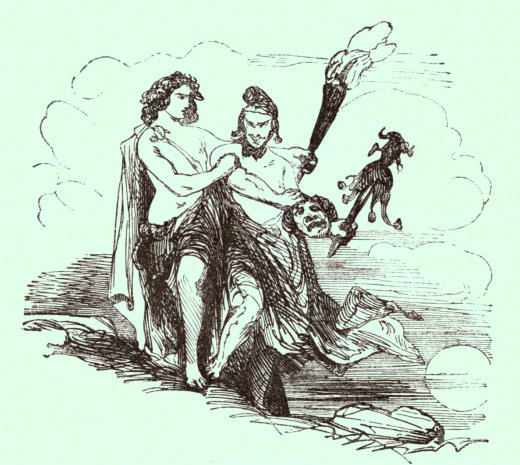
Art above by Edmund Dulac shows Comus in red wig and green frock leading his followers in a wild dance in his role as the god of festivity, revels and nocturnal dalliances.
He is a son and a cup-bearer of the god Bacchus. Comus represents anarchy and chaos. His mythology occurs in the later times of antiquity. During his festivals in Ancient Greece, men and women exchanged clothes.
He had a wreath of flowers on his head and carried a torch that was in the process of being dropped.
Comus was often depicted with Momus (illustration left), who was the deity of satire and mockery and who later became the familiar court jester.
Unlike the purely carnal Pan or purely intoxicated Bacchus, Comus was a god of excess.
He is the god of drunken revelry, merrymaking, the source of jokes and comedy, especially anything which provokes a huge belly laugh. He is the god who makes a party go with a swing.
His festival was a time of fun and frolics, with men dressed in drag and women sauntering about in male garb.
27 de maio é o festival grego de Comus ... o deus dos travestis! Comus é o filho de Dionísio. Durante seu festival, os adoradores de Comus vestir-se-iam nas roupas do sexo oposto e dariam o divertimento dançar toda a noite. Ele é o deus do travestismo, da festa, da comédia e dos comediantes. A arte por Edmund Dulac mostra Comus na peruca vermelha e no vestido verde que conduz seus seguidores em uma dança selvagem.
27 de mayo es el festival griego de Comus ... el dios de los travestis! Comus es el hijo de Dionisio. Durante su fiesta, los adoradores de Comus se vestirían con ropas del sexo opuesto y se divertirían bailando toda la noche. Él es el dios del travestismo, fiesta, comedia y comediantes. El arte de Edmund Dulac muestra a Comus en la peluca roja y el vestido verde que lleva a sus seguidores en una danza salvaje.
Monday, May 25, 2026
ANTINOUS WITH MITHRAS
Sunday, May 24, 2026
WORSHIPERS WORLDWIDE VIA ZOOM
CELEBRATE THE SACRED BULL HUNT
Another part, which is in the ancient record and therefore can be regarded as biographical, is that he was a hunter...on horseback...and perhaps on foot...able to chase down wild animals, and kill them with a spear.It is these wild forces that we must face, if we are ever to regard ourselves as Men.
Thursday, May 21, 2026
CASTOR AND POLLUX
TWIN GODS OF HOMOSEXUALITY
TODAY the Sun enters the Sign of Gemini — the sign of the Twins Castor and Pollux, Gods of Homosexuality. This is the zodiac sign which ushers in a special sacred time in the Religion of Antinous, for this is the time of year when the STAR OF ANTINOUS rises, after having been hidden below the horizon since the Death of Antinous at the end of October.
We honor the Dioscuri who were born as triplets with the beautiful Helen as their sister. The mother of the three was Leda who was seduced by Zeus who came to her in the form of a swan. Leda gave birth to an egg from which emerged Castor, Pollux and Helen.
The photo above shows the Prado's Ildefonso Group, twin statue of Castor and Pollux, with a marble head of Antinous "restored" to the left figure.
The identical brothers were inseparable, and had a deep affection for one another, for which reason they were often worshipped as gods of homosexuality. Helen was constantly being abducted and in need of rescue, which the brothers were usually successful in accomplishing, however, her beauty was eventually to lead to the Trojan War.
Castor was a skilled horseman, and Pollux was an unconquerable boxer. They took part in the voyage of the Argonauts, and with Orpheus they calmed a storm, for which reason they were worshipped as the protectors of sailors.
Later in the voyage, Castor was killed. Pollux was so overwhelmed that he begged Zeus to accept his life in exchange for his brother's.
Out of compassion, Zeus immortalized Castor and proclaimed that Pollux would spend half the year in the underworld and half the year in heaven with his brother.
Together they were placed in the sky as the sign of Gemini.
The Divine Twins miraculously appeared in Rome to announce the victory of the Republic over the allies of the last king by watering their horses in the Fountain of Juturna in the Forum.
Flamen Antonius has this further insight into Castor and Pollux:
"The sacredness of the Twin Gods, with their third twin sister Helen is found in Norse Mythology as the Alcis and as the twins Frey and Skirnir with their third twin sister Freya.
"The symbolism of brotherly love, and of sacrificing one's life for the immortality of a brother is at the heart of the Religion of Antinous, and is an example of the sacrifice that Antinous is said to have committed for the prolongation of the life of Hadrian. The Dioscuri are Antinous and his "rival" Aelius Caesar, and they are also seen in the two brothers of Hadrian's court, Macedo and Statianus Caesernius, who were servants, protectors, confidants, lovers, friends, witnesses and first priests of Antinous.
"The Sacred Star of Antinous rises during the sign of the brothers Castor and Pollux."
THE BIRTH OF PLATO
SAINT OF ANTINOUS
SAINT OF ANTINOUS
ON May 21st the Religion of Antinous honors Plato, Saint of Antinous, because May 21st is Plato's birthday, and no worshipper of Antinous could possibly forget HIS birthday.
The greatest of all western mystics and philosophers was born on this day in the year 427 BC. He was originally named Aristocles, but was called Plato by one of his teachers because of the breadth of his shoulders and of his speech, and we might also say because of the magnitude of his legacy of wisdom.
He was a follower of Socrates and the majority of his works are written as Dialogues of Socrates, wherein Plato elaborates his vision of the Universe, the inner workings of mankind, the complexities of human relationships, and the virtues of civilization.
All we know about Socrates is in reality only what Plato has told us of his teacher. Out of loyalty, Plato gave all personal credit to the wisdom of his divine teacher.
Plato founded the Academy in Athens that was dedicated to the love of wisdom and to the perfection of the minds and souls of young men. The image above is a mosaic from Pompeii showing Plato and his academy assembled under his famous olive tree.
Plato studied Pythagoreanism in Italy and made further speculation into the mathematical mysticism of the first philosopher thereby creating the model upon which western monotheism is based. The Platonic system was essentially a unification of the social inquiry of Socrates with the cosmic ramifications of the teachings of Pythagoras.
Here is how Flamen Antinoalis Antonius Subia explain's the significance of Saint Plato:
"In the vision of Love that Plato expounded, Venus Urania, Celestial Love, is glorified as highest form of human affection, above the earthly requirements of procreation. The love between two men, what is innocently called Platonic Love, was considered by Plato to be the most divine form of relationship.
"Hadrian, in all ways the most Platonic of all Emperors, the veritable manifestation of the Philosopher King as glorified by Plato in The Republic, was demonstrating the meaning of Venus Urania, for all the world to see, in his passion for Antinous.
"For the beautiful light in which Plato illuminated the inner nature of homosexual love, he is venerated as a divine Saint of the Religion of Antinous."
Wednesday, May 20, 2026
THE SACRED BULL HUNT 2026
By Flamen Antinoalis Antonius Subia
Another part, which is in the ancient record and therefore can be regarded as biographical, is that he was a hunter...on horseback...and perhaps on foot...able to chase down wild animals, and kill them with a spear.It is these wild forces that we must face, if we are ever to regard ourselves as Men.