Showing posts with label art. Show all posts

Sunday, October 4, 2026

ANTINOUS LOVED ANIMALS


OCTOBER 4th is World Animal Day #WorldAnimalDay.


Here, we see how Antinous harvests grapes as a dog looks up at him adoringly, and who can blame it? 


This is the Lanuvium bas-relief. Its inscription describes a group loosely translated as the Companions of Antinous.


The inscription says Antinous was born on November 27th. That is how we know his birthday. 


Join Antinous in loving all creatures!


O Dia Mundial dos Animais: Antinous e cão no basuário Lanuvium. Junte-se a Antinous em amar todas as criaturas! ... El Día del Animal o Día Mundial de los Animales: Antinous y perro en el basrelief de Lanuvium. ¡Únete a Antinoos para amar a todas las criaturas! #worldanimalday  🐶🦊🦁🐵🐔🐥🐼🐷🐨🐸🐝🐞🐍🐌🦋🐙🐠🐁🐢🐯🦇🐫🐳🌍❤️

Monday, September 28, 2026

THE FIRST MIRACLE OF ANTINOUS
INVOLVED AN EGYPTIAN INTERSEX DEITY


ON September 28th the Ancient Egyptians celebrated the Feast of the Creation of the Nile Inundation as represented by the intersex deity HAPI.

It was through HAPI that Antinous worked his first miracle ... bringing about a bountiful Nile inundation which ended a long famine ... only a few months after he died and was deified.


Hapi is special to us especially because Hapi is intersex. With many other such deities, the gender division is down the middle of the body (like some Hindu deities) or the top half is one gender and the bottom half is the other.

But Hapi is very complex and the genders are mixed throughout his/her body. Male deities invariably have reddish-orange skin in Egyptian Art and female deities have yellowish skin. 

However, Hapi has bluish-green skin. Hapi has long hair like a female deity but has a square jaw and a beard. Hapi has broad shoulders yet has pendulous breasts like a nursing mother. 

Hapi has narrow hips and masculine thighs, but has a pregnant belly. Nobody knows what sort of genitals Hapi has, since they are covered by a strange garment reminiscent of a sumo wrestler's belt.

Hapi is both father and mother to the Egyptians. Hapi provides them with everything necessary for life. As Herodotus wrote, "Egypt is the gift of the Nile". 

Hapi wears a fabulous headdress of towering water plants and she/he carries enormous offering trays laden with foodstuffs.

The Ancient Egyptians had no problem worshipping a mixed-gender deity. 

It is very important to draw the connection between Hapi and Antinous, especially since the First Miracle that Antinous performed as a god involved Hapi. The Egyptians accepted Antinous into their own belief system immediately and were among the most ardent followers of Antinous.

They had no problem worshipping a gay deity who had united himself with a transgender deity. 

It must have seemed very logical and credible to them.

It made sense to them and enriched their belief system, made it more personal since they could identify more easily with a handsome young man than with a hermaphrodite wearing a sumo belt (Hapi forgive me!).

Herodotus also said he once asked a very learned religious man in Egypt what the true source of the Nile was.

The learned man (speaking through an interpreter, since most Greeks never bothered to learn Egyptian) paused and finally told him the true source of the Nile is the thigh of Osiris.

We think of it as a strange answer. We think of the Nile as an "it" and the source as a "geographical location". 


But the Egyptians thought of the Nile as "us" and its true source as "heka" — the magical semen of the creator.

So, a learned Egyptian would have assumed that a learned Greek would understand what was meant: That Hapi is the equivalent of Dionysus, who was "incubated" in the inner thigh of Zeus after his pregnant mortal mother Semele perished when she could not bear the searing sight of her lover Zeus in all his divine panoply.

It's a very poetic way (a very Egyptian way) of saying that the "true  source" of the Nile, which is to say Egypt itself, is the magical heka/semen from the loins of the original creator.

The grandest depiction of HAPI is a colossal statue found in the submerged ruins of HERACLEION at the mouth of the Nile ... this statue once flanked the portals of the Great Temple in that city before earthquakes and tsunamis sent it to the bottom of the sea. 


It was rediscovered by marine archaeologist Marck Goddio and is the highlight of a British Museum EXHIBITION ... as seen in the photo at left.

We will never know what happened during that journey up the Nile along the drought-parched fields with anxious Egyptian farmers looking to Hadrian for a miracle ... in September and October of the year 130 AD. 

All we know is that Antinous "plunged into the Nile" and into the arms of Hapi in late October of the year 130.

And then the following summer, Hapi the Inundation Deity provided a bountiful Nile flood which replenished the food stocks of Egypt — and the Roman Empire.

The First Miracle of Antinous the Gay God is enshrined in the hieroglyphic inscription on the OBELISK OF ANTINOUS which stands in Rome.

The East Face of the Obelisk, which is aligned to the rising sun Ra-Herakhte, speaks of the joy that fills the heart of Antinous since having been summoned to meet his heavenly father Ra-Herakhte and to become a god himself.

Then the inscription tells how Antinous intercedes with Ra-Herakhte to shower blessings upon Hadrian and the Empress Sabina Augusta.

And Antinous immediately calls upon Hapi ...

Hapi, progenitor of the gods,
On behalf of Hadrian and Sabina,
Arrange the inundation in fortuitous time
To make fertile and bountiful, the fields
Of Both Upper and Lower Egypt!

We joyfully celebrate this, the First Miracle of Antinous!

Friday, September 25, 2026

ON NATIONAL COMIC BOOK DAY
WE REMEMBER JACQUES MARTIN


SEPTEMBER 25th is National Comic Book Day ... and we say Happy birthday to Jacques Martin, creator of Alix the blond Gallic-Roman boy who fights evildoers in ancient Rome. Jacques Martin was born 25 September 1921. Alix and his Egyptian orphan teen friend Enak have delighted comic book readers for more than 75 years ... In the image above, notice the Antinous Farnese statue on the balustrade as Alix and Enak frolic in the Edessa Falls in Greece.


Thursday, September 24, 2026

FEATURED ANTINOUS STATUE OF THE DAY
THE ANTINOUS OF ELEUSIS


THIS statue of Antinous from Eleusis - Ἐλευσίς - is the only one that seems to refer back to an incident in his life, his initiation into the Eleusinian Mysteries of death and resurrection in September 128 AD.

The sculpture was erected after his death in the outer courtyard of Eleusis and captures this instant of his life, though officially it depicts him as the god Dionysos Zagreus, a divinity of suffering abd resurrection associated with the Eleusinian Mysteries.

Technically it is not one of the best of the depictions of Antinous, but it evokes a mood and a moment.


The sulptor clearly envisaged the young lad draped in his himation, standing in the darkened Telesterion (the initiation hall) and confronted with the Eleusinian Mysteries of death and resurrection.

He clutches at the folds of his himation anxiously, insecure, staring wide-eyed, his mouth pursed in awe, with an expression of apprehension, intent rapture and awareness of the tremendous significance of what was being revealed to him.


Even though it is a mediocre statue in workmanship and details it is redeemed by its expressiveness and pathos.

This statue is now housed in the Archaeological Museum of Eleusis: Antinous as Dionysus Zagreus, Inv. 5092, 1.83 m, in marble of Thasos.

Friday, September 18, 2026

PAMELA COLMAN SMITH
SAINT OF ANTINOUS


MAGINATION is the key word. Just imagine the cramped artist's studio in London's Chelsea district and, with the help of the artist's images, you are there. It is December 1909. The solid-black walls of the apartment contrast starkly with the red-orange drapes. 

Jamaican folk artefacts share space on a Victorian curio shelf with photographs of friends and relatives — a mother in Jamaica, a father in Brooklyn Heights, a famous actress in a West End production, Bram Stoker, W.B. Yeats. The jet-black walls form a void-like exhibition space which highlights the dazzling Caribbean art as well as the dozens of paintings and sketches which line the walls. Suffragette posters. Oil landscapes. But particularly watercolor illustrations of dreamscapes and fairy tales.

A brightly painted miniature theatre with ornate proscenium and cloth curtain stands proudly in one corner, with its cast of tiny cardboard cut-out "actors" waiting patiently for their entrances.

An enormous gramophone stands in the opposite corner, and Debussy's La Mer is playing at full volume, as it has been all morning. The neighbours have long since stopped complaining about the music.


The artist, Pamela Colman Smith, is a petite woman in her early 30s who sits in the middle of the studio with paint brush in hand, mixing watercolors, her eyes trance-like as the music envelops her. She is wearing a vividly hued kimono with broad sleeves made even more colorful by splotches of paint.

One of the two Japanese combs pinning back her long dark hair has loosened, causing her tresses to sag to one side, but she is oblivious.  The paint is dripping from her brush, but she pays no mind, keeping her eyes firmly shut as Debussy transports her to a place she calls "the unknown country" of her artistic inner heart.

On the easel in front of her is a small canvas showing an androgynous person wearing a short kimono-like tunic with sleeves and an abstract floral design uncannily like the kimono she is wearing. The figure is striding to a precipice as a small white animal dances at his heels.

The painting is almost finished. The outline was done in pen. Only a  few more brush strokes are needed for the hand-coloring. Debussy will provide the musical sunrise which will be the cue that the illustration is finished.

And then the small illustration will join all the others (about 80 in all, give or take one or two) which are carefully arranged on drying shelves around the studio. The printer is waiting. The cards must be delivered by the end of December.


She has been working on the Tarot card project for about a year, since Arthur E.A. Waite asked her to illustrate "his" new pack of Tarot cards in his long-running one-upsmanship feud with other occultists in London. 

He had very strong ideas about the design of the 22 Greater Trumps but was unconcerned with the 56 Lesser Trumps. Only one other artist had ever illustrated all 78 cards, an unknown 15th Century artist whose dazzling cards were jealously guarded by the Sola Busca family of Italy. 

The Sola Buscas had grudgingly permitted photographic copies of the cards to be put on view at the British Museum in 1908.

And so it was, that a petite 30-something sufragette took a tweedy advertising executive for the Horlick's bedtime powdered milk drink  (Waite's "day job" when he wasn't doing occult spellwork) and dragged him to the British Museum and said she would do the job but only on condition that she illustrate all 78 cards with artistic license for design and color.

It had taken months of pain-staking work. "A big job for very little cash!" she would write to her friend and benefactor Alfred Stieglitz,  who had made room in his famed New York photography gallery for exhibitions of some of her "Pictures in Music", watercolors she painted in a trance-like state while listening to her favorite composers, such as Mozart, Tchaikovsky and Debussy. On a visit to Paris, she had even been bold enough to introduce herself to Debussy and show him paintings she had done to his music. She was greatly flattered when he said she had captured the very essence of his music.


"You ask me how these pictures are evolved," she said. "They are not the music theme — pictures of the flying notes — not conscious illustrations of the name given to a piece of music, but just what I see when I hear music-thoughts loosened and set free by the spell of the sound."

She explained that, for example, "Often when I hear Bach I hear bells ringing in the sky, rung by whirling cords held in the hands of maidens dressed in brown."

Stieglitz had shown her music paintings to rave reviews in New York in 1907. The New York Sun critic wrote: "Pamela Colman Smith is a young woman with the quality rare in either sex — imagination."

Pamela — "Pixie" to her few close friends (mostly women) — had grown up in London and New York City, as well as in Jamaica. Her father was a globe-trotting businessman who spent little time at home. Her mother came from a long line of women poets and children's story-book writers. The details of her childhood are fuzzy. She had a dark complexion and facial features which prompted speculation that she had been adopted during her father's many trips to Jamaica. At any rate, she spent her formative years in Jamaica, where she learned the patois dialect perfectly and became a master story-teller of Jamaican tales of magic and wonder.


But when her mother died at an early age, little Pixie moved to Brooklyn Heights where she lived with her father and pursued art classes at the renowned Pratt Institute, a progressive school which encouraged students to explore new avenues of expression.

And when her father also died suddenly, she was shipped back to England to live with a troupe of actors who were friends of her eccentric father. She was relieved to be back in England, since her skin color had exposed her to racist discrimination in the States.

The rarified atmosphere of London's Leicester Square theatre district was an invigorating change. In New York she had been "a mulatto". 

In London's West End she was simply exotic. She lived with the high-profile actress Ellen Terry, who became her mother, mentor and best friend. Sir Henry Irving, a leading thespian and empresario, became her ersatz father. The three of them toured Britain in productions when they weren't staging their own plays in the West End. Pixie lived in Irving's theatre. She learned set design, costume design (and how to mend costumes between acts) and she learned how the stage is the world-in-small.

A century on, it is hard for us to appreciate how mind-opening the theatre was. There was no radio, no television. Even the cinema was in its infancy. To see the world, you went to the theatre. Pamela didn't just go to the theatre. Surrounded by actors and directors 24 hours a day, she truly LIVED the theatre. She said it was the perfect place for a budding artist.


"Go and see all the plays you can," she advised young artists. "For the stage is a great school — or should be — to the illustrator — as well as to others."

She openly admitted she had learned more in the theatre than at her famous New York art institute.

"The stage has taught me almost all I know of clothes, of action and  of pictorial gestures," she said, and her advice to other artists was to  throw away the textbook and just open their eyes and ears. An artist should always have a sketch pad at hand. She even took her sketch pad to the ballet to see Nijinsky dance.


"Learn from everything, see everything, and above all feel everything! And make other people when they look at your drawing feel it too!"

She was dismissive of painters who are interested only in their medium and who shun other liberal arts.

"Keep an open mind to all things," she said. Even though you are a painter, listen to music, go to the ballet.


"Hear all the music you can, for sound and form are more closely related than we know."

And she dismissed turn-of-the-century painters who strove only for beauty, ignoring ugliness.

"For through ugliness is beauty sometimes found," she observed. She recalled having seen a very dark and brutal stage production which in a way reminded her of the gritty beauty of poverty-stricken Jamaica.

"All through that play I thought that ugly things may be true to nature, but surely it is through evil, that we realize good. The far-off  scent of morning air, the blue mountains, the sunshine, the flowers, of a country I once lived in, seemed to rise before me — and there on the stage was a woman sitting on a chair, her body stiff, her eyes rolling, a wonderfully realistic picture of a fit."

Through Ellen Terry and Henry Irving, Pamela made friends with literary luminaries such as "Dracula" author Bram Stoker, "Peter Pan" playwright J.M. Barrie and and poet/playwright W.B. Yeats.

In fact, "Sherlock Holmes" was her uncle — because her real-life great uncle was the actor William Gillette, who brought Holmes to the stage in London and on Broadway. It was Gillette who introduced many of the mannerisms and props (the deerstalker cap, the meerschaum pipe) which have been intrinsically associated with Sherlock Holmes by succeeding generations. Her Uncle Bill even saw to it that Pamela illustrated the programs for his Holmes productions.


Pamela became well-known for her afternoon literary teas, at which Yeats, Stoker and other luminaries would gather in her studio while she put on the costume of a Jamaican wise woman and sat cross-legged on the floor, relating Jamaican folk tales in dialect.

She used a miniature theatre and tiny cardboard characters to illustrate her hugely delightful tales.

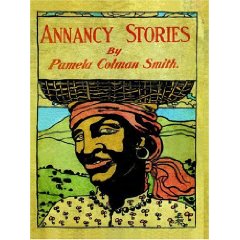
Her literary friends encouraged her to publish and illustrate the stories under her own name, which she did. The book is still in print.

One frequent male visitor described one such literary evening, saying, "The door was flung open, and we saw a little round woman, scarcely more than a girl, standing in the threshold. She looked as if she had been the same age all her life, and would be so to the end. She was dressed in an orange-colored coat that hung loose over a green skirt, with black  tassles sewn all around over the orange silk, like the frills on a Red Indian's trousers. She welcomed us with a little shriek. She was very dark, and not thin, and when she smiled, with a smile that was peculiarly infectious, her twinkling gypsy eyes seemed to vanish altoghether. Just now, at the door they were the eyes of a joyous, excited child."

This was shortly after the turn of the 20th Century, and she had perfected her artistic style and was busy as a book and magazine illustrator. While publishers mandated style to some extent, Pamela Colman Smith advocated the Arts and Crafts style, also known as the Secession style or, in the US, as the Craftsman or, especially in California, called the Mission style.

The Arts and Crafts Movement was a style which dominated in the years before World War I, and which was between the Art Nouveau style of the 1890s and the Expressionist style which would revolutionize art after the Great War. The Arts and Crafts Movement was an attempt to reject superfluous Victorian "wedding cake" adornment and to simplify things to the basics of simple lines and solid colors, in defiance of bourgeouis homeowners who wanted clutter.

For one brief moment, in the cosy years before the war, idealistic artists such as Pamela depicted a magical world in which machines did not dominate humankind. They were artists who sought to recreate pre-industrial, even primitive styles in art, architecture and decoration. Lines were simple. Colors were bold and earthy.


Pamela's generation of artists saw that a world driven by steam pistons was heading blindly, full-steam ahead for collision with the cold and immutable forces of nature. The Titanic disaster in 1912 was only a symbolic inevitable disaster waiting to happen, as far as these artists were concerned.

The Arts and Crafts Movement flourished in the first decade of the 20th Century, and Pamela managed to get by financially with her illustrations in that style. She also provided illustrations and even wrote articles for Gustav Stickley's "The Craftsman" magazine which was a leading purveyor of the style.

Not surprisingly, her Tarot cards are an enduring monument to the Arts and Crafts Movement and its philosophy which holds that a return to timeless styles in the Arts can help the human race return to timeless virtues and ageless wisdom. She was seeking to create a world in which racist thought and moral hypocrisy would vanish along with high-button shoes and celluloid shirt collars. She wanted everyone to sit on the floor, cross-legged, and discover the childlike magic of just being alive.

The cards were published with very little fanfare in December 1909. Only a few occultists took notice, and most of them were engaged in feuds with each other. The general public did not notice. Tarot cards were considered to be "French". The only Tarot cards hitherto available were from France, and they were considered only slightly less objectionable than saucy French porn postcards. Pamela was keenly aware that her cards were not going to make inroads into popular culture.


"Oh, the prudishness and pompous falseness of a great mass of intelligent people!" she wrote in an article for Stickley's "The Craftsman". It was an article aimed at inspiring young artists. "Lift up your ideals, you weaklings, and force a way out of that thunderous clamor of the steam piston, the hurrying herd of blind humanity, noise, dust, strife, seething toil!"


Those 78 cards are a veritable map of the place which she called "the unknown country" within an artist's heart. Many of her book illustrations are variations on that theme, such as "The Hill of Heart's Desire" at left.

To look at each card in succession is to take a trip through a magical land where cosmic wisdom and virtue prevail. You can spot  recurring landmarks, such as castles, bridges and towers, which recur from different vantage points throughout the "journey". This magical land is peopled by beings who at times wear Renaissance clothing and at other times wear chitons and togas. The whole magical world is a place beyond linear time and space.


Waite never adequately acknowledged her work. In the book accompanying the cards he failed to mention her by name, saying only that a "young woman artist" had illustrated them on his instructions. 
But in fact, Pamela had been a member of the Order of the Golden Dawn along with Stoker and Waite. In a way it was only natural since the English-speaking world's first esoteric book store, Watkins, had just opened its doors a few steps away from the Leicester Square theatre district.

Pamela never wrote about her initiation into occult mysteries. But the very first card in the deck, The Magician, is graphic proof that she was privy to occult knowledge of the most secret sort. In 1909 only a handful of people had read a badly translated copy of Das Buch Abramelin, a 15th Century German-language grimoire written by a German-Jewish sorcerer who claimed to have been initiated into ancient mysteries by a master living in a desert cave on the banks of the Nile.

Even now, a century after Pamela painted that card, very few people have read the Book of Abramelin, certainly not in the original German. To this day there is no full English translation. Those few who have read it immediately realize that The Magician card is a very precise portrait taken straight from the ancient book.

In it, the novice magician is instructed to wear a clean white tunic bound at the waist by a symbolic ouroboros serpent. He is to wear a  crimson mantle over the tunic while standing before a simple wooden table upon which are his magical tools. The book then says that, for best results, the magician's magical work space should look out over a witch's garden of flowers and magical herbs.

Whatever Waite thought of "his" cards — and he was very vague in  saying what their purpose should be other than clearly to aggrandize  himself — Pamela knew they were tools not for TELLING the future, but for SHAPING the future through ancient Abramelin magical spells. That occult secret, sealed in the colorful symbolism of her cards, was destined to die with her — to be rediscovered a century after she created the cards by priests of ANTINOUS THE GAY GOD.


With that first card, The Magician, and with Renaissance alchemical symbolism throughout the deck, Pamela shows she was highly knowledgeable in the occult arts.

The rest of her story is quickly told. The Titanic sank but the age of the steam pistons did not go down with it. Instead, the First World War swept aside the lofty dreams of Pamela's generation of artists. The Arts and Crafts Movement was the first casualty. By 1915 Gustav Stickley's "The Craftsman" magazine ceased publication and his design company went bankrupt.

Pamela's illustration assignments dried up. By the mid-1920s she was unable to get even one job a year. When a distant uncle died and left her a modest nest egg, she took the money and left London, buying a village cottage at the far western tip of England — not far, in fact, from the fictional location of Baskerville Hall, which had figured so prominently in Uncle Bill's Broadway-hit Sherlock Holmes plays.


She lived in isolation with a woman companion. She died penniless at age 72 on September 18, 1951. The cottage and all her possessions were auctioned to pay back taxes, leaving her companion with nothing.

In December 1909 she had told her New York gallerista friend Alfred Stieglitz that she would send him a pack of the Tarot cards which she said were being "printed in color lithography (probably very badly) as soon as they are ready" and that she would also "send over some of the original drawings as some people MAY like them." By "some people", she meant "buyers". But the original art work has never surfaced. Not one of the 78 originals is known to exist.

The printed card decks vanished into obscurity for decades until the  American playing card connoisseur Stuart R. Kaplan resurrected them in about 1970. It is largely thanks to him that anyone knows anything about this extraordinary artist, who created a single work which is ageless and timeless and which continues to appeal to new generations.

The final word belongs to Pamela Colman Smith, and it is a statement of inner strength which could just as easily be the catch-phrase of The Fool card in her Tarot:


"Banish fear, brace your courage, place your ideals high up with the  sun, away from the dirt and squalor and ugliness around you and let that power that makes the 'roar of the high-power pistons' enter into your work — energy — courage — life — love. Use your wits. Use your eyes. Perhaps you use your physical eyes too much and only see the mask. Find eyes within, look for the door into the unknown country."

Thursday, September 17, 2026

FRENCH EGYPTOLOGIST ALBERT GAYET
IS A SAINT OF ANTINOUS


WE are proud to consecrate French archaeologist Albert Gayet as a Messenger Saint of Antinous for his pioneering efforts to reclaim the city of Antinoopolis from the sands of oblivion.

The city that Hadrian built and dedicated to his lover Antinous flourished for hundreds of years before being looted and plundered and lost to the desert sands of Egypt.

Napoleon's French team of proto-archaeologists mapped and catalogued the remains at the turn of the 19th Century. 


But it was this rather curious and eccentric French bachelor who would make the lost city ... Antinoopolis ... famous again.

Antinoopolis became renowned around the world in 1895 when Gayet began exploring the vast necropolis burial grounds south of Antinoopolis. 


An estimated 40,000 mummies were buried in the Antinoé necropolis.

Between 1895 and 1911, Gayet worked tirelessly at Antinoé, the French name for the city which became synonymous with his own name. 


He stood out against the squalor of the wretched modern village and the moonscape of ancient ruins ... dressed impeccably in a three-piece black linen suit and tie, with a boater hat, a cane and white gloves ... more befitting a stroll on the Champs Élysée in Paris than overseeing Egyptian workers toiling in the blistering Egyptian sun as they unearthed mummies from the sands.

Gayet's crews worked day and night unearthing hundreds of mummies representing all social classes and historical epochs.

To his utter astonishment, many of the mummies were gilded, many were swathed in priceless woolen wraps and others wore Byzantine jewellery and headdresses.

He returned to Paris, where the most exquisite mummies were put on display at the Louvre, attracting throngs of visitors and spawning a "Coptic Craze" throughout Europe and America.

Antinoopolis embroidery and linens inspired Matisse, Renoir and the leading Paris fashion designers, who incorporated the rich colors and designs into their work.

But the craze soon waned. The mummies were packed away in storage, most of them to disintegrate or become lost. 


Gayet died in Paris at age 60, impoverished and embittered after having spent 20 years of his life trying to raise funds for further exploration of Antinoopolis. 

Unmarried, he bequeathed a number of Antinoopolis artefacts which he had kept for himself to his sister in Dijon, where the artefacts are in the local museum and a street is named after him.

Gayet's dream of a "Musee d'Antinoé" in Paris died with him.

Wednesday, September 16, 2026

ACACIA TREE


BY STEPHANOS KILGORE 

SACRED KNIGHT OF ANTINOUS


Silent I have been
Silent I will be
Sitting under an acacia tree
Pondering the turning
Wheel of all
Gods returning
Vibrations strong
Past lives converging
Great Sphinx
Waiting
Knowing all
Saying nothing
Antinoo
Standing tall
Obelisk
Reminder to all

Bambikilgore
Sept 16 2012

Tuesday, September 15, 2026

HADRIAN's VILLA COMES TO LIFE
FOR ANTONIUS SUBIA


HADRIAN must have delighted in forcing Patrician Romans to make the 20-mile (30 km) trek to his Tibur Villa in the rugged hill country east of Rome.

Perhaps the surroundings reminded him of his native Hispania. Perhaps he just despised Rome and its snooty residents because he had been taunted as a youth for his "Hispanic" accent and provincial manners. 

Whatever the reason, he spent most of his reign as emperor far away from Rome, traveling to the far-flung corners of his realm.

And when he wasn't traveling, he resided at his Villa, far removed from the city he abhorred. Anyone who wanted to see him was forced to make the journey over hill and dale out to Tibur. In the days of the "letica" or litter chair, it was an uncomfortable and wearying ordeal.

And it still is, even in these days of rapid transit and buses.

"He must have enjoyed making them come all the way out here," Flamen ANTONIUS SUBIA told Priest Hernestus as they waited for one of the notorious overcrowded and unairconditioned "Blue Buses" that ferry passengers from a suburban commuter rail station out to Tivoli ... and then walking a couple of miles along dusty roads to the imperial compound.

Arriving hot and weary, you then ascend a steepish incline to the walls of the Villa itself before finally arriving, out of breath, at the top of a small hill surrounded by magnificent pines, cypress and olive trees.

It is then that you realize what Hadrian loved about this place. A cool breeze wafts across the hilltop, carrying with it the scent of pine, cedar and wild roses and other flowering plants.

Antonius had never been to Hadrian's Villa until his Sacred Pilgrimage, but he knows the layout of the compound by heart, having studied its floor plans and schematic drawings for years.

"So people would arrive here," Antonius said, pointing to the entry portals only a few meters from the enormous bath complex. 

"And they would immediately be invited into the baths to freshen up before being admitted into the presence of the Emperor."

Even in a ruinous state, the baths are breathtakingly enormous, towering the equivalent of six stories overhead.

The private quarters are less easily discerned today, though Antonyus marched through them as if he had always been at home there.

"Just imagine, this is where Hadrian slept," he said in awe.

"And where do you suppose Antinous had his quarters? He must have had separate quarters of his own," Hernestus wondered.

"Somewhere with a nice view, no doubt," Antonius speculated.

The Canopus area of the compound is still stunning even today. At the end of a long pool flanked by Greco-Egyptian style statuary is a seashell motif alcove.

"This is where they dined," Antonius said with a sweep of his hand around the curved base of the alcove, "on dining couches all along here."

Very few tourists were there the day Antonius visited the Villa, just one group from a charter bus and a few hardy souls who had made the rather harrowing trip on a careening and over-crowded public bus and the trek on foot from the bus stop.

No one was paying any attention to what appeared to be a barren field between the baths and the Canopus. There was no sign indicating that this was the very heart of Hadrian's Villa, the most sacred part of the complex.

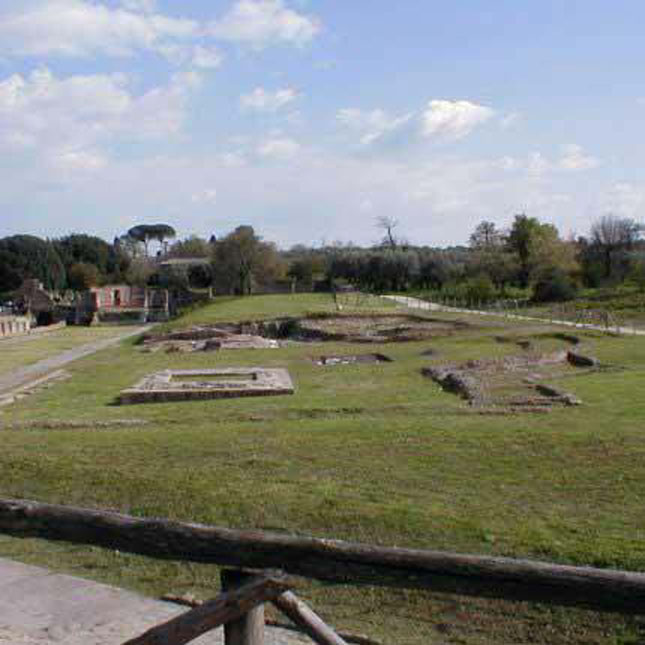
The ANTINOEION — the Temple of Antinous.

This was where the OBELISK OF ANTINOUS originally stood. This is possibly where the Lost Tomb of Antinous is located.

The Antinoeion is adjacent to the curving entry pathway. It is the spiritual cornerstone of Hadrian's Villa.

"It was the first thing that anyone saw as they approached," Antonius said with a smile reflecting the satisfaction that Hadrian must have felt. "He made them acknowledge Antinous as a God."

Despite repeated promises by curators of the Villa to erect a sign, there is nothing to mark the sprawling temple complex which may yet conceal the Lost Tomb of Antinous.

Antonyus stood for a long time at the low fence which cordons off the area. To the other tourists, it was just a barren field with a few remnants of marble marking foundations of a few buildings and a plinth where an obelisk may have stood.

But for Antonius, this was Sacred Ground. This was where the Ancient Priests of Antinous had laid down the precepts of a beautiful new religion based on tolerance, love and beauty. This was where Hadrian himself came to commune with his Beloved.

A cool breeze wafted across the field, bringing with it the scent of late summer roses, pine and cedar and the sound of cicadas in the olive trees beyond the field, only a portion of which has been excavated in very recent years.

The rest of the weed-overgrown field is a ripple of mounds of earth. Or are these mounds actually the remains of still more structures, possible the Lost Tomb itself?

"There has to be much more buried under there," Antonius said. "There just has to be."

Click here to join Antonius on his tour of Hadrian's Villa:


Monday, September 14, 2026

ROMAN SKELETONS BURIED HOLDING HANDS
NOW HAVE BEEN IDENTIFIED AS TWO MALES


TWO ancient Roman skeletons, who mysteriously were buried holding hands, now have been identified as two males, researchers have revealed.

In 2009, archaeologists discovered the remains in the Italian city of Modena. The pair were dubbed the "Lovers of Modena" by the media, the assumption being that they were a heterosexual couple.

The researchers at that time could not determine the gender of the skeletons when they were found in Italy in 2009 because they were badly preserved.

But a new technique, using the protein on tooth enamel, revealed their sex.

The actual relationship between the skeletons from the 4-6th Century AD remains a mystery.

The researchers say the two adult males were intentionally buried hand-in-hand.

Some of the suggestions for the link between the two skeletons are that they are siblings, cousins or soldiers who died together in battle, study author Federico Lugli told Italy's Rai news site (in Italian).

Researchers suggest that their burial site could have been a war cemetery.
The researchers from Italy's University of Bologna said in Scientific Reports that the findings had profound implications for understanding funeral practices at that time in Italy.

Saturday, September 12, 2026

RUN LIKE PHEIDIPPIDES
JUST DON'T DIE LIKE PHEIDIPPIDES


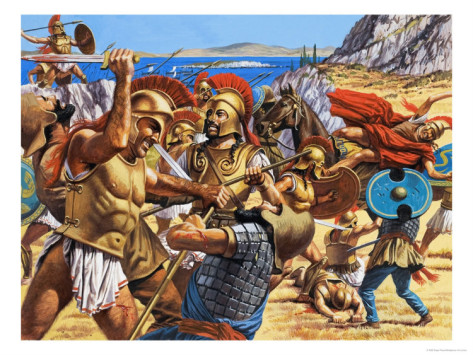
ON September 12, 490 BC, 10,000 Greeks use superior tactics to push 100,000 Persians back into the sea at the Battle of Marathon Bay ... forever changing the course of Western Civilization.

Though outnumbered 10 to 1, the Greeks won thanks to their new tactics.

Instead of individual soldiers fighting one-to-one duels, the Greeks rolled out their "phalanx" battle line of Hoplite soldiers who fought as one impenetrable unit.

The Battle of Marathon was a watershed in the Greco-Persian wars, showing the Greeks that the Persians could be beaten; the eventual Greek triumph in these wars can be seen to begin at Marathon. 

The battle also showed the Greeks that they were able to win battles without the Spartans, as they had heavily relied on Sparta previously. 

This win was largely due to the Athenians, and Marathon raised Greek esteem of them. Since the following two hundred years saw the rise of the Classical Greek civilization, which has been enduringly influential in western society, the Battle of Marathon is a pivotal moment in history.

The battle is perhaps now more famous as the inspiration for the marathon race. 

Although thought to be historically inaccurate, the legend of the Greek messenger Pheidippides running to Athens with news of the victory became the inspiration for this athletic event, introduced at the 1896 Athens Olympics, and originally run between Marathon and Athens.

Pheidippides was a professional "hemerodrome" (foot courier) who was sent to Sparta to request help when the Persians landed at Marathon, Greece. 

He ran 240 km (150 mi) in two days. Thanks to him, the Persians were defeated. 

He then ran the 40 km (26 mi) from the battlefield near Marathon to Athens to announce the Greek victory over Persia in the Battle of Marathon (490 BC) with the words "Chairete, nikomen!" ("Rejoice, we are victorious!") ... before collapsing and dying ... uttering "Cairete" (Rejoice) with his final rasping gasp of breath.

Image at top of entry: "Man Runs First Marathon To Bring News of Greek Victory Over Persia" painting by Tom Lovell (1909–97)

Wednesday, September 9, 2026

'QUINTILIE VARE, LEGIONES REDDE!'
COINS CONFIRM SITE OF TEUTOBURG BATTLE


WHERE was the Battle of Teutoburg Forest fought in the year 9 AD? That is a trick question which school teachers have loved to spring on their pupils for generations.

The answer, of course, is that the Battle of Teutoburg Forest was fought at Teutoburg Forest, changing the course of Western Civilization. But where is that?

Now, for the first time, archaeologists say they have found eight gold coins which confirm the location was at a place called Kalkriese Hill … which is a short distance from the modern-day Teutoburg Forest.

Such a find is extremely rare, the researchers say, and this recent discovery at Kalkriese Hill expands the number of gold coins collected at the site by more than double the previous amount.

The coins featured images of the Emperor Augustus, with the imperial princes Gaius and Lucius Caesar on the back, and all date back to a period before the ancient battle. Thus they were carried by the legions into the battle.

The defeat of the crack troops, who were led to their deaths by ex-Consul Publius Quinctilius Varus, effectively changed the course of Western Civilization.

Prior to 9 AD, Emperor Augustus Caesar pursued a course of military expansion across the Rhine and into central and northern Europe. After 9 AD, the Rhine became the frontier between the "civilized" Roman world and the "barbaric" lands to the east and north.


Prior to becoming emperor, Hadrian himself had served a stint of duty along the Rhine. As emperor, he consolidated the borders of the empire and his forces never ventured across the Rhine into across-the-Rhine Germania.

Historians have always referred to the Battle of Teutoburg Forest as a defining moment which affected the course of history. 


It has even been cited as a factor in both world wars, especially by the French and British, who considered themselves to have a Roman heritage, as opposed to the Germans, whom war propagandists condemned as the descendants of barbarians.

As a result, Germany was never incorporated into the Roman Empire, leaving that region a breeding ground for barbarian incursions which eventually would bring down the empire and eventually (according to Allied war-time propaganda) result in two world wars.

Arminius, known as Herrmann to the Germans, has indeed come down through German history as a heroic symbol of liberty and German national strength. Herrmann turned back the Roman occupation forces forever, according to the popular interpretation by German nationalists. 


In the late 19th and early 20th Century, unscrupulous German leaders used Hermann as a rallying figure in wars of aggression.

A monument near the site of the Teutoburg Forest battlefield celebrates Herrmann as a national hero. Thousands of German tourists visit the site annually. And the regional soccer team (in Bielefeld) is called Bielefeld Arminia. "Armin" is a popular name for German boys to this day.

Archaeologists in recent years have determined the exact location of the battle near the modern village of Engter north of the city of Osnabrueck. Bones, weapons and armour from the fleeing soldiers of the XVII, XVIII and XIX Legions are strewn along a narrow 17-km-long stretch of marshy woodlands bounded by confining hills to the north and south.


Now the coins definitely confirm that location.

Arminius had been educated in Rome and had become a trusted friend of Varus. The idea was that raising future chieftains in Rome would bond them to Rome when they returned to their families on the frontier.


Arminius was an example of how that policy could backfire and result in knowledge of Roman ways being used against the Romans. Arminius ingratiated himself with Varus, who was one of the most influential men in Rome, a friend of Augustus Caesar himself. 

It was that trust in Arminius which resulted in Varus leading a punitive expedition into an indefensible, boggy forest without sentries or reinforcements ... on advice of his trusted friend Arminius.

In the resulting massacre, Roman soldiers fled for their lives. Most were cut down in the mud. Blue markings in the graphic show where Roman bodies and armament have been found. 


Those who survived were sold into slavery or else were placed in wicker cages and burned alive as sacrifices to the Germanic deities. 

Reports of the battle are sketchy for the simple reason that almost no one survived to report what had happened.

Never before had three entire legions been wiped out in a single battle. The defeat was so devastating that the numbers of the Legions XVII, XVIII and XIX were retired forever, never again to appear in the Roman Army's order of battle. 


Augustus was so traumatized by the loss of three elite legions that he went into a prolonged state of mourning as though for a beloved son ... he tore his clothes, refused to cut his hair for months and, for years afterwards, was heard to moan from time to time, "Quintilie Vare, legiones redde!" ("Quinctilius Varus, give me back my Legions!").

This scene from the epic BBC/PBS mini-series I, Claudius dramatically recreates how Augustus received the news:


Sunday, September 6, 2026

PORTAL TO ANOTHER DIMENSION
IN THE MIDDLE OF MODERN-DAY ROME


IN a quiet corner of a shady plaza in the middle of Rome stands an ages old portal to another dimension.

The "Magical Doorway" (Porta Alchemica) is all that remains of a 17th Century alchemical laboratory which drew scientists from across Europe ... and which drew the wrath of the Inquisition.

The Alchemy Gate or Magic Portal is a landmark from the Villa Palombara built in 1680 by Massimiliano Palombara marquis of Pietraforte on the Esquiline Hill.

The Porta Alchemica is the only survivor of the five gates of the villa Palombara. 

There was a lost door on the opposite side dating from 1680 and four other lost inscriptions on the walls of the mansion inside the villa. 

The marquis was fascinated by occult and esoteric sciences. His wealth and social position enabled him to act as a patron to a number of  alchemists. 

In his villa he also held meetings, attended by other important personages who shared his interests, such as the Swedish Queen Christina, who lived in Rome after having abdicated, the distinguished astronomer Domenico Cassini, the renowned scholar Father Athanasius Kircher, and others.

Villa Palombara had a small detached outbuilding, probably a laboratory, where the occult meetings and the alchemic experiments were secretly held, and occult rituals were performed.

A young doctor and alchemist from Milan named Giuseppe Borri, who had been expelled from the Jesuit college for delving into the occult, came to Rome and joined the circle of Villa Palombara.

A legend says that Borri, sponsored by the marquis, was successful in transforming lead into gold ... creating the Philosopher's Stone of transformational magic. 

But one night he suddenly fled - this really happened, after being stalked by the pope's Inquisition - and left behind a number of papers inscribed with complicated formulae which nobody was able to decipher. 

So Massimiliano Palombara had them inscribed on the doorways of his laboratory.

Another version of the legend says that an occultist calling himself Antimony (an alchemical element whose symbol adorns the portal lentil) conducted experiments at the villa ... and vanished through the doorway one night ... disappearing into a magical dimension ... leaving behind only a solid-gold apple as proof that he could transform matter into gold.


Unfortunately Villa Palombara was completely demolished in the second half of the 1800s, when the new district was built. 

The other doorways were lost ... along with their alchemical formulae.

On both sides of the surviving portal stand two bearded and bandied-legged  statues ... they are statues of the Egyptian deity BES which once stood at a Temple of Isis and Serapis in Ancient Rome.

Knowledge of the Egyptian hieroglyphs had long since been lost when the portal was built. 

The marquis could not have known that BES was a worshiped by the Egyptians not only as a protective deity ... but also as a protector of Egyptian SEM magician-priests.

Or perhaps the marquis was very well aware of this ....

Saturday, September 5, 2026

ROMULUS SHRINE TO JUPITER LOCATED
AT BASE OF PALATINE IN ROME


IN the old Roman calendar, September was the seventh month of the year in counting March as the first. Among the festivals observed in September were several honoring Jupiter. 

He was hailed as the chief of the gods and had many epithets as a result.


As Jupiter Optimus Maximus, he occupied the temple of Jupiter Capitolinus on the Capitoline hill with the goddesses Juno and Minerva. With them, he received a Lectisternium (September 13) and the Ludi Romani  (September 5-19). 

He was honored with festivals as Jupiter Liber and Jupiter Fulminator (September 1) and as Jupiter Stator (September 5).

Jupiter Stator is the hand of Jupiter giving Roman troops their unstoppable force.

Romulus built a temple to Jupiter Stator at the foot of the Palatine Hill, Italian archaeologists say.


The ruins of the shrine to Jupiter Stator (Jupiter the Stayer), believed to date to 750 BC, were found by a Rome University team led by Andrea Carandini.

"We believe this is the temple that legend says Romulus erected to the king of the gods after the Romans held their ground against the furious Sabines fighting to get their women back after the famous Rape (abduction)," Carandini said in the Archeologia Viva (Living Archaeology) journal.


Historians have always been intrigued by ancient references to the temple, but never knew precisely where it was located or what it looked like. The lithograph above is a fanciful 19th Century idea of its possible appearance.

According to myth, Romulus founded Rome in 753 BC and the wifeless first generation of Roman men raided nearby Sabine tribes for their womenfolk, an event that has been illustrated in art down the centuries.

Carandini added: "It is also noteworthy that the temple appears to be shoring up the Palatine, as if in defence".

Rome's great and good including imperial families lived on the Palatine, overlooking the Forum.

Long after its legendary institution by Romulus, the cult of Jupiter the Stayer fueled Roman troops in battle, forging the irresistible military might that conquered most of the ancient known world.


In the article in Archeologia Viva, Carandini's team said they might also have discovered the ruins of the last Palatine house Julius Caesar lived in - the one he left on the Ides of March, 44BC, on his way to death in the Senate.

Friday, September 4, 2026

DID ANTINOUS AND HADRIAN VISIT
THIS SANCTUARY OF PAN/FAUNUS?


EXPERTS in Israel have discovered what may turn out to be a sanctuary to the god Pan/Faunus which may have been seen by Antinous and Hadrian during their trip through the Eastern Provinces.

Archaeologists unearthed a gateway in the city of Hippos where they discovered a large and rare mask of Greek God Pan. 

The mask is an extraordinary find and suggests the ancient sanctuary was dedicated to the Greek God Pan.

According to experts, bronze masks of this size are extremely rare and usually do not depict Pan or any of the other Greek or Roman mythological images.

University of Haifa archaeologist Michael Eisenberg led a team that unearthed a 1.8-meter-tall (6-foot-tall) Roman gate near a stone building where the mask was found, leading him to speculate that the gate might have led to a sanctuary dedicated to Pan. 

"The mask, and now the gate in which it was embedded, are continuing to fire our imaginations," Eisenberg says. 

"The worship of Pan sometimes included ceremonies involving drinking, sacrifices and ecstatic rituals, including nudity and sex. This worship usually took place outside the city walls, in caves and other natural settings." 

The possible sanctuary was located near the city gates and was constructed sometime during the reign of Hadrian, who was emperor from 117 AD to 138 AD. 

Hadrian and Antinous traveled through the area in 129-130 AD.

Hippos-Sussita is located about 2 km east of the Sea of Galilee in the Sussita National Park of the National Parks Authority.

In recent years, the mysteries of Hippos-Sussita have been revealing their secrets in an extraordinary way.

In 2011, scientists found an ancient sculpture of Hercules. Two years later a basalt tombstone with a sculpture of the deceased’s bust was uncovered. 

Now there is a new surprise: the only finding of a bronze mask of unnatural size, in the form of the god Pan/Faunus.

In Greek mythology, Pan was the god of the wild, hunting and companion of the nymphs. He was depicted as being half human, while having the legs and horns of a goat, just like a faun. 

His Roman counterpart was Faunus and he was in many ways similar to Herne the Hunter, the horned god and lord of the forest in British mythology.

Until now it was thought there were no temples attributed to Pan, but he was rather worshipped in natural settings such as caves.

A more thorough cleaning in the lab, revealed strands of a goat beard, long pointed ears, and other characteristics that led Dr. Eisenberg to identify the mask as depicting a Pan/Faunus/Satyr.

"Now that the whole gate has been exposed, we not only have better information for dating the mask, but also a clue to its function," Eisenberg said in a statement. "Are we looking at a gate that led to the sanctuary of the god Pan or one of the rustic gods?"

Pan is the son of Antinous .. not "our" Antinous, but "Antinous the Suitor" of Homer's Odyssey and Iliad.

At the online Temple of Antinous, our own ANTONIUS SUBIA  explains the esoteric reason for the connection between Antinous and Pan.  He notes that there are two deities named Pan ... the Great Pan who is "all things" ... and the lesser Pan who is the cloven-footed goat-horned god. 

The "Little Pan" is the son of Antinous ... not OUR Antinous, but rather the Antinous of Greek mythology who was slain by Odysseus for having hit on his wife Penelope while Odysseus was off on his Odyssey.

Two different Pans. Two different Antinouses.

It gets a little confusing.

But Antonius suggests there is a clue to the names ... he says it is because they all came from the same place. Antonius points out that it was in August of the year 128 that Hadrian and Antinous traveled through the Peloponnesus and visited the home of Antinous's ancestors in Arcadia, at the city of Mantineia. 

Here is how Antonius explains the Pan-Pan and Antinous-Antinous connection at the online TEMPLE OF ANTINOUS:

"This is an important first event for Antinous as it represents his return to the place of the origin of his blood, which is the source of his mysterious name. Mantineia was to become the fourth most sacred city of the religion of Antinous, honoring Our God with a Temple and Sacred Games. The Queen who founded the city was named Antinoea, she was led to the site of the city by a serpent or dragon. 

"While in the city, Antinous and Hadrian pay homage at the grave of Epaminondas, the great Theban general who defeated the Spartans in the battle of Mantineia, but died after shortly after the victory from his wounds. The battle was won because of the courage of the Sacred Band, also known as the Army of Lovers, a corps of 300 homosexual lovers. Mantineia is the home of the prophetess Diotima, who was the teacher of Socrates, from whom he learned his philosophy of Love, particularly the mysteries of Venus Urania, which is a metaphor for gay love. 

"And Mantineia is the birthplace of the horned god Pan, son of Penelope and 'Antinous the Suitor.' The patron deity of Mantineia, and of all Arcadia is the Great God Pan. There are two gods named Pan, the Great Pan, who is all things, and the Little Pan, who is the son of 'Antinous the Suitor.' 

"We dedicate ourselves to the dual nature of Pan, the most ancient faith of Antinous, the goat-horned god, who follows in the train of Dionysus, and is the King of Satyrs. We seek to understand that within our Antinous is the nature of the Great Cosmic Pan, and also the Little Cloven-hoofed Pan of Mantineia."