Tuesday, February 10, 2026

CELEBRATING AN ANTINOUS FACEBOOK PAGE
FOR ANTINOMANIACS LIVING IN BRITAIN


WE are proud to celebrate the eighth anniversary of British Antinous Priest Martinus Campbell's Facebook page devoted to Antinous.

Below is one of his exclusive, first-person posts, and his followers are continually impressed with the scope of Martinus's knowledge and the depth of his devotion to Antinous. CLICK HERE to follow all of his posts!

Martinus writes:

Today I am showing you a UK based bust of Antinous about which I know some history. You can find it at the magnificent Hampton Court Palace, just West of London - the favoured home of King Henry the VIII and his 7 unfortunate wives.

It is Roman and created in the first century AD. Made of marble it stands 100 cm (3.28 feet) tall. It was acquired by King Charles I, of Great Britain during his ill-fated reign (1600-49).

Antinous is depicted wearing an ‘Attic’ helmet (meaning inspired by ancient Greek designs). Experts classify the attic, in this case, by the diadem-shaped band and the short neck guard. It is surmounted by a very worn sphinx resting on a wedge-shaped base. 

The sphynx’s tail divides in two at the back and forms two scrolls on the sides of the helmet. 

It is a style that Hadrian may have designed himself.

During his reign, Charles I put together an important collection of Roman antiquities. 

It is believed that this portrait bust of Antinous was acquired by Charles I around 1625 and that it was one of the marble portraits from the Gonzaga collection in Mantua, Italy, that were sold to Charles I by Duke Vincenzo II.

It is remarkable that it has survived in the Royal collection. The English Civil War (1642–1651) resulted in King Charles being beheaded and the aristocracy being  replaced by the new 'Commonwealth' republic, ruled by Oliver Cromwell.

This lasted for 5 years until Cromwell died and young King Charles II was given the throne. Like most revolutions the great houses of the exiled or executed elite were raided and looted.

Somehow this Antinous survived. Hadrian protected it. In reality it was probably too heavy to carry!

Monday, February 9, 2026

THE PERDITION MOON OF ANTINOUS
THE SCORPIO THIRD QUARTER MOON


TONIGHT's Scorpio Third Quarter Moon is the Lunar Phase in Antinous Moon Magic which we call the PERDITION MOON of coming to terms with loss and diminishment.

Each Lunar Phase represents a Divine Spirit or Archetype. The Spirit of the Perdition Moon is the embodiment of grief and loss. It is the gnawing sense of resources dwindling and being reduced. Perdition is diminishment and slow collapse.

It embodies the feeling that all the walls have fallen down and there is nothing to lean on. It is the spirit of consummate grief and lamentation for a loss. It is also the embodiment of that loss. It is the griever and also the subject of grief...


It is symbolized by grief-stricken Emperor Hadrian cradling the limp form of his beloved Antinous after his body had been recovered from the Nile.

The Scorpio Third Quarter Moon is precisely this sort of dull ache and sense of emptiness and loss.

Meditations and rituals carried out during this Lunar Phase are best suited for seeking to come to terms with loss and finding areas in your life where you may unconsciously be causing yourself loss or sadness.

This Lunar Phase is not about giving in to loss and grief, but rather it is about moving through them to find new ways towards growth and fulfillment.

TRY FIRE OPAL FOR THE PERDITION MOON
By Our Crystal Meditation Advisor Martin Campbell


TONIGHT's Perdition Moon of Antinous focuses on coping with loss.

Each of us must cope with this on a daily basis. Recently, a woman consulted me about the loss of a moonstone which had popped out of the setting of a finger ring. She couldn't find it anywhere. I advised her on what the moonstone may have been "telling" her and offered my advice on her replacement ring ... handmade in India with two sapphires!

But sometimes we are confronted with a serious loss, such as the loss of a job, or a home or a loved one. This is profound grief ... something which Hadrian faced when Antinous died.

I have searched my cabinets for the best crystal for meditations in time of grief ... and I always come back to:

FIRE OPAL - In April 2012 I had a catastrophic brain haemorrhage and nearly died. My world was turned upside down I was suddenly disabled.  I grieved deeply.

The only crystal which helped was the one many experts advise for grief – Fire Opal.


I carried a Fire Opal with me for over a year and held it during mediations in that period too.

It helped my immensely – I felt my moments of grief released more readily yet the outcomes of each cry or moment of depression were somehow channeled into more positive thinking.

In Light and Love
MARTIN

To get more advice from Martin Campbell and to find out how to contact him CLICK HERE.

DID YOU KNOW THAT PIZZA
WAS INVENTED BY AENEAS?


FEBRUARY 9th is Pizza Day ... Did you know that pizza was invented by Aeneas? The origin of pizza is in Virgil's Aeneid! The hero Aeneas sails the seas with other fugitives from Troy. They seek a new home. They are starving when they land on the shores of Italy. They only have some stale round loaves of bread to eat. They collect some "fruits of the field" (cheese? herbs? garlic?) and put these on top of the thin base. “Hey! We’re even eating our tables!” says Ascanius, the son of Aeneas. (Heus! Etiam mensas consumimus inquit Iulus!) Immediately, Aeneas remembers a prophecy: When you arrive at a place so tired and hungry that you eat your tables, you will know you have reached your promised land. Antinous remembers this story when he and Hadrian order pizza ... delivered by their lararium winged genius! So when you eat pizza, remember to quote the words of the son of Aeneas: Heus! Etiam mensas consumimus!

Sunday, February 8, 2026

I FOUND THE ANTINOUS TEMPLE
OF BITHYNIUM-CLAUDIOPOLIS!

By FLAMEN ANTINOALIS ANTONIUS SUBIA


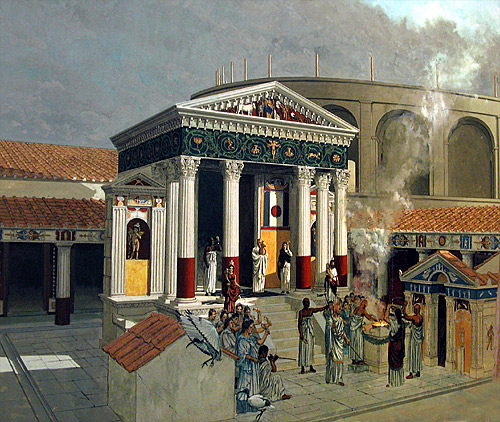
I AM not even sure what I was searching for at the time, but I literally stumbled onto the location of the mysterious Temple of Antinous in his hometown in the city of Claudiopolis that is now known as Bolu, Turkey.

(See the photos at the bottom of this entry.)

It was in a Turkish language website but had a map of excavations made in 1978. I recognized a familiar name, Antinoos and the turkish word "Mabeti" which means Sanctuary. 

With the aid of the drawing, it was easy to locate its location with google maps. It is located on a hill top that may have once been the citadel of Bithynium-Claudiopolis and the sacred precinct. 

Below to the left or east is the town center where the ancient agora and administrative town center was and still is today. 

On the south, or "sunny side" at the bottom of the hill, are the remains of a stadium. An inscription in Greek was found along the steps of the stadium which names Hadrian as its builder. 

The website says that a frieze and a column were found at the Antinous sanctuary that are now located in the Bolu Museum. I found what I think they mean to be the frieze, which has an inscription in Greek that names Hadrian.

I cannot find exactly what column they are referring to that specifies that it was found at this location ... there are a few pieces of columns that are displayed with the frieze,

The Stadium was where the Sacred Games of Antinous took place in Bithynium-Claudiopolis. What is interesting is that the Temple or Santuary of Antinous was located right above the stadium, overlooking it, so that it would seem to be watching over the games.

From the google satellite image we can see regularly spaced dots, no idea what these are but they must be very large, like maybe the bases of columns, but they are not arranged in a recognizable temple shape. 

If they are column bases, perhaps they were like a crypt level that held up the floor of a temple above, or perhaps it was a "hypostyle" temple like you see in Egypt. 

The only other description on the map says "Su Deposu" which means "water tank" ... very mysterious. So was this part of the ancient temple? Was there a water feature, fountains, an artificial stream? 

The tank was at the highest point on the hill, was this part of the Antinous temple, or just the drinking water tank for the hilltop complex ... or was it both? How was it supplied?

Our friend and Cappel Meister, Dorian Agaric, recently visited Bolu. He visited the museum and as I recall mentioned seeing the steps of the Stadium. But I do not think he knew how close he was to the actual TEMPLE OF ANTINOUS BITHYNIUM-CLAUDIOPOLIS ... I would love to hear what his recollections are about visiting the sacred city.

The only way we are ever going to know what is going on there on that hill is for someone to go there and see for themselves, because I don't think we are going to information for casual visitors. There will be fences to jump over and authorities to avoid ... most likely, from what you can tell by looking at the latest depressing streetview images of that area ... I doubt anyone will even care.

For me this is one of the most important discoveries of my life, to see it for myself where the original temple of Antinous was in his home town ... a place that we can visit and connect with our ancient ancestors who were members of our religion.

Now we know where one of the most important temples of our Religion was located.

May Antinous bless us with this knowledge,
and why it was given to us now

~FLAMEN SUBIA


Pic1-The 1978 Map

Pic2 -Google map with my outline where the temple is


Pic3- The Stadium steps


Pic4-closeup of steps


Pic5- This is a drawing of where the Antinous Temple was 
(not made by me)


Pic6-Frieze which names Hadrian, 
which we assume is the one referred to on the website


Pic7-most depressing picture of all...
what this site currently looks like....
according to Google Street View


Pic8-map of city center of Bolu, "A" marks the spot


Pic9-My coin that shows a very weathered 
but still recognizable image of Hadrian on the front 
and a clear image of a temple on the back 
that says BEITHINIAS

Saturday, February 7, 2026

WE PRAY TO ANTINOUS/DIANA
TO GUIDE US IN OUR HUNT BY MOONBEAMS


TONIGHT, February 7th,  is one of the festivals of Diana goddess of the Moon and hunting in her guise as lunar deity Selene. 

She is goddess of wild places and wild animals and the protector of young women, pregnant women and those giving birth. 

Diana is the twin sister of Apollo. 

As Antinous is often assimilated to Apollo, he therefore substitutes as the twin of Diana, though he can often be viewed as her male double, so that Antinous is Diana. 

Antinous and Diana are both hunters, and moon deities, and they are also gods of magic and darkness. 

Diana is often compared to Hecate, the supreme goddess of Theurgian magicians, who rose to prominence during the reign of Marcus Aurelius. 

Antinous therefore is the male equivalent of Hecate.

ANTONIUS SUBIA says: "We pray to Diana to guide us in our hunt and to illuminate our nights with the silver light of her sublime power. We recognize that the Moon of Diana is the Moon of Antinous."

Friday, February 6, 2026

WEREWOLVES WERE WELL-KNOWN
IN THE DAYS OF ANTINOUS


FEBRUARY 6th is National Werewolf Day, when we remember that even a man who is pure in heart ... and who says his prayers by night ... can become a wolf when the wolfsbane blooms ... and the Moon is full and bright.

It is difficult to say precisely when the story of the werewolf first developed, but wolf-men were well-known in Greek and Roman times. 

The twins Romulus and Remus had been suckled by a she-wolf, and so the idea of the human/wolf hybrid was ingrained in the Roman psyche from an early date.

Shape-shifters were quite common in Greek and Roman mythology.

One of the very earliest depictions of a wolf-man is on an Etruscan Black Figure Plate from the 5th Century BC with decoration representing Hercules pursuing the centaur Nessos in the presence of Deianira ... and at center a wolf-man.

Usually, the metamorphosis from human to animal form often occurred as a direct result of divine punishment ... the gods condemning an individual on the basis of pride, boastfulness or blasphemy.

Pliny the Elder described the lycanthropic shape shifting of a man into a wolf by the gods following an act of cannibalism.

Early in the 1st Century AD, the Roman poet Ovid wrote "Metamorphoses," in which which King Lycaon (from whom we get the term "Lycanthrope") offended the gods by serving them human flesh.

Wanting to see if Zeus/Jupiter was truly omniscient, he slaughtered men and served them for dinner.

In return, Zeus turned Lycaon into a man-wolf and killed his 50 sons with lightning bolts. He is shown here holding a wicked meat axe.

Forget the Hollywood full-moon myths ... a werewolf can change at any time ... if the wolf-man has the right clothes! Some ancient myths speak of cloaks or belts which enable a human to become a wolf.

In the "Satyricon," Petronius writes of such a transformation: "And when I looked for him ... I was appalled to see he had stripped off naked and placed his queer garments by the roadside ... whereupon he walked in a circle round the heap of clothes, urinating a protective ring about them upon the ground ... and then ... as I watched in dread ... he transformed into a wolf!"

Emperor Hadrian had a fascination for magic and strange customs ... he must have told Antinous many weird bedtime tales of uncanny things he had heard in his travels.

ANTINOUS HOLDS YOU IN HIS HEART
AND SENDS YOU LOVING SUPPORT


MILLIONS of LGBTIQ people are feeling angry, depressed, isolated, frightened and abandoned in these troubled days.

Remember always that #Antinous holds you in his heart ... Antinous sends gratitude and love to you for all you do and for being you. 

Here are a few survival tips:

- If you are feeling depressed, isolated, scared, remember that you aren't alone. Reach out for support. If you don't know who can support you, send priests of Antinous a message. We are here and can also refer you to other places. 

- Avoid burnout while resisting. Find a sustainable way to resist. Sign a petition, write a letter, go to a demonstration, donate money if you can, reach out and talk to people. Do what you can and remember that this will be a long struggle. Keep yourself strong. 

- Act locally ... do something concrete to help people who are struggling right now. Stay connected to community. 

- Practice self care. Do things that keep you grounded, strong, and healthy.

- Limit consumption of depressing news and posts. Stay informed, but don't overdo it. 

- Remember the beautiful things in life. Don't ignore what is hard. Just remind yourself that there is much beauty and much love in the world. 

Wherever you are, whatever woes beset you, take heart because #Antinous promises that #LoveWins! #LoveAlwaysWins. 

Thursday, February 5, 2026

ASTRO FORECAST: FEBRUARY 5th—15th, 2026

Antinous is a Moon God. He is, of course, many other things and he wears many hats. But one of the ways he was worshiped in Antiquity was as ANTINOUS THE MOON GOD.

His worshipers looked skyward and saw His beautiful face perpetually turned towards the Earth. The Man in the Moon was actually the Blessed Boy in the Moon for the ancient priests and worshipers of Antinous. Swiftest and most youthful of all the Zodiacal deities, Antinous speeds through an entire year's worth of Astrological signs in just 28 days.

ANTINOUS THE MOON GOD represents our deepest personal needs, our basic habits and reactions, and our unconscious gay selves. Where Hadrian the Sun acts, Antinous the Moon REACTS. How do we instinctively react or respond to problems? What do we feel we need for a sense of security? Look to ANTINOUS THE MOON GOD for answers.

ANTINOUS THE MOON GOD is both our inner boy child and our inner lover. His ever changing phases, as he sweeps past all the other Planets in all the Signs, make us at turns responsive, receptive, and reflective. Eternally youthful, ANTINOUS THE MOON GOD represents our childlike spontaneous and instinctual reactions.

ANTINOUS THE MOON GOD beams down on us to make us imaginative, creative, intuitive, sentimental, adaptable, introspective, and protective. On the negative side, and depending on where he is in the Zodiac, he can make us moody, restless, and irrational.

Antinous Astrology Forecast


FEBRUARY 5th
to 15th, 2026


THURS-FRIDAY, FEBRUARY 5th-6th, 2026

Getting you in the mood for Valentine's Day, Mercury leaves emotionally dry, rational Aquarius and dives into the deeply emotional waters of Pisces. Your EQ Emotional Quotient takes precedence over your IQ Intelligence Quotient.

SAT-SUNDAY, FEBRUARY 7th-8th, 2026

This weekend, it's make-up or break-up time when Venus squares off against Uranus. You can be sure that unanticipated upheavals will occur in interpersonal relationships. Misunderstandings and arguments come from no where. This is the sort of day when seemingly stable relationships break up for a minor reason. And at work, you sense that people are conspiring against you. And quite possibly they are.

MONDAY, FEBRUARY 9th, 2026

On Monday, the Day of the Moon, we come to the Scorpio Third Quarter Moon. This is the Lunar Phase in Antinous Moon Magic which we call the PERDITION MOON of coming to terms with loss and diminishment. Meditations and rituals carried out during this Lunar Phase are best suited for seeking to come to terms with loss and finding areas in your life where you may unconsciously be causing yourself loss or sadness. This Lunar Phase is NOT about giving in to loss and grief, but rather it is about moving through them to find new ways towards growth and fulfillment.

TUES-WEDNESDAY, FEBRUARY 10th-11th, 2026

This week, romantic Venus leaves emotionally cold Aquarius and dives into the romantic depths of Pisces. This sign change marks a major change not only in love but also in finances. Pisces Venus is not only loving and compassionate but also creative and generous. The motto for the next four weeks is: "Give, and you shall receive!" Pisces Venus is super-compassionate and over-generous. For the next month you may find yourself obsessed with spirituality and consumed with compassionate charity for others. On the negative side, common-sense practicality may be hard to muster.

THURS-SUNDAY, FEBRUARY 12th-15th, 2026

This week, after having slipped "backwards" (as seen from Earth) into Pisces last September 1st, now Saturn finally leaves placid Pisces for the next 28 years and steams full-speed ahead into aggressive Aries, where it will remain until April 2028. Aries is known for its bold spirit of leadership, courage, and independence and can lean towards impulsiveness. Saturn, on the other hand, is the task master of the zodiac. He demands steady, sustained effort and hard work. The result is you feel you have one foot on the accelerator and the other on the brake. Ideally, you will be able to take bold initiative in your life while ensuring your choices are sustainable and well thought out. Courage does not mean acting recklessly ... it means stepping forward with conviction while respecting what it takes to create and sustain growth. Full details here about SATURN IN ARIES.

SNEAK PREVIEW OF NEXT WEEK:

Another exciting week lies ahead between February 16th and 22nd, 2026, when we come to the AQUARIUS NEW MOON — which in Antinous Moon Magic we call the OBELISK MOON — the lunar phase embodying knowledge in all its forms, knowledge which is gained through study and learning. The Aquarius New Moon is also always CHINESE NEW YEAR and 2026 is the Year of the Horse, specifically the Fire Horse, which occurs every 60 years in the Chinese calendar and is known as a period of rapid change. In simple terms, the Fire Horse Year 2026 brings rapid change, fresh opportunities, personal growth, and a faster pace of life ... More details next time ....


THE RIDDLE OF THE ROMAN DODECAHEDRON
IS UNRAVELED AT LAST BY NIMBLE FINGERS


MORE than 100 of these strange objects are known to exist, and their purpose remains a puzzling mystery that has baffled archaeologists since their first discovery.

All throughout Europe, small geometric objects known as Roman dodecahedrons have been recovered. 

As far north as Hadrian's Wall, and further south toward the Mediterranean, the dodecahedrons, usually made of bronze or stone, are seldom larger than about eight to ten centimeters in size. 

So what was their purpose?

No written records mention them, and experts have come up with many suggestions.

They could have been gaming pieces or weapons or even impediments strewn ahead of invading armies to cripple cavalry horses.

Others have speculated that they may hold religious or cultural significance, and some have gone so far as to presume they could have been useful in determining the proper times for planting various crops throughout the year.

But was there a simpler and more practical use … a use that was literally at our fingertips?

And for one man, this kind of practical thinking led him to finding a unique use for the Roman dodecahedrons… as well as a possible solution to their creation in ancient times.

In the video below, YouTube user Martin Hallett offers his own thoughts about what the Roman dodecahedrons might have been used for, demonstrating a fascinating potential solution to their design … and an interesting, but creative outcome as well.

Using a 3D printer, he had a scale replica of one of the dodecahedrons made, and then went to work experimenting… with knitting yarn.

His breakthrough came when he realized the holes in the dodecahedron always come in five different sizes ... just as human fingers always come in five different sizes. 

He deduced that these strange objects must have served some practical purpose related to fingers.

And the answer was indeed right at his fingertips ….


Wednesday, February 4, 2026

WAS THIS LAPTOP TAKEN BACK IN TIME?
OR IS IT JUST AN ANCIENT GREEK TABLET?


ANTINOUS and Hadrian visited the Oracle of Delphi, which connected priests with super natural beings who passed along advanced technology and information.

NOW conspiracy theorists claim that is how a modern-day laptop ended up in a Greek sculpture from 100 BC.

But historians say the sculpture is just a deceased woman "touching the lid of a shallow chest".

"I am not saying that this is depicting an ancient laptop computer,"  StillSpeakingOut, conspiracy theorist, said in a video he released on YouTube.

"But when I look at the sculpture I can't help but think about the Oracle of Delphi, which was supposed to allow the priests to connect with the gods to retrieve advanced information and various aspects."

The sculpture, "Grave Naiskos of an Enthroned Woman with an Attendant" is on display at The J. Paul Getty Museum in Malibu, California.

"Lounging in a cushion armchair, a woman reaches out to touch the lid of a shallow chest held by a servant girl on this funerary," reads the historian's description.

The concept of this image has been a part of Greek funerary art for centuries and most likely pertains to the hope they that will still have the same earthly pleasures in the afterlife.

It depicts an object that closely resembles a modern laptop or handheld device with USB ports, explained StillSpeakingOut.

Another picture taken by a tourist, we see the object is wide but the structure is too narrow to be a jewelry box and it doesn't match the depictions of the mythical Pandora Box either, he explained.

The myth says the Oracle of Delphi would allow priests to connect with the gods, aliens or time travelers who would share 'advanced information and high-tech devices.

Those who don’t believe in aliens or time travel, say the object is a wax tablet that ancient Greeks used for writing with a stylus or pen, reported Inquisitr.

But paranormal investigators argue that the "wax tablet" shown in the funerary relief sculpture does not resemble any other wax tablets seen in Greek art.

StillSpeakingOut says the object shown etched in the sculpture is much thinner than the wax tablets and that the woman isn't holding stylus, also seen in Greek art with individuals using the wax tablet.

Believers do not see the box as a jewel box or a wax tablet, but a modern-day electronic laptop computer with USB ports on the side, which have never been seen in other examples of jewel boxes or wax tablets.

The woman's eyes are focused on the inner lid of the object, the same location of a laptop monitor, conspiracy theorists claim.

And even go so far to argue that the way her fingers are touching the lid looks like she is using a touchscreen device.

"I can't help but think that Erich von Däniken had been right all this time and that most of these myths of magical artifacts given by the gods to a very restricted group of individuals in ancient civilizations were high-tech devices similar to what we have today," said StillSpeakingOut.

Monday, February 2, 2026

ANTINOUS AND THE ZOROASTRIAN
ORIGINS OF GROUNDHOG DAY


ON February 2nd we remember the travels of Hadrian and the Blessed Boy throughout the Eastern Empire where they encountered ancient rituals of greeting the newborn sun which endure to this day ... culminating in the ridiculous folk holiday known as Groundhog Day.


This is the farthest East that Antinous was ever to travel and is observed here in conjunction with Imbolc, also known as Candlemas (Dia de la Candelaria), a Festival of Newborn Light. 

In many countries today, February 2nd is the day when people take down their Christmas decorations.

This is the day when Christmas trees are removed from front rooms after having been set up on Christmas Eve.

It is an odd phenomenon that, in the English-speaking world, people put up Christmas trees about a month PRIOR to Christmas and then take them down right after the Big Day.

But in other cultures, trees go up on Christmas Eve and decorate living rooms for weeks AFTER Christmas.

Thus Imbolc/Candlemas is an arcane and largely forgotten non-event in the English-speaking world. 

Yet in fact, it is the evening when the God of Light becomes manifest in the world ... part of an ancient celebration that goes way  back before Christianity and even before Celtic tradition.

Hadrian and Antinous got a first-hand glimpse of these celebrations which, even in their time, were truly very ancient.

Hadrian, who was fascinated with ancient cultures, was intrigued by the Armenians, which explains why he made this particular side trip over the mountains in the dead of winter.

On February 2nd, we invite you to turn out the lights in your home and light a simple beeswax candle symbolizing the end of the Northern Hemisphere's Winter Festivals (Halloween through Christmas) and the beginning of the Spring Festivals of New Birth and New Light. In fact, this is the start of the Carnival season. 

And, indeed, in some years Mardi Gras occurs in early February. And even in years when Carnival starts later, this night is always considered party night by those people who design and make Mardi Gras floats and costumes ... in Rio and in New Orleans and in Venice, Carnival aficionados will by partying all night tonight.


And the following morning ... bright and early on February 2nd ... people in another obscure part of the globe will be watching for a Groundhog called Punxsutawney Phil to emerge from his burrow to catch a glimpse of the God of Light.


These seemingly disparate customs are all remnants of a religious festival so very ancient that it was archaic even in the time of Hadrian and Nations. Today it is little more than a day to pack away ornaments or a day to get drunk at a pre-Carnival party. 

It is scarcely more than media hype surrounding a mammal held aloft at dawn by Pennsylvania Dutch descendants of immigrants from Central Europe. 

And it is a day when garbage men throughout Europe stagger under the weight of dried-out old Christmas trees.

But if you turn out the lights and leave just one simple candle burning brightly in the darkness … you may just catch a glimpse of the God of Light. That is what Hadrian and Antonius were hoping to catch a glimpse of on this day so many centuries ago.

Sunday, February 1, 2026

THE LEO FULL MOON
THE LION HUNT MOON OF ANTINOUS


TONIGHT you get an ego-boost and are ready for your chance to go for the gold ... when we come to the lunar phase we call the LION HUNT MOON, the LEO FULL MOON.

It is a reminder that Antinous slew a man-eating lion in Egypt. Antinous peered out into the barren wilderness with all its deep and hidden dangers. He charged forth, his bridle-reins in one hand and an adamantine-tipped lance in the other, and he faced the beast unafraid. For Antinous knew he would triumph over death. The Spirit of the Lion Hunt is the bravery of Antinous the Lion Slayer.

Each Lunar Phase represents a Divine Spirit or Archetype. The Spirit of the Lion Hunt Moon is courage and bravery. It is exemplified by selfless devotion and dogged perseverance.

The image above shows Antinous and his steed attacking the man-eating Marousian lion in the Egyptian desert in the year 130 AD. The Sacred Lion Hunt was immortalized in poetry and in stone, showing Antinous brashly attacking the lion with his adamantine-tipped speer and wounding it ... so that Hadrian had to gallop to his rescue and dispatch the beast.

Hadrian added medallions to the Arch of Constantine showing him and Antinous with feet on the lion's neck and also making sacrifice to the great lion-killer Hercules.

Soon legend would have it that scarlet-red lotus blossoms had sprung forth from the pool of the lion's blood -- which we honor as THE SACRED LOTUS MOON, the Pisces Third Quarter Moon in June.

Within a few short weeks after the Sacred Lion Hunt, Antinous himself would be dead. The Sacred Lion Hunt is the last recorded event in His short life.


The Leo Full Moon in the bold and fiery sign of the Lion is a time to take center stage, stand in the spotlight and play the starring role in the divine drama. Leo is the sign of creative extroversion and action.

Meditations and rituals conducted tonight are best suited for finding courage and determination in daunting situations. Remember always that courage is not the absence of fear, but rather the judgment that something else is more important than fear.

The brave may not live forever, but the cautious do not live at all. Tonight's rituals and meditations should enable you to traverse the road between who you think you are and who you can be. The key is to set forth on the journey ... with adamantine-tipped spear in hand ... galloping forward.

LABRADORITE FOR THE LION HUNT MOON
By Our Crystal Meditation Advisor Martin Campbell


IF you are going to meditate using crystals at this Leo Full Moon, moon phase you can be assured that this practice has existed for thousands of years and is still influencing key spiritual teachers around the world now. 


I was surprised, recently, to have found some crystal advice that has come down to us from a 12th Century Christian Nun! 

Hildegard von Bingen was a nun worshipping Christ in part of what is now Germany. She composed the music and lyrics of beautiful hymns which have survived and are still used in convents today. 

In 1994 these were put against modern mood music by Angel Music (Vision The Music of Hildegard Von Bingen) to create a magical, ethereal sound. 

As an example of her crystal advice she advised the following for diamonds:

"...if a man is fanatical and choleric, he should keep this stone always in his mouth and by the power of this stone the evils will be turned away."

In modern day Brazil there is a spiritual teacher, guide and healer called John of God (João de Deus).

He is a follower of Christ but also recognises the power of crystals from surprising personal experience:

"Having been a gem miner, I have learned that in order for a precious stone to show its full beauty, it must first suffer tghe process of refinement, likewise, each child [person], a rare diamond of creation, must be polished in order to realise their full superior destination".

Knowing that I have such powerful voices speaking with me I am proud to offer the following crytsal meditation advice for this moon phase.

The Leo Full Moon is interpreted as the Lion Hunt Moon in the Antinous cycle of the year. The key focus of this period is the determination and courage to handle daunting situations along our physical and spiritual journey. To deal assertively with fear. 

I would recommend that you meditate using the following crystals:

LABRADORITE - These wonderful, irridescent stones (pictured at top of this blog entry) are a particular favourite of mine. Apart from being utterly beautiful they remove fear from this life and past lives. They also help you live your life with creative purpose and strong imagination.

JASPER - There are many different colours of Jasper all of which have differing strengths. Overall though the family of Jasper stones aid self realisation and imparts the determination to do anything you desire. It helps to calm your nerves. Jasper also brings you the courage to deal with problems assertively.

Light and Life,
MARTIN

To get more advice from Martin Campbell and to find out how to contact him CLICK HERE.

ANTINOUS ON MOUNT IDA
WHENCE GANYMEDE WAS SWEPT ALOFT


ON February 1st the Religion of Antinous commemorates the ascension of Antinous to the summit of Mount Ida.

Landing in Asia Minor in early 129 AD from Eleusis, Hadrian and Antinous stopped at Troy, visiting the grave of Achilles, and then scaled sacred Mount Ida, home of the Great Mother of the Gods, and spot where Phrygian Prince Ganymede was taken up by Zeus to be his immortal lover.


Mount Ida is the most sacred of three mountains in Phrygia including Didymus, and Agdistis, named for Zeus's hermaphroditic offspring Agdistis whose powers so frightened the gods that they chopped off her male genitals.

The mountain was famous for its sibylline prophecies, and its mysterious springs and waterfalls are still a place of mystery.

From the summit of Mount Ida, called Kaz Daglari today, Antinous looked down over the plain of Illium, and across the land of his Phrygian ancestors.


Flamen ANTONIUS SUBIA has pointed out that Mount Ida is sacred to an aspect of the Great Mother of the Gods known as Agdistis, who was served by drag queen priests.

Antonius has equated her also with the Mexican-American folk saint La Santisima Muerte … "Most Holy Death"

Antonius has said: "La Santisima Muerte is the Dark Lady...Proserpina and Magna Mater all at once...she is all regarded as the darkside f the Virgin Mary.  Her cult is spreading all over the US right now ... wherever there are Mexicans ... in little shrines are cropping up with this skull faced lady. Her religion and the Religion of Antinous are two new (ancient) faiths that are resurfacing. .. the connection to Magna Mater and Antnous makes me feel that Our Lady Death and Our Lord Antinous are part of a similar resurgence."


Santa Muerte is increasingly popular amongst LGBTI people, including worshipers at the TEMPLO DE ANTINOO MÉXICO who created this exquisite papier-maché figure of her. 

She is garbed in a gay wedding dress on her Holy Night October 31st. She is often offered cigar smoke rather than incense...she is also fond of Tequila and Roses.

The ascent up Mount Ida must have been spooky and awe-inspiring, with transgender priests accompanying them amongst clouds of incense and much wailing and chanting.

May Our Lady Most Holy Death watch over you!

Saturday, January 31, 2026

DEREK JARMAN
SAINT OF ANTINOUS


ON January 31st the Religion of Antinous celebrates the life of Saint Derek Jarman.

St. Derek, born on this day in 1942, created eleven extraordinary feature films ... including "Sebastiane," "Jubilee," "The Tempest," "Caravaggio," "The Last Of England," and "Edward II" ... and over three dozen shorts.

This multi-talented artist is also acclaimed for his painting (several major exhibits), stage and film design (for director Ken Russell and for a glorious Pet Shop Boys concert tour), gay and human rights activism, literature (memoirs, social criticism, poetry), and, on a serene note, his exquisite gardens full of "found" art.

Most gay men have seen Sebastiane which, when it came out more than 30 years ago, was the first British film to feature positive images of gay sexuality, not to mention the first film entirely in Latin.

Edward II raised eyebrows among critics for its upfront depiction of the brutal assassination of England's openly gay monarch by means of rectal assault.


The exquisitely beautiful Caravaggio is Saint Derek's best-known film.

We Antinoians remember Saint Derek for his art and we honor him as well for his boundless courage. His death from AIDS was cruelly slow and agonizing. And yet, as AIDS robbed him of his mobility and even of his eyesight, he turned the tables on Death and Dying by turning Death and Dying into an art form. 


His last feature-length film, Blue, consists of a single shot of saturated blue color filling the screen as Derek talks about his "vision" of life and art. How very typical of Derek Jarman.

Thumbing his nose at fate right up to the end. A dying man who is blind and yet who talks about his vision.

The light of his eyes faded until all he saw was the darkness where the Night Terrors feed on fear and doubt. And what did Derek do? He turned the darkness into vibrant color. He turned his fear and his worries into artistic energy. The dramatic lighting and brilliant colors of his films were so very dramatic and brilliant because they were always, always set against the inky darkness.

That is why we consecrate Derek Jarman a Saint of Antinous. Just like Saint Caravaggio, also one of our Blessed Saints, Martyrs and Exemplars, his "vision" lay in turning the Darkness into Light and Color. He died February 19, 1994.

Friday, January 30, 2026

THIS BIOGRAPHY SAYS LIVIA WAS NOT
THE WICKED WITCH OF ANCIENT ROME


MENTION the name Livia, who was born on 30 January in 58 or 59 BC, and the image pops to mind of a treacherous and vindictive woman, as beautiful as she was wicked and cruel. 

Second wife of the Emperor Augustus and the mother of his successor Tiberius, Livia has been vilified by posterity (most notably by Tacitus and Robert Graves) as the quintessence of the scheming Roman matriarch, poisoning her relatives one by one to smooth her son's path to the imperial throne.

Played by Siân Phillips with viperish glee in the classic BBC TV drama series "I, Claudius", she hissed and writhed through the marble halls of the emperor's palace, leaving corpses in her wake as she ruthlessly intrigued to get her one surviving son, Tiberius, to the Imperial throne ... finally even poisoning Augustus himself and forging his will.

Now a new book says Livia was not evil, she was merely a powerful and ambitious woman ... and as such, she was damned by male historians. 

Like Egypt's Hatshepsut, Livia MUST have been a wicked and cruel step-mother who would stop at nothing in her own quest for power. Or so it was claimed by male historians from Tacitus to Robert Graves in the 20th Century. 

In recent years, Hatshepsut has been vindicated, most notably by historian Joyce Tyldesley. Dr. Tyldesley says Hatshepsut's name was erased from historical records by male successors who feared a "female pharaoh" was a dangerous precedent — dangerous to male domination.

Now it is Livia's turn to be vindicated in the new historiographical book "Empress of Rome: The Life of Livia" by Matthew Dennison. In this elegant and rigorously researched biography, Dennison rescues the historical Livia from the crudely drawn sexist caricature of the popular imagination.

He depicts a complex, courageous and richly gifted woman whose only true crime was not murder but the exercise of power, and who, in a male-dominated society, had the temerity and chutzpah to create for herself both a prominent public profile and a significant sphere of political influence.

As with the life of Hatshepsut, the challenge facing any biographer of Livia is the lack of recorded facts. To handle this problem, "Empress of Rome" tells her story in a series of thematic chapters in roughly chronological order.

It makes for riveting reading.

All that we can be certain of is that Livia enjoyed a reputation for probity and traditional values. She seems to have taken care not to interfere in politics, although always on hand to give confidential advice to her husband Augustus. And he has gone on record as having valued her advice.

Dennison convincingly demonstrates in his biography of this much put-upon woman that she hardly needed to resort to poisoning anyone in an age when poor hygiene and lack of antibiotics meant that anyone might die at any time. 

Reports of poisoning in the Roman empire tended to coincide with epidemics, unrecognised or misunderstood by the unreliable medical science of the day. 

In some cases Livia was many hundreds of miles away from her putative victims and would have had to hire agents to do the dirty deed for her — an extraordinarily foolhardy risk.

A line of hopeful young noblemen, one after another, was struck down mysteriously. The first was Marcellus, Augustus's nephew, who (probably) died of typhoid fever at the age of 20.

The whisper spread that Livia had administered poison. Similar rumours blamed her for the deaths of her younger son Drusus, the emperor's grandsons Gaius and Lucius Caesar, and even Augustus himself (supposedly she smeared figs on his favourite tree with venom).

Her alleged motive was love for her eldest boy Tiberius, in whose interest she meant to eliminate all competitors for the imperial succession. She was a Claudian and wanted to ensure a Claudian dynasty, or so the story goes.

The idea of Livia as serial killer was given new life by Robert Graves in his historical novel "I, Claudius", and she reached a mass audience in the television series of the book, memorably interpreted by Siân Phillips.

Where did Graves get his Livia? The key figure is Tacitus, a Roman historian whose "The Annals Of Ancient Rome" is one of the great masterpieces of historical literature.

Tacitus disliked Livia. In fact he loathed her. Writing slightly more than a century after Livia's heyday, he never directly accused the empress of mass murder but slyly insinuated it with a nudge and a wink. Graves simply fleshed out those insinuations in his historical novel — historical fiction which readers accepted as historical fact.

But Dennison points out that at least two historians of the Roman Empire, who were actually writing at the time, made very few criticisms of Livia.

Born in about 58 BC, she came from an upper-class Roman family living under a strict moral code, which was even stricter for women.

They wove a lot. They looked after the household and the education of their children. A contemporary wrote that an ideal wife "can relax with her husband and he can confide all his secrets to her since it is like confiding in himself".

That explains the genuinely close relationship between Liva and Augustus.

This doesn't change the fact that she was a Claudian and family dynasties were what really mattered. Octavian Caesar (who became Augustus) married into Livia's Claudian family because it gave him more power. She conveniently left her husband to marry Augustus because he was rich and powerful.

The problem for Livia was that Augustus wanted to create, in essence, a hereditary monarchy. That would exclude her sons by Claudius Nero, and she could have none by Octavian (now dubbed Augustus). 

That meant the end of the line for the Claudians. 

The rivals who stood in her way went down like ninepins, although not necessarily by Livia's hand. 

Marcellus, Augustus's nephew and the first to go, could well have died of typhoid, says Dennison.

Augustus's daughter Julia was exiled to a rocky islet off the Italian coast after Livia fed the puritanical Augustus stories of her wanton immorality. No proof, says the author.

Lucius and Gaius Caesar, grandsons of Augustus, dying abroad mysteriously? Tacitus suggests Livia's "secret hand" but no other historians mention the rumor.

Postumus, another grandchild of Augustus, murdered, while unarmed, by an unknown hand on the islet to which his mother Julia had been exiled? The identity of the killer is still open to debate, we are told.

However, there is little question about the death of Augustus himself. It is a near contemporary historian who records Livia smearing poison on some figs and offering them to him with her own hand.

And there is no question that Livia, skilled in "medicinal potions", lived to be nearly 90 years old — more than twice the average life span. And she did indeed ensure that the Claudians remained in power through Tiberius, Caligula, Claudius and Nero.

And, of course, it was her grandson Claudius who proclaimed her an immortal goddess, thus absolving her of all earthly misdeeds ... whether factual or only fictional.