Showing posts with label antonyus subia quotes. Show all posts

Tuesday, October 6, 2026

NOMINATIONS FOR SAINTHOOD 2026
NOW BEING ACCEPTED BY OUR PRIESTS


THE time has come to Nominate Gay Saints of Antinous for 2026.

Before making a nomination, please check the current LIST OF SAINTS to be sure that your suggestion is not listed already.

All nominations will be considered, but as a reminder, our traditional criteria is as follows:

I. A Nominee for Sainthood must be:

    1. A person who is no longer alive.

    2. A person who was known to be Gay or reasonably suspected to have been Gay or bisexual to a significant degree.

    3. A person who made a notable contribution to gay society or human society in general.


II. A Nominee for the category of Martyr Saint should be:

    1. Any gay person who committed suicide or was the victim of gay violence.


III. A Nominee for the category of Venerable Saint can be:

    1. Any person who was not gay, or whose homosexuality is uncertain, but who made a significant contribution to gay society or gay spirituality that we feel deserves to be recognized in an official capacity.

IV. Members of Ecclesia Antinoi, and those they love may be nominated for passage on the Barque of Millions of Years.

The deadline for nominations is October 25th, any nominations made after that date will have to be added to the nomination list for 2027.  Discussion is open to all considering the qualifications of any nomination.  The Priesthood of Antinous will make the final decision...an announcement will be made on October 30th, and a ceremony of consecration will proceed that evening.

May the Saints of Antinous be with us,
Watch over us,
And guide us to Antinous Consciousness.

Antonivs N. Svbia


Flamen Antinoalis

Monday, October 5, 2026

ON WORLD ARCHITECTURE DAY
WE HONOUR HADRIAN'S PANTHEON


THE first Monday in October is World Architecture Day and Hadrian's Pantheon is one of the most magnificent examples of architecture the world has ever seen. 

Hadrian's Pantheon brings tears to your eyes. Imagine being with ANTONIUS SUBIA as he describes the monolithic columns each carved from a single stone from Egypt ... "as if he could snap his fingers and have such columns appear here" ... and the marble in the interior coming from every corner of Hadrian's vast empire.

Then you stand under the oculus ... the eye of the cosmos ... the most spiritual architectural element anywhere.

Friday, October 2, 2026

BLESSED ORPHEUS THE GOD


"Three times the sun had ended the year, in watery Pisces, and Orpheus had abstained from the love of women, either because things ended badly for him, or because he had sworn to do so. 

"Yet, many felt a desire to be joined with the poet, and many grieved at rejection. 

"Indeed, he was the first of the Thracian people to transfer his love to young boys, and enjoy their brief springtime, and early flowering, this side of manhood." 

- Ovid: the Metamorphoses 

~SVBIA

Thursday, October 1, 2026

ANTINOUS AND THE ORPHIC MYSTERIES


ON THIS DAY, October 1st, the beginning of the holy month of the Sacred Nights of Antinous, we venerate Orpheus. 

Antinous our God was initiated into the cult of Orpheus so that his teachings became part of the Religion of Antinous, and therefore we receive the salvation that Orpheus accomplished through our god Antinous, the New Dionysus.

It is on this date that the Religion of Antinous remembers the blessed heritage of The Orphic Mysteries, into which Hadrian and Antinous were both initiated.  

The Orphic Mysteries teach that human souls are divine and immortal but doomed to live (for a period) in a "grievous circle" of successive bodily existences through reincarnation. 

This belief that each of us is divine and immortal — Man-Godliness-Becoming-One — is the mystery which Flamen Antinoalis Antonius Subia calls HOMOTHEOSIS. 

By welcoming this divine force instead of rejecting it, we take the first step away from our instinctive animalistic fearful self on the long road to becoming a Shining One of Heaven.

Hadrian and Antinous must have known by heart the story of Orpheus in the Underworld: Orpheus was the son of Apollo and the muse Calliope, and from his father he received the Lyre and the gift of music. 

So powerful was the music of Orpheus that he could tame the hearts of beasts and birds and his song enchanted even the trees and stones.

He was one of the Argonauts who, together with Jason, retrieved the Golden Fleece. Returning from the journey, he married Euridice, but the marriage was short-lived because while fleeing the Shepherd God Aristaios (ironically also often depicted as a form of Antinous in ancient times), who was attempting to rape her, she was bitten by a snake hidden in the grass and died. 

Orpheus was so overwhelmed with grief that he used his powers of enchantment to travel to the underworld to bring back his wife.

His music soothed the three-headed dog, and gained his entry into the dark hall of Hades and Persephone. There he sang to the rulers of the underworld, and his song touched the cold heart of the Lady of Death. Persephone decreed that he could lead his wife out of hell provided that he did not turn to see her following.

Orpheus, singing as he went, very nearly succeeded, but at the last moment, at the very gate of darkness, he turned and saw his wife vanish back into oblivion.

Flamen Antinoalis Antonius Subia tells the rest of the story, and why it is important to us:

From that moment Orpheus was a changed man, he became a priest of Dionysus, and gave himself over to intoxication, completely shunning the company of women, and separating himself from the customs of the world. Orpheus is said to have been the first to sanctify homosexuality as an indulgence that frees the soul from  continued reincarnation through the procreation of the flesh. His journey through the underworld gave him a deep detestation of death that he developed into a new philosophy. Orpheus taught that we were all children of the fallen star Dionysus-Zagreus, who had been torn to pieces by the Titans and consumed by them so that his light was mingled throughout their flesh. Zeus struck the Titans down with his lightning and from their ashes arose mankind, fashioned by Prometheus.
So that we will never suffer the fate of passing into the realm of Hades, Orpheus taught that we must restrain our titanic nature and restore the purity of our godliness, we must become Bachkoi, which is that we must become Dionysus again. A pure life, free from murder, including blood sacrifice and the eating of meat is required, and we must undergo initiation into the blessed rites which he inaugurated.
Although part of the religion of Dionysus, the Orphic cult was limited to men. Orpheus wrote volumes of sacred poems that comprised the heart of his new religion. The Orphic cult was a combination of the freedom and indulgence of Dionysus, tempered with the high-minded nobility of Apollo.
The Orphics denied the world and set their minds on the inner light of Dionysus so as to liberate the soul from imprisonment within the flesh.

You can see the parallels between the story of Orpheus and Eurydice and the true-life story of Hadrian and Antinous. The emperor mourned and wept and sought to bring his Beloved Boy back to the world of the living. 

Hadrian's route through the Underworld was of a purely spiritual nature. He recognized that Antinous had always been Divine — a fact which is a tenet of The Orphic Mysteries. He decided to establish a religion which would enable the followers of Antinous to become aware of their own Divine Nature and to become one with ANTINOUS THE GAY GOD.

It is indeed ironic that this beautiful religion was born out of Hadrian's inconsolable grief. But the divine regenerative sacred force of this phenomenon is the secret behind the Tarot Trump called Death.

Death occurs in so many forms. We experience Death in some form every day of our lives. Loss of job. Loss of a lover. Loss of a friendship. Loss of money or status. Loss of confidence in ourselves ....

Your grief can be the powerful Gnosis which makes you remember that you are the musician. You are the dancer. You are that which has died and entered the Underworld. You are also that which rises re-born bright and shining like the dawn sunrise.


It is the process (because it is a process and not a method) which Flamen Antinoalis Antonius Subia calls HOMOTHEOSIS ... "Gay-Man-God-Becoming-the-Same-As-Gay-Man-God."

Sunday, September 27, 2026

WE HAVE A NEW PRIEST OF ANTINOUS
Priest Peter Fiske


WE have a new priest of Antinous! Peter Fiske of Palm Springs, California, was consecrated tonight as the priest of the newly established Temple of Antinous in Palm Springs.

His priestly name is Petrus Aquila Aelius Fiske and he took his vows during international Zoom ceremonies attended by attendees in North America, South America, Britain and Europe.

His consecration occurred during the cycle of the September Equinox as modern worshipers of Antinous around the world gathered via Zoom for ceremonies originating from Palm Springs to celebrate the feast of the Persephonea, the Sacred Stag Hunt and the initiation of Antinous into the Eleusinian Mysteries of life and death at Eleusis.

We regard the September Equinox (Autumnal in the Northern Hemisphere and Vernal in the Southern Hemisphere) as the SACRED STAG HUNT in which Antinous spiritually pursues the magic stag through the spiritual forest ... the stag representing the male god force within us. 

The stag is a symbol for gay spirituality, a graceful, beautiful animal, crowned with horns, mighty and strong, yet pursued by hunters who yearn for the taste of his tender meat.

We look to the story of Cyparissus the beautiful young man who was lover of Apollo or in another version of the forest god Silvanus. 

As a gift of love, the god gave Cyparissus a beautiful stag, but while hunting the ever jealous god of the west wind fooled Cyparissus into accidentally shooting and killing his beloved stag. (Image: "Cyparissus" by Jacopo Vignali)

The young man was so consumed by grief that Sylvanus-Apollo took pity and immortalized him by turning him into the Cypress tree, which is an emblem of death. 

So it is the the Stag Hunt brings summer to a close and prepares the way for the Death and Transfiguration of Antinous.

We pray to the Horned God to come into our lives and direct our magical forces as gay men towards fulfilling our goals and accomplishing our dreams. We are both hunter and hunted.

Antinous is both the beautiful Cyparissus and his beloved stag, and between the two is a sacred gay mystery.

Worshipers also commemorated the initiation of Antinous into the ELEUSINIAN MYSTERIES in Greece at the outset of Emperor Hadrian's Imperial Tour of the Eastern Provinces.

Historical records state that, in the late summer of the year 128, the Imperial Court embarked on a grand tour of the East. The Empress Sabina, Hadrian's wife, and her attendants were members of the entourage.

But on this particular journey, Antinous was the most favored of Hadrian's companions. Their love affair was openly, and gracefully displayed before the eyes of the world. This journey through the East, what we call the SACRED PEREGRINATION, is the only part of the short life of Antinous that history has conveyed to us. 

For this reason it takes on the importance of a sacred epic. Antinous  was in the very flower of his beauty and vigor, he was a shining star  held in the wings of the Imperial Eagle, and it is no coincidence that  this court of demigods should travel through the lands of Ganymede, Attis, Adonis, Jesus and Osiris, who were all beautiful souls taken from life before their time.

The court stayed in Athens for five or even six months, they arrived in time for the celebration of the MYSTERIES OF ELEUSIS, which symbolically portrayed the rape of Proserpina by Hades, the mourning of her mother Demeter, and the return of Spring. 

In the modern Religion of Antinous, we commemorate these ELEUSINIAN MYSTERIES during the September Equinox, for it is believed that Antinous underwent the secret initiations provided by the Priests of Eleusis at the Temple of Demeter/Ceres.

Through the Priests of Eleusis Antinous received the consecration of the dark goddess of the underworld Persephone/Proserpina, which prepared him for his own death and resurrection.

In the Mysteries of Eleusis, the initiates are led into the realm of death and are confronted with immediate death. 


Two years later, in 130 AD, Hadrian and Antinous would indeed be confronted by physical death. 

Wednesday, September 23, 2026

THE DAY ANTINOUS WAS INITIATED
INTO THE ELEUSINIAN MYSTERIES


ON THE EQUINOX in September the Religion of Antinous commemorates the FEAST OF THE PERSEPHONEA — the initiation of Antinous into the ELEUSINIAN MYSTERIES in Greece at the outset of Emperor Hadrian's Imperial Tour of the Eastern Provinces.

Historical records state that, in the late summer of the year 128, the Imperial Court embarked on a grand tour of the East. The Empress Sabina, Hadrian's wife, and her attendants were members of the entourage.

But on this particular journey, Antinous was the most favored of Hadrian's companions. Their love affair was openly, and gracefully displayed before the eyes of the world. This journey through the East, what we call the SACRED PEREGRINATION, is the only part of the short life of Antinous that history has conveyed to us. 

For this reason it takes on the importance of a sacred epic. Antinous  was in the very flower of his beauty and vigor, he was a shining star  held in the wings of the Imperial Eagle, and it is no coincidence that  this court of demigods should travel through the lands of Ganymede, Attis, Adonis, Jesus and Osiris, who were all beautiful souls taken from life before their time.


The court stayed in Athens for five or even six months, they arrived in time for the celebration of the MYSTERIES OF ELEUSIS, which symbolically portrayed the rape of Proserpina by Hades, the mourning of her mother Demeter, and the return of Spring. 

In the modern Religion of Antinous, we commemorate these ELEUSINIAN MYSTERIES during the September Equinox, for it is believed that Antinous underwent the secret initiations provided by the Priests of Eleusis at the Temple of Demeter/Ceres.


The painting above by Joseph Gandy in 1818 shows how the temple may have looked in the 2nd Century AD. The painting at right is "The Garden of Persephone" by Robert Hale Ives Gammell.

Through the Priests of Eleusis Antinous received the consecration of the dark goddess of the underworld Persephone/Proserpina, which prepared him for his own death and resurrection.

In the Mysteries of Eleusis, the initiates are led into the realm of death and are confronted with immediate death. 


Two years later, in 130 AD, Hadrian and Antinous would indeed be confronted by physical death. 

In the Mysteries of Eleusis (and indeed in the Underworld after Death), the initiates cannot go back the way they have come. 

And they cannot go forward without knowing the Words of Power that will allow the gatekeepers to throw open their gates.

But we face such situations not only in secret initiations, or on our deathbeds. No, we face such "mysteries" every day of our lives. 


We put off our dreams and aspirations so we can cope more effectively with the challenges of the present, ostensibly to have more time and leisure to realize our purpose in the future. 

Or we tell ourselves that we will chase our dreams someday once we have accomplished other lesser goals.

(Photo left: Antinous statue found at Eleusis.)

In truth, it is our fear that keeps us from seeking fulfillment in the here and now — because we view failure as a possibility, our reasons for delaying our inevitable success seem sound and rational. 

If we ask ourselves what we are really waiting for, however, we discover that there is no truly compelling reason why we should put off the pursuit of the dreams that sustain us.

That is what "mystery initiations" are all about. Hadrian and Antinous were forced by the Eleusinian priests to confront their fears and to find a way to go forth into life — NOW. They had no options. It was now or never. Life or Oblivion. In our own lives, we face the same question every day. And usually we try to find a way to avoid the question.

The idols, the images, the icons, the gilded statues and the gods themselves are as nothing.

YOU YOURSELF HOLD THE KEYS TO FINDING AND FULFILLING YOUR OWN DESTINY.

It is yours to find and to fulfill. No one else's. Not even the gods'.

That is what the ELEUSINIAN MYSTERIES are all about. And that is what the PERSEPHONEA is all about. And the Journey Up the Nile by Hadrian and Antinous to their Fateful Destiny with Eternity. And it is also what the symbolism of the Equinoxes is all about.

Even if the days are getting shorter, they are also getting longer — it is all a matter of perspective. The days ARE getting longer — our brothers in South America, South Africa and Australia can look out the window and see the lavender blossoms of the jacarandas in springtime bloom.

Remember Hadrian and Antinous in the Underworld (or on their Fateful Voyage Up the Nile) and understand what they understood: That the keys of fate are in your hands and you can venture forth RIGHT NOW wherever you wish to go.


FOR IT IS WRITTEN ON THE OBELISK OF ANTINOUS:  


He is able to enter any place he wishes.
The Guardians of the Gates
Of the Underworld
Say "Praise to You!" to Him...
They loosen their bolts
And throw open their Gates before Him ...
Millions of years ... daily ...
As His duration of life is as the sun,
Never in eternity elapsing!"


Tuesday, September 22, 2026

ANTINOUS ON MOUNT CASIUS
WAS NEARLY STRUCK BY LIGHTNING


IT was at the season of the Equinox in the year 129 that the imperial court ascended Mount Cassius (also called Mons Casius, Mount Kel or Mount Casius).

They climbed the mountain overlooking the sea because on top of it was a Temple of the Sun. 

A storm broke while they made their ascent, and Hadrian had the priests conduct the Equinox ceremony in the rain. 

During the sacrifice at the altar, a bolt of lightning struck with a horrific, earth-shattering clap of thunder ... killing the priest and the sacrificial animal together. 

This was taken as a very significant portent, one that perhaps Antinous alone comprehended, the darkness of the coming death and transfiguration were presaged. 

Hadrian took it as a sign that the gods of Syria had turned against him, thinking it was Baal-Zeus who struck down the priests as a warning to Hadrian of what lay ahead when the court entered Jerusalem. 

Perhaps it is all a myth and a legend, of course. There were many myths and legends about the events leading up to the deification of Antinous. 

Researching background information on the Lightning Bolt Omen on Mount Cassius, we stumbled upon an old Epistle which Antonius Subia wrote to the original members of this religion at this time of year back in 2002. There were only a handful of followers ... about five or six. 

Take a moment to read what Antonius wrote so many years ago:

"Whatever myths and mysteries were fabricated to legitimize the Religion of Antinous, we can be sure that they were only for the benefit of the vulgar populace, dependent on poetry and allegory. The Priesthood of Antinoopolis however, had to deal with the truth. I can't help but think that the pinnacle of his mysteries, revealed to only the most devoted, was the unsettling revelation that Antinous the God was no more than a boy, just as any of them were or had been."

And Antonius says that THAT fact was what makes our religion so special. He goes on to write:

"That Antinous lived a truly human life, died, and miraculously became a God is what captivates me, even more than his beauty. Unlike so many other, mythical gods, there is a definite level of certainty that all that is said about him is true. It is only when one begins to dig deeper that the mysteriousness of his story becomes manifest. There is a desperate shortage of evidence from his time, almost nothing at all, and what little is written is rare and clothed in foreign languages. Antinous, because of the peculiarity of his divinization, is not a subject of great philosophical interest as are the other, more popular gods."

And then he hints at the idea of HOMOTHEOSIS:

"The most important impression one receives from his story, which is utterly non-mythological, is that if he could become a God, with a star, and a flower, and an eternal name, then what prevents all of us from following in his trail? Antinous destroys the very concept of Godhood. For the vast majority, this is an incomprehensible concept, but Antinous is not a god of the populous, who remain simple in their acceptance of theology … then as now."

And he says Antinous is the divine spark of Sacred Homosexuality:

"Homosexuals suffer from a terrible lack of Gods and divine heroes. Heterosexuality has an overabundance. 

He adds: "I don't see the harm in claiming the truth of our one and only patron saint and god. The emphasis of our day, in which homosexuality is gaining acceptability, seems to be on bringing our sexuality into line, and in conformity to the rest of the population. But what we need most is our own identity, not as an aberration, or a peculiarity, or a mere deviation from the norm, but as a sanctification, a sacred state of blessedness. 

"For thousands of years we have been considered a degeneration, a sin, and even a disease of lust. Now people are beginning to see that we are just different, but there is almost no talk, even amongst ourselves, that we are a wonder of the human species, a divine grace, a delicate flower possible only in the most elevated levels of civilization. It is no coincidence that our sexuality has regained the prominence of respect that it knew in the age of the Antonines, and Antinous is the emblem, in my heart, of our blessedness, then as now."

Antonius then says non-pagans balk at our religion, but he also notes that traditional pagans also have problems with the concept of Antinous as the Gay God for the 21st Century, rather than remaining a reconstructed Classical deity from ancient times:

"Already I have encountered the difficulty of explaining what is so personal to an uninformed listener, and this conflict of interest, as it were, may only increase. My only hope is that Antinous has already prepared the way, as he has done with me, and a few others. However difficult and testing his message may be to bring to the world, I trust that those who are prepared to listen will need very little explanation, the truth being already ingrained within the depth of their soul.

"All I can ever do is turn the key that they alone suspected was there, but the door is for them to open. The statues, and the stark reality of his life, show that there are many sides to our Antinous, none of which is ultimately and universally true.

"However much we may delineate and formalize his religion, it must always remain founded on personal connection, and individual truth. 

"I am prepared to say that this is far more simple than it seems, if we are willing to succumb wholly to absolute freedom in ourselves, and in others."

Antonius (writing back in 2002, remember) has a final question ... a question he has posed to each new priest over the years:

"My question is this, if ever you felt yourselves to be secret priests, evangelists of beauty, and missionaries of sacred homosexuality among these barbarians of our age, what would you say to a soul in whom you could plainly see Antinous, just beneath the skin? But more importantly, why would you even mention his name?"

This weekend, as the shadow of the Super Moon Eclipse falls upon the Earth, and as we remember the story of the Lightning Omen on Mons Cassius, it is perhaps good to remember the founding tenets of our religion:

Antinous was a flesh-and-blood human being of lowly birth.


Antinous and Hadrian were male-male lovers.


Antinous died tragically, perhaps in sacrifice for his beloved Emperor.


Hadrian "wept like a woman" and issued a decree establishing the Religion of Antinous … declaring Antinous a God … the last Classical Deity.

And the question for us today is whether we would recognize a modern-day Antinous if he walked up to us on the street, or if we saw him on Netflix or on the Internet.

More importantly, can we see Antinous in the eyes of all gay men.

Because that's the first place to look for him.

Monday, September 21, 2026

WE ARE THE HUNTER AND THE HUNTED
DURING THE EQUINOX STAG HUNT


ON the Equinox ... may Antinous-Cyparissus bless us with celestial alignment and let us be in harmony with the cosmos. 

We regard the September Equinox (Autumnal in the Northern Hemisphere and Vernal in the Southern Hemisphere) as the SACRED STAG HUNT in which Antinous spiritually pursues the magic stag through the spiritual forest ... the stag representing the male god force within us. 

The stag is a symbol for gay spirituality, a graceful, beautiful animal, crowned with horns, mighty and strong, yet pursued by hunters who yearn for the taste of his tender meat.

We look to the story of Cyparissus the beautiful boy who was lover of Apollo or in another version of the forest god Silvanus. 

As a gift of love, the god gave Cyparissus a beautiful stag, but while hunting the ever jealous god of the west wind fooled Cyparissus into accidentally shooting and killing his beloved stag. (Image: "Cyparissus" by Jacopo Vignali)

The boy was so consumed by grief that Sylvanus-Apollo took pity and immortalized him by turning him into the Cypress tree, which is an emblem of death. 

So it is the the Stag Hunt brings summer to a close and prepares the way for the Death and Transfiguration of Antinous.

We pray to the Horned God to come into our lives and direct our magical forces as gay men towards fulfilling our goals and accomplishing our dreams. We are both hunter and hunted.

Antinous is both the beautiful Cyparissus and his beloved stag, and between the two is a sacred gay mystery.

Ave Antinous the Stag Hunter

~ANTONIUS SUBIA

Tuesday, September 15, 2026

HADRIAN's VILLA COMES TO LIFE
FOR ANTONIUS SUBIA


HADRIAN must have delighted in forcing Patrician Romans to make the 20-mile (30 km) trek to his Tibur Villa in the rugged hill country east of Rome.

Perhaps the surroundings reminded him of his native Hispania. Perhaps he just despised Rome and its snooty residents because he had been taunted as a youth for his "Hispanic" accent and provincial manners. 

Whatever the reason, he spent most of his reign as emperor far away from Rome, traveling to the far-flung corners of his realm.

And when he wasn't traveling, he resided at his Villa, far removed from the city he abhorred. Anyone who wanted to see him was forced to make the journey over hill and dale out to Tibur. In the days of the "letica" or litter chair, it was an uncomfortable and wearying ordeal.

And it still is, even in these days of rapid transit and buses.

"He must have enjoyed making them come all the way out here," Flamen ANTONIUS SUBIA told Priest Hernestus as they waited for one of the notorious overcrowded and unairconditioned "Blue Buses" that ferry passengers from a suburban commuter rail station out to Tivoli ... and then walking a couple of miles along dusty roads to the imperial compound.

Arriving hot and weary, you then ascend a steepish incline to the walls of the Villa itself before finally arriving, out of breath, at the top of a small hill surrounded by magnificent pines, cypress and olive trees.

It is then that you realize what Hadrian loved about this place. A cool breeze wafts across the hilltop, carrying with it the scent of pine, cedar and wild roses and other flowering plants.

Antonius had never been to Hadrian's Villa until his Sacred Pilgrimage, but he knows the layout of the compound by heart, having studied its floor plans and schematic drawings for years.

"So people would arrive here," Antonius said, pointing to the entry portals only a few meters from the enormous bath complex. 

"And they would immediately be invited into the baths to freshen up before being admitted into the presence of the Emperor."

Even in a ruinous state, the baths are breathtakingly enormous, towering the equivalent of six stories overhead.

The private quarters are less easily discerned today, though Antonyus marched through them as if he had always been at home there.

"Just imagine, this is where Hadrian slept," he said in awe.

"And where do you suppose Antinous had his quarters? He must have had separate quarters of his own," Hernestus wondered.

"Somewhere with a nice view, no doubt," Antonius speculated.

The Canopus area of the compound is still stunning even today. At the end of a long pool flanked by Greco-Egyptian style statuary is a seashell motif alcove.

"This is where they dined," Antonius said with a sweep of his hand around the curved base of the alcove, "on dining couches all along here."

Very few tourists were there the day Antonius visited the Villa, just one group from a charter bus and a few hardy souls who had made the rather harrowing trip on a careening and over-crowded public bus and the trek on foot from the bus stop.

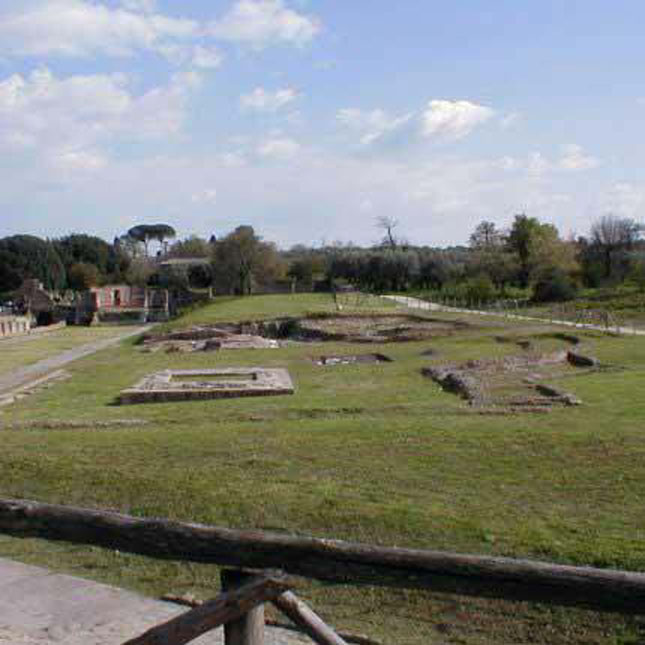
No one was paying any attention to what appeared to be a barren field between the baths and the Canopus. There was no sign indicating that this was the very heart of Hadrian's Villa, the most sacred part of the complex.

The ANTINOEION — the Temple of Antinous.

This was where the OBELISK OF ANTINOUS originally stood. This is possibly where the Lost Tomb of Antinous is located.

The Antinoeion is adjacent to the curving entry pathway. It is the spiritual cornerstone of Hadrian's Villa.

"It was the first thing that anyone saw as they approached," Antonius said with a smile reflecting the satisfaction that Hadrian must have felt. "He made them acknowledge Antinous as a God."

Despite repeated promises by curators of the Villa to erect a sign, there is nothing to mark the sprawling temple complex which may yet conceal the Lost Tomb of Antinous.

Antonyus stood for a long time at the low fence which cordons off the area. To the other tourists, it was just a barren field with a few remnants of marble marking foundations of a few buildings and a plinth where an obelisk may have stood.

But for Antonius, this was Sacred Ground. This was where the Ancient Priests of Antinous had laid down the precepts of a beautiful new religion based on tolerance, love and beauty. This was where Hadrian himself came to commune with his Beloved.

A cool breeze wafted across the field, bringing with it the scent of late summer roses, pine and cedar and the sound of cicadas in the olive trees beyond the field, only a portion of which has been excavated in very recent years.

The rest of the weed-overgrown field is a ripple of mounds of earth. Or are these mounds actually the remains of still more structures, possible the Lost Tomb itself?

"There has to be much more buried under there," Antonius said. "There just has to be."

Click here to join Antonius on his tour of Hadrian's Villa:


Thursday, September 10, 2026

GAY TEEN MARTYR JOÃO ANTÔNIO DONATI
FIRST BRAZILIAN SAINT OF ANTINOUS


ON September 10th we remember the brutal mutilation murder of a gay teenager on this date in 2014 in Brazil ... the first official saint of Antinous in Brazil.

The death of 18-year-old JOÃO ANTÔNIO DONATI galvanized worshipers of Antinous into proclaiming him the first martyr saint of Antinous in Brazil.

His severely beaten body was found in the city of Inhumas in the state of Goiás with his neck fractured and both legs broken and with his mouth and trachea stuffed with a plastic bag and a paper note, on which had been scrawled an anti-gay hate message saying that this is what should happen to all queers.

His horrific bruises, lacerations and contusions showed that he had put up a desperate struggle against his attackers.

On the same day that João was killed, two other gays were beaten and a transvestite was murdered in the same state. But the images of João's smiling Facebook selfies instantly touched the hearts of millions.


Outrage swept the nation, with protest marches and vigils held in numerous cities.

Brazil has the largest Antinous faith community in the non-English speaking world, and adherents of Antinous have taken the unprecedented move of proclaiming João the first Saint of Antinous in Brazil. 

Brazilian Novitiate Priest DECO RIBEIRO says more than 300 LGBTIU victims of homophobic murders were reported in Brazil in 2015 alone, though the true figure is unknown.

"Hundreds more have died since then," says Deco. "Each and every one of these is a martyr who is symbolized by João Antônio Donati. He was a vibrant young man filled with all the hopes and dreams of so many his age, and who became yet another victim of homophobia in Brazil, and who so deeply touched us that we have been moved to initiate something in our country that has long been in the offing: the Declaration of Apotheosis and canonization of the martyrs of homophobia in Brazil."

Noting that anti-gay hate crimes and murders are frequent in Brazil, Deco says: "This is the first statement and official nomination amid many others that will follow continuously over time honoring the names of many victims who have died in the past and who inevitably will be murdered in the future."


He adds, "We are setting out upon a long and arduous road which will entail hard battles for criminalization of homophobia in a country that has become increasingly Christo-Fascistic, homophobic and intolerant in a grotesque throwback of catastrophic and irreparable proportions. This is a turning point in history."

At the Hollywood Temple of Antinous, the founder of the modern religion of Antinous, ANTONIUS SUBIA, says:

"My prayer goes out to Antinous to take João Donati into his embrace, to give him a place of glory and bliss and show him that the world is not merely a place of hatred and violence, but that love still exists here.  

"May his short beautiful life prove to be a changing point for Brazil, may his violent death awaken his country to the darkness and hatred that has infiltrated their society.  May he be a martyr whose violent death brings an end to such things in the future," Antonius said in the statement issued moments ago.

After João's death, his FACEBOOK page was filled with messages of condolence. 

A month before his murder, he updated his profile image with the accompanying message: "Determination, courage and self-confidence are decisive factors for success.

"No matter what obstacles and difficulties. If we are possessed of an unwavering determination, we will be able to overcome them."

Though Brazil passed same-sex marriage into law in May 2014, homophobic attacks and transphobic attacks are still common.

Tuesday, September 8, 2026

HOW WOULD YOU RESPOND
IF YOU SAW ANTINOUS TODAY?


FLAMEN Antonius Subia likes to ask new dedicants of Antinous this question:


"If you encountered Antinous right here in your midst today, how would you react? Would you believe it was H.I.M? Or would you say it couldn't be true?"

That is why we love this painting by one of our favorite artists, ANDRÉ DURAND.

He entitles it "The Disciples of Emmaus" from a biblical verse about two men who are so busy talking about the death of Jesus that they fail to recognize him walking towards them on the road to the village of Emmaus.

They "believe in" the promise of eternal life.

But they do not "really believe" that it is possible ... even when they see it with their own eyes.

We are in the midst of the greatest turning point in human history since the discovery of fire … you hold it in the palm of your hand as you scroll your smart phone's apps.

Look around yourself and you see people so engrossed in the the magical world of their smart phones that they are unaware of the magic happening all around them.

It is the same with HOMOTHEOSIS … Gay-Man-Godliness-Becoming-The-Same. Many people "believe in" becoming one with Antinous. But they don't "really believe" it is possible.

Antonius has always believed that a "New Antinous" may already have been born ... or soon will be. He won't be the same "Old Antinous". He will be the Antinous we gay men need in the 21st Century.

Antonius always asks the question to prospective new priests, "Would you recognize Antinous if you were to see him on the street today? And if so, how would you respond?"

Do you "believe in" ... or do you "really believe"? A very good question.

Sunday, August 30, 2026

ANTINOUS WORSHIPERS WORLDWIDE
TAKE PART IN LION HUNT CEREMONIES


ANTINOUS worshipers worldwide participated live online tonight in ceremonies commemorating the SACRED LION HUNT, the final recorded event in the brief life of Antinous ... when he and Hadrian slew a man-eating lion in Egypt in August of the year 130 AD.

Worshipers on both coasts of North America as well as worshipers in South America, Europe and Africa took part in the ceremonies originating at the Hollywood Temple of Antinous.


The skin art image shows Antinous subduing the man-eating Marousian lion in the Egyptian desert in the year 130 AD.

The SACRED LION HUNT was immortalized in poetry and in stone, showing Antinous brashly attacking the lion with his adamantine-tipped spear and wounding it ... so that Hadrian had to gallop to his rescue and dispatch the beast.

Hadrian added medallions to the Arch of Constantine showing him and Antinous with feet on the lion's neck and also making sacrifice to the great lion-killer Hercules.

Soon legend would have it that scarlet-red lotus blossoms had sprung forth from the pool of the lion's blood ... which we honor as the LOTUS MOON, the Pisces Third Quarter Moon in June.

Within a few short weeks after the Sacred Lion Hunt, Antinous himself would be dead. The Sacred Lion Hunt is the last recorded event in His short life.

Flamen ANTONIUS SUBIA celebrated the liturgical ritual in Hollywood.

Antonius noted that the brave may not live forever, but the cautious do not live at all. Tonight's rituals and meditations were aimed at enabling participants to traverse the road between who they think they are and who they can be. The key is to set forth on the journey ... with adamantine-tipped spear in hand ... galloping forward.

Monday, August 24, 2026

THE HISTORY OF THE ROSY LOTUS
OF ANTINOUS THE GAY GOD


When Emperor Hadrian visited Alexandria,
the poet Pancrates presented him
with a beautiful lotus flower.


Awestruck by the magnificent rosy-red petals,
Hadrian agreed to name the flower
after his beloved Antinous.


Drawings by Julien


Beautiful CG Art by Antonius Subia


Music by Kevin MacLeod


For more info: THE TEMPLE OF ANTINOUS

Friday, August 21, 2026

THE SACRED LION HUNT


ON the 21st of August, with the Sun in the final degrees of Leo the Lion, we commemorate the Sacred Lion Hunt ... when Hadrian and Antinous slew a man-eating lion in Egypt in August 130 AD.

Priests of Antinous celebrate the event in with ritual ceremonies at the Hollywood Temple of Antinous which also see worshipers participating live online from North and South America, Europe and Africa.

During the special ceremonies they also honor the Sacred Rosy Lotus of Antinous ... the pink waterlily said to have sprung forth spontaneously from the lion's blood as it splattered the banks of the Nile.


Flamen Antonius Subia relates in vivid detail the events of the Sacred Lion Hunt: The place is Egypt, somewhere in the rocky wilderness between the scattered oases southeast of Alexandria. 

The time is August of the Year 130 AD. The Sun is poised to enter the Sign of Leo. The Constellation of Aquila the Eagle is at its zenith in the nighttime sky ... just as it is now.

It is the constellation of the Emperor. And the Emperor and his Beloved are touring Egypt when they hear grisly accounts of a man-eating lion marauding the countryside on the edge of the cultivated land. The "Marousian Lion" it was called.

They lead a hunting expedition out into the wilderness. The whole expedition is rife with symbolism from the start since the Sun is in Leo in the daytime skies and the Eagle is soaring in the nighttime skies and the Ancients believed killing lions was tantamount to defeating death itself. Lion hunting was the sport of kings.

When at last the Imperial party flushes out the man-eater, the huntsmen and archers stand back and leave Hadrian to close in on the beast with his steed. Hadrian has just got off an arrow which wounds the animal when, all of a sudden, out of nowhere, young Antinous rides ahead, his reins in his left hand, an adamantine-tipped lance in his upraised right hand.

As the Imperial retinue looks on in horror, the snarling lion charges toward the boy, causing his panicked horse to whinny and wheel about in terror. But Antinous maintains his balance and, instantly judging distance and angle, sends his lance sailing towards the lion as it quickly closed the gap between them. 

The lance slams into its rear flank, inflicting a serious but not fatal wound. Enraged even more, the lion uses its fangs to pull out the lance and charges anew against the Boy who is fumbling with his quiver to ready a shot with his bow. But an arrow is already in the air from behind Antinous, and it whizzes past his ear and hit its mark in the throat of the lion.

It has been fired by Hadrian, who is approaching at full gallop and who, even while the first arrow was still in the air, had already readied a second arrow, which this time penetrates both lungs.

The lion spins about and collapses writhing in the dust, rage in its eyes, blood and saliva guttering from its fanged mouth, gasping for breath as it struggles to get to its feet — because Antinous has dismounted and is sprinting toward it with a drawn dagger.

Hadrian draws his steed to a halt and dismounts with an agility and  lightness befitting a man half his age, fueled by adrenaline and alarm for his Beloved Boy, who faces imminent peril from the mortally wounded lion, still capable of severing an artery with one swipe of its mighty paw.

Hadrian draws his hunting axe from his belt and holds it high as he  lunges onto the lion's back and dispatches the beast with one powerful blow which splits its skull in two with a frightening crack and a spurt of bright red blood which bathes both the older man, now panting and perspiring heavily, and the younger man who still shows no visible expression of concern, just a wild-eyed look of excitement in his eyes, as if he never realized the danger he had been in — as if he thinks he is immortal.

A cheer goes up from the coterie of onlookers when they realize the lion is dead, killed seemingly by a single blow from the Emperor's hand. Courtiers whose eyes are unskilled in the ways of hunting will later claim Hadrian had struck the lion dead with a club.

As soldiers and nervous bodyguards rush forward to make sure everything is all right, the emperor, his adrenalin-strength ebbing as quickly as it came, shakily wraps a blood-spattered arm around Antinous and plants his gilded, spike-soled sandal on the dead animal's neck and nods to Antinous to do the same.

There they stand, bathed in blood and bathed in the adulation of the Imperial coterie, each with one foot on the vanquished man-eater as the animal's blood spreads out and covers the surrounding rocks and sand and a few scrubby wildflowers growing from a crevice in a rock.

Even the flowers are splattered with blood. And these red blossoms  will be plucked by members of the entourage to take back as souvenirs to show to envious courtiers who had not been invited along.

THE SACRED LION HUNT was immortalized in poetry and in stone, with Hadrian adding medallions to the Arch of Constantine showing him and Antinous with feet on the lion's neck and also making sacrifice to the great lion-killer Hercules.


Soon legend would have it that scarlet-red lotus blossoms had sprung forth from the pool of the lion's blood, the lion which had been brought down by Antinous and which had been dealt its death blow by Hadrian — the SACRED RED LOTUS.

Under the Sign of Leo. And under the Constellation of the Eagle. 

Within a few short weeks, Antinous himself would be dead. The Sacred Lion Hunt is the last recorded event in His short life.

And some time afterward, grieving Hadrian would look up into the  nighttime skies with tear-filled eyes and his court astronomers would point out a New Star which had appeared in the southern part of the Constellation of Aquila the Eagle.

The New Star would be interpreted as a celestial sign that Antinous had been raised to the firmament, that the Constellation of the Imperial Eagle had been joined by the CONSTELLATION OF ANTINOUS. It was a sign that Antinous was now a God.

If you go outside tonight and peer out into the darkness with all its deep and hidden dangers, remember Antinous and how he peered out into the barren wilderness with all its deep and hidden dangers. 

He charged forth, his bridle-reins in his left hand and an adamantine-tipped lance in his right, and he faced death unafraid.

For Antinous knew he was immortal.

The Constellation of Antinous, still under the wing of the Imperial Eagle, will be right directly over your head tonight ... shining proof that Antinous is a God and that he is indeed immortal.


Don't look out into the darkness around you and be afraid. Instead, look up and remember the Beloved Boy, who was a fearless hunter, who stalked death itself, and who emerged victorious over it.

Tuesday, August 11, 2026

LEGIONS PROCLAIM HADRIAN EMPEROR
A TURNING POINT IN LGBT HISTORY


ON August 11th 117 AD, the Legions proclaimed Hadrian as successor to Trajan to become Emperor of Rome ... a major turning poing in LGBT history. 

While on campaign in Nikomedia, capital of Bithynia, Hadrian receives word that Trajan unexpectedly died on August 8th.

He learns that Trajan's "deathbed will" named him as the emperor's adopted son and successor. It is the de facto accession of Hadrian as emperor of Rome.

It is believed that Trajan's wife, the Empress Plotina (who adored Hadrian), forged the will of her husband, naming Hadrian as successor. 

Whatever happened, the Legions proclaimed Hadrian emperor on August 11th.

The support of the army insured the validity of our Emperor's claim, ushering in the Sacred and Golden Age of the Antonines, the dynasty of peaceful and wise emperors which would end with Marcus Aurelius. 

Our own FLAMEN ANTINOALIS ANTONIUS SUBIA explains what this means to gay men everywhere:

"Hadrian became Emperor over Rome at the pinnacle of her glory. Her boundaries stretched farther than ever before; farther than they ever would again. Millions of people were subject to his authority. As Emperor, Hadrian first made peace with the Parthians, surrendering some of the land that Trajan had occupied, and then began the work of consolidating the Empire from the inside. We celebrate the Accession of Hadrian as the miracle that might never have been, without which Antinous would never have been known, and our religion would never have been born. Hadrian is Our Father, Our Emperor and Our Capitoline God, we recognize on this day that the beginning of his age is the beginning of our own."

On August 11th, please take a moment to remember the day on which Hadrian's long and heartfelt dreams and ambitions became reality and the path was paved for him to begin work on creating a civilization based on Hellenistic tolerance — and above-all his dream of founding the perfect religion based on love and beauty.

May the Divine Hadrian help us all achieve our heartfelt dreams and ambitions in this regard.

Saturday, August 1, 2026

ANTINOUS AND HADRIAN ENTER
THE GOLDEN CITY OF ANTIOCH


ANTIOCH was called the "golden" city because of its wealth and gilded architecture and statuary.

On August 1st the Religion of Antinous commemorates the entry of Hadrian and Antinous into Antioch. It was founded by one of the generals of Alexander the Great, who reportedly had camped on the site and said it would be a good location for a great city.

Indeed it was, and Antioch rivaled Alexandria as the most important city in the Eastern Empire.

The emperors preferred Antioch. Julius Caesar visited the city. Tiberius and others showered favors on Antioch because it was far more strategically important than Alexandria.

Alexandria was between the desert and the sea. Antioch was at the crossroads of major trading routes and military roads.

Antioch was a pure Hellenistic city refounded by Augustus in 25 BC as a Roman colony. Hadrian felt very much at home here in this Hellenistic atmosphere.

Antioch was to be the base of Hadrian's Imperial administration until early spring of 130. This prolonged stay was spent visiting the regions of Syria. Starting with Antioch, the whole atmosphere of the Imperial Tour began to change. Antioch is a turning point.

Unlike the cities of Asia Minor, which had opened their hearts to Hadrian and proclaimed him a living god, the people of Antioch were cold and critical of Hadrian's policies.

The large Jewish population resisted the policies of Hellenization, which Hadrian promoted. They would not cooperate with the new religious order of unity, and condemned the whole effort as blasphemous.

The Christians were equally seditious, and defiant. They were disgusted by the presence of Antinous by the side of the Emperor, and called the whole affair an abomination. 


Antioch was the center of Christianity in the ancient Roman world. It had been the base from which Paul the Apostle operated, and was considered to be his seat. 

It was from Antioch that Paul wrote the Epistle to the Romans that is now part of the Bible, which specifically forbids and condemns homosexuality, and thereby dictates the position of the Christian religion on same-sex love (a position never taken by Jesus).

Flamen ANTONIUS SUBIA explains the significance of the visit to Antioch:

"Antioch represents the enemies of homosexuality as embodied by the Apostle Paul. It was here that Hadrian and Antinous first discovered that their love was considered to be unholy, a reality that was to over cloud the religion of Antinous and of same-sex love for centuries to come.

"We observe that when Antinous entered Antioch, the darkness of hatred for homosexuality was born. Our enemies in the Christian Church took inspiration from the beauty of Antinous and used his deification as a weapon for our destruction. It was in Antioch that homosexuality was crucified.

"We lament the misery brought against our kind, and we remember those countless souls who were brutalized and murdered for our cause, and for our form of Love. Through Antinous, upon whom the hatred of Antioch fell, we pray for salvation as we enter the second year of the Sacred Peregrination. "


Antioch today is a pile of ruins ... periodic earthquakes have taken their toll on the Roman forum and the beautiful marble palace where Hadrian and Antinous resided in August of the year 129. The tremors of their tour of the Eastern Empire sent shock waves which reverberate to this very day.