Showing posts with label anubis. Show all posts

Monday, August 31, 2026

ANTINOUS ENABLES YOU TO DISCOVER
THE INTELLIGENCE OF THE HEART


IN ancient times, Antinous was known as a miracle worker. His worshipers prayed to him for miracles, oracles, visions and answers to problems in their daily lives.

The Egyptian hieroglyphs on the OBELISK OF ANTINOUS state clearly that Antinous answers the prayers of all who call upon him through dreams and visions, for example.

The hieroglyphs also make cryptic references to his ability to work magic through his heart. This is a reference to the Ancient Egyptian concept of the "Intelligence of the Heart."

The Egyptians knew that the brain is the center of motor activity and sensory perception. But they believed the heart is the center of a form of intelligence which has baffled most mainstream Egyptologists ... who assume the Egyptians believed the heart was where cognitive thinking occurs.

But the Egyptians had a very different view of the universe from our rational, scientific view of the universe. We dissect facts and analyze them. But while the Egyptians were very good at analyzing facts, they also retained the Zen-like ability to see the whole ... which leads to contemplation ... not analysis.

The Egyptians understood that if you want to find an intelligent solution to a problem, your brain can do the work. You have all the necessary intelligence inside the bone in your skull.

However, most people use their brains the same way they use their muscles. You can strain your head just as if it were a muscle, and work very hard trying to arrive at an answer, but it doesn't really work that way.

When you really want to find an answer to something, what you need to do is contemplate the problem. Visualize your question as well as you can, and then simply wait.

If you don't, and if you instead try to find the solution through brute mental strength, you may be disappointed, because any solution that comes in that way is likely to be wrong.


But when you have waited for a while, the solution will come of itself. That is what the Egyptians called the Intelligence of the Heart ... using your heart instead of your head.

It will work for you in the same way your stomach will digest your food for you without your having to supervise it consciously. Our attempts to supervise everything consciously have all led to consequences that aren't too good for our stomach, and the reason for that is quite simple.

Conscious attention, which employs words, cannot think of very much. We are forced, therefore, to ignore almost everything while we are thinking. We think along a single track, but the world doesn't proceed along a single track.

The world is everything happening altogether everywhere, and you just can't take all that into consideration because there isn't time.

However, the Intelligence of the Heart can take it all into consideration because it is capable of handling innumerable variables at once, even though your conscious attention cannot...


The hieroglyphs on the Obelisk of Antinous promise that Antinous the Gay God enables us to discover the Intelligence of the Heart ... the Intelligence of HIM ... he opens his heart to you .... 

Wednesday, August 26, 2026

NINE MILLION MUMMIFIED DOGS
FOUND AT EGYPTIAN TEMPLE OF ANUBIS


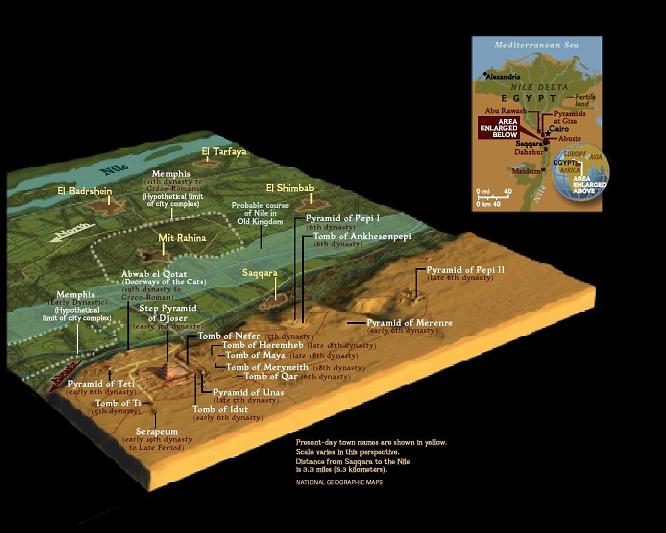
AS Antinous and Hadrian journeyed up the Nile in August and September of 130 AD, they must have seen the mighty monuments at Memphis ... and the sprawling cliffside ANUBIEION, the mystery-shrouded Temple of the jackal-headed Egyptian deity Anubis at Saqqara south of modern Cairo.

But was Antinous aware that nine million dog mummies were entombed there?

The unique, terraced temple compound was built into the face of the cliffs overlooking the ancient Egyptian capital city of Memphis-Mennefer. Beyond the Anubieion lay the necropolis city of the dead. In front of it lay the teeming city nestled in the Nile Valley.

For decades, experts were unsure what purpose the Anubieion served. No where else in Egypt is there a temple dedicated solely to Anubis. Some temples to other deities had niche shrines to the jackal-headed deity who conveyed the souls of the dead to everlasting life.

But the discovery of myriads of mummified dogs in the Anubieion's catacombs makes it clear that the Anubieion was indeed a temple whose goal was to assist people in making the transition from earthly life to eternal life.

The dog mummies were sold to serve as "guide dogs" for souls of the departed.

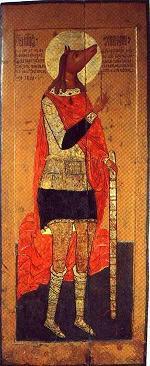
As Christianity spread in Egypt, Anubis morphed into St. Christopher ... and many early Coptic images of Saint Christopher depict him with the head of a dog (image at left).

The discovery came during routine excavations at the dog catacomb in Saqqara necropolis by an excavation team led by Salima Ikram, professor of Egyptology at The American University in Cairo (AUC), and an international team of researchers led by Paul Nicholson of Cardiff University.

Initial inspection reveals that dogs of all breeds and ages were mummified, from newborn puppies to decrepit old dogs.

“We are recording the animal bones and the mummification techniques used to prepare the animals,” Ikram said.

Ikram also told National Geographic, which is financing the project, that "in some churches people light a candle, and their prayer is taken directly up to God in that smoke. In the same way, a mummified dog's spirit would carry a person's prayer to the afterlife".

Saqqara dog catacomb was first discovered in 1897 when well-known French Egyptologist Jacques De Morgan published his Carte of Memphite necropolis, with his map showing that there are two dog catacombs in the area.

However, mystery has overshadowed such mapping as it was not clear who was the first to discover the catacombs nor who carried out the mapping, and whether they were really for dogs.

"The proximity of the catacombs to the nearby temple of Anubis, the so called jackal or dog-headed deity associated with cemeteries and embalming, makes it likely that these catacombs are indeed for canines and their presence at Saqqara is to be explained by the concentration of other animal cuts at the site," Nicholson wrote on his website.

"These other cults include the burials of, and temples for, bulls, cows, baboons, ibises, hawks and cats all of which were thought to act as intermediaries between humans and their gods."


Despite the great quantity of animals buried in these catacombs and the immense size of the underground burial places, Egyptologists have focused on the temples and on inscriptional evidence rather than on the animals themselves.

The mysteries behind De Morgan's mapping were unsolved until 2009 when this team started concrete excavations at the cemetery in an attempt to learn more about the archaeological and history of the site.

"Results at the first season showed that De Morgan map has substantial inaccuracies and a new survey is under way," Nicholson said.


"The animal bones themselves have been sampled and preliminary results suggest that as well as actual dogs there may be other canids present. Furthermore the age profile of the animals is being examined so that patterns of mortality can be ascertained."

Monday, January 19, 2026

THE GOING FORTH OF ANUBIS


ON January 20th is the Ancient Egyptian Feast of "The Going Forth of Anubis" (Yinepu) when his statues are carried through the streets for worshipers to honor ... in hopes that Anubis will convey them through the darkness of death to eternal light and life. 

This feast occurs between the completion of the mummification of Antinous on January 11th and the birthday of Hadrian on January 24th.

Anubis leads the new god Antinous to the Home of the Gods amongst the Imperishable Stars.

Wednesday, October 22, 2025

SOME MODERN ANTINOUS WORSHIPERS
PURCHASE NEWSPAPER DEATH NOTICES


LATE October is the time of the Sacred Nights of Antinous ... culminating with the death and deification of Antinous.

In the modern religion of Antinous, we commemorate the Death of Antinous on 28 October ... but many scholars and Antinous adherents believe 22 October may have been the date.

Some faithful worshipers purchase obituary death notices in newspapers on the anniversary, such as the one above.

The death notice at the left was published in the Camden New Journal on 17 October 2013.

The exact date is uncertain. 

All we know for certain is that his death occurred in the final week of October during a visit to Egypt with Emperor Hadrian in the year 130 AD. 

Near the Egyptian village of Hir-wer, Antinous fell into the Nile and drowned. Antonius Subia says:

"Antinous fell into the Nile, beneath the swirling waves, but when his body was pulled from the water ... a God emerged. Antinous is our God, he has accomplished the salvation of all lovers of his beauty. His is our salvation. He is Antinous the Gay God. He is the last pagan God of Classical Rome."

Saturday, August 30, 2025

ANTINOUS ENABLES YOU TO DISCOVER
THE INTELLIGENCE OF THE HEART


IN ancient times, Antinous was known as a miracle worker. His worshipers prayed to him for miracles, oracles, visions and answers to problems in their daily lives.

The Egyptian hieroglyphs on the OBELISK OF ANTINOUS state clearly that Antinous answers the prayers of all who call upon him through dreams and visions, for example.

The hieroglyphs also make cryptic references to his ability to work magic through his heart. This is a reference to the Ancient Egyptian concept of the "Intelligence of the Heart."

The Egyptians knew that the brain is the center of motor activity and sensory perception. But they believed the heart is the center of a form of intelligence which has baffled most mainstream Egyptologists ... who assume the Egyptians believed the heart was where cognitive thinking occurs.

But the Egyptians had a very different view of the universe from our rational, scientific view of the universe. We dissect facts and analyze them. But while the Egyptians were very good at analyzing facts, they also retained the Zen-like ability to see the whole ... which leads to contemplation ... not analysis.

The Egyptians understood that if you want to find an intelligent solution to a problem, your brain can do the work. You have all the necessary intelligence inside the bone in your skull.

However, most people use their brains the same way they use their muscles. You can strain your head just as if it were a muscle, and work very hard trying to arrive at an answer, but it doesn't really work that way.

When you really want to find an answer to something, what you need to do is contemplate the problem. Visualize your question as well as you can, and then simply wait.

If you don't, and if you instead try to find the solution through brute mental strength, you may be disappointed, because any solution that comes in that way is likely to be wrong.


But when you have waited for a while, the solution will come of itself. That is what the Egyptians called the Intelligence of the Heart ... using your heart instead of your head.

It will work for you in the same way your stomach will digest your food for you without your having to supervise it consciously. Our attempts to supervise everything consciously have all led to consequences that aren't too good for our stomach, and the reason for that is quite simple.

Conscious attention, which employs words, cannot think of very much. We are forced, therefore, to ignore almost everything while we are thinking. We think along a single track, but the world doesn't proceed along a single track.

The world is everything happening altogether everywhere, and you just can't take all that into consideration because there isn't time.

However, the Intelligence of the Heart can take it all into consideration because it is capable of handling innumerable variables at once, even though your conscious attention cannot...


The hieroglyphs on the Obelisk of Antinous promise that Antinous the Gay God enables us to discover the Intelligence of the Heart ... the Intelligence of HIM ... he opens his heart to you .... 

Tuesday, August 26, 2025

NINE MILLION MUMMIFIED DOGS
FOUND AT EGYPTIAN TEMPLE OF ANUBIS


AS Antinous and Hadrian journeyed up the Nile in August and September of 130 AD, they must have seen the mighty monuments at Memphis ... and the sprawling cliffside ANUBIEION, the mystery-shrouded Temple of the jackal-headed Egyptian deity Anubis at Saqqara south of modern Cairo.

But was Antinous aware that nine million dog mummies were entombed there?

The unique, terraced temple compound was built into the face of the cliffs overlooking the ancient Egyptian capital city of Memphis-Mennefer. Beyond the Anubieion lay the necropolis city of the dead. In front of it lay the teeming city nestled in the Nile Valley.

For decades, experts were unsure what purpose the Anubieion served. No where else in Egypt is there a temple dedicated solely to Anubis. Some temples to other deities had niche shrines to the jackal-headed deity who conveyed the souls of the dead to everlasting life.

But the discovery of myriads of mummified dogs in the Anubieion's catacombs makes it clear that the Anubieion was indeed a temple whose goal was to assist people in making the transition from earthly life to eternal life.

The dog mummies were sold to serve as "guide dogs" for souls of the departed.

As Christianity spread in Egypt, Anubis morphed into St. Christopher ... and many early Coptic images of Saint Christopher depict him with the head of a dog (image at left).

The discovery came during routine excavations at the dog catacomb in Saqqara necropolis by an excavation team led by Salima Ikram, professor of Egyptology at The American University in Cairo (AUC), and an international team of researchers led by Paul Nicholson of Cardiff University.

Initial inspection reveals that dogs of all breeds and ages were mummified, from newborn puppies to decrepit old dogs.

“We are recording the animal bones and the mummification techniques used to prepare the animals,” Ikram said.

Ikram also told National Geographic, which is financing the project, that "in some churches people light a candle, and their prayer is taken directly up to God in that smoke. In the same way, a mummified dog's spirit would carry a person's prayer to the afterlife".

Saqqara dog catacomb was first discovered in 1897 when well-known French Egyptologist Jacques De Morgan published his Carte of Memphite necropolis, with his map showing that there are two dog catacombs in the area.

However, mystery has overshadowed such mapping as it was not clear who was the first to discover the catacombs nor who carried out the mapping, and whether they were really for dogs.

"The proximity of the catacombs to the nearby temple of Anubis, the so called jackal or dog-headed deity associated with cemeteries and embalming, makes it likely that these catacombs are indeed for canines and their presence at Saqqara is to be explained by the concentration of other animal cuts at the site," Nicholson wrote on his website.

"These other cults include the burials of, and temples for, bulls, cows, baboons, ibises, hawks and cats all of which were thought to act as intermediaries between humans and their gods."


Despite the great quantity of animals buried in these catacombs and the immense size of the underground burial places, Egyptologists have focused on the temples and on inscriptional evidence rather than on the animals themselves.

The mysteries behind De Morgan's mapping were unsolved until 2009 when this team started concrete excavations at the cemetery in an attempt to learn more about the archaeological and history of the site.

"Results at the first season showed that De Morgan map has substantial inaccuracies and a new survey is under way," Nicholson said.


"The animal bones themselves have been sampled and preliminary results suggest that as well as actual dogs there may be other canids present. Furthermore the age profile of the animals is being examined so that patterns of mortality can be ascertained."

Sunday, January 19, 2025

THE GOING FORTH OF ANUBIS


ON January 20th is the Ancient Egyptian Feast of "The Going Forth of Anubis" (Yinepu) when his statues are carried through the streets for worshipers to honor ... in hopes that Anubis will convey them through the darkness of death to eternal light and life. 

This feast occurs between the completion of the mummification of Antinous on January 11th and the birthday of Hadrian on January 24th.

Anubis leads the new god Antinous to the Home of the Gods amongst the Imperishable Stars.

Tuesday, October 22, 2024

SOME MODERN ANTINOUS WORSHIPERS
PURCHASE NEWSPAPER DEATH NOTICES


LATE October is the time of the Sacred Nights of Antinous ... culminating with the death and deification of Antinous.

In the modern religion of Antinous, we commemorate the Death of Antinous on 28 October ... but many scholars and Antinous adherents believe 22 October may have been the date.

Some faithful worshipers purchase obituary death notices in newspapers on the anniversary, such as the one above.

The death notice at the left was published in the Camden New Journal on 17 October 2013.

The exact date is uncertain. 

All we know for certain is that his death occurred in the final week of October during a visit to Egypt with Emperor Hadrian in the year 130 AD. 

Near the Egyptian village of Hir-wer, Antinous fell into the Nile and drowned. Antonius Subia says:

"Antinous fell into the Nile, beneath the swirling waves, but when his body was pulled from the water ... a God emerged. Antinous is our God, he has accomplished the salvation of all lovers of his beauty. His is our salvation. He is Antinous the Gay God. He is the last pagan God of Classical Rome."

Monday, September 30, 2024

ANTINOUS IN MENNEFER (MEMPHIS)
ANCIENT CAPITAL OF EGYPT


WE have arrived at the eve of the most sacred month of our Liturgical Calendar, the month of October when Antinous the mortal died beneath the waves of the Nile during a tour of the Eastern Provinces which had started out as the crowning glory of the reign of Emperor Hadrian, but which quickly descended into disaster.

By the end of October, Antinous would be dead and Hadrian would be a changed man. 

Up until this turning point, his rule had been marked by Hellenistic tolerance and diplomacy. 

From this point onward, the emperor became increasingly capricious and unpredictable.


Just imagine those last few weeks in September and October of the year 130. Hadrian and Antinous had visited Alexandria. They had marvelled at the towering lighthouse. 


Perhaps, in his youthful exuberance, Antinous had even scaled the lighthouse to get a spectacular view from the top.

They would have visited the Tomb of Alexander the Great and have  marvelled at the rock crystal sarcophagus containing the body of the young man who had conquered the world by the time he was just a little over half Hadrian's age.

That's assuming the Tomb of Alexander was still located in Alexandria in the year 130. Like the Tomb of Antinous, no one knows the whereabouts of Alexander's Tomb.

That would have been a recurring theme during their travels through Egypt: The plundering of the tombs of Egyptian rulers.

Hadrian and Antinous would have gazed in awe at the Sphinx and the Pyramids, which were already incredibly old even then. The Great Pyramid was 2,500 years old THEN! (With apologies to John Anthony West who believes the Sphinx, at least, could be many thousands of years older than that.)

And those monuments had long since been plundered. The Sphinx had undergone "restoration" work more than 1,000 years before Hadrian and Antinous saw it.

At the Egyptian capital of Memphis, called Mennefer by the Egyptians, they would have scaled the cliffs on the western fringes of the huge city to visit the famous Step Pyramid of Djoser designed even before the Great Pyramid by the fabled man of science and art known as Imhotep, who himself was deified after death, just as Antinous soon would be. Another ancient name for the city was Ineb-hedj, meaning White Walls" or White Fortress.

Everyone scaled those cliffs to look out over the city and the Nile and the sprawling Temple of Ptah compound -- The House of the Ka of Ptah (Ha-Ka-Ptah), which was so famous, so synonymous with the Land of the Nile that it became the name used by tourists for the land itself: Hakaptah, Aegypto, Egypt.

It must have been spectacular. It must have been one of those things  that all tourists do. In London you see Big Ben and the Tower. In San Francisco you see the Golden Gate. In Paris, the Eiffel Tower. In ancient Memphis Egypt, you climbed the western cliffs for the view across that marvelous city of gleaming-white temples and palaces.

The city is gone -- or rather, the city has been uprooted and moved, stone-for-stone a few miles down-river. Memphis, the capital of Egypt, never ceased to exist. It just morphed into Cairo.

The view from the cliffs is still spectacular. To the east is the verdant valley where the ruins of the once-mighty city lie strewn among date palm orchards. This is the city from which the name PHARAOH comes, PER-AWU (Two Great Gates). It refers to Pharaoh's palace double-doors, through which the Living God-King (Hadrian for example) emerged on occasion for the public to see.

To the west lies the desert and the city of the dead. You look across rippling sand dunes and stony mounds and your jaw drops as you realise those aren't sand dunes -- they are the remnants of tomb and mortuary monuments large and small, thousands of them stretching as far as the eye can see.


Like the Step Pyramid, many of those tombs had been plundered by the time Hadrian stood there, taking in the scene.

To the south lie the hot lands of the source of the Nile. Still more pyramids dot the horizon.

To the north, more pyramids and tombs. You can see the tips of the Great Pyramid and the two lesser Gizeh pyramids to the north, with a gentle and cooling north breeze blowing in your face.

You stand there in wonderment, oblivious to the urchins tugging your sleeve and trying to sell you bundles of filthy rags which they claim are "genuine old" mummified cats which you can take home as souvenirs.


You can just envision Hadrian standing there, enjoying the view of that bustling city and the ancient pyramids, and smiling to himself as he glanced over and saw Antinous trying to keep his composure while being badgered by children waving blatantly fake cat mummies in his face.

Just imagine Antinous standing there in the late-afternoon sun, the north breeze tousling his hair and robes, atop those cliffs on the cusp between the verdant land of the living in the teeming valley below and the sterile and barren city of the dead on the desert plateau behind him where the sun would soon set.

We commemorate this Imperial visit to Mennefer (Memphis) on October 5th. Shortly after that date, they would have sailed on upstream to the city of Shmunu (Hermopolis), the ancient and sacred city of Thoth, the scribe god of writing who taught Isis the magical spells that she used, with the assistance of Anubis, to raise Osiris from the dead after he drowned in the Nile.

It was only across the Nile from Hermopolis that Antinous himself drowned.

All of this would have been fresh in Hadrian's mind as the grief-stricken Emperor bent over the lifeless body of his Beloved Boy.

He would have remembered how even the Egyptians, despite all their cunning and ingenuity, had been unable to create a plunder-proof tomb.

Sick with grief, what would he have done? What would you do in Hadrian's place? Would you build a showy tomb? Would you send the body back to the boy's family for cremation? Would you build a chapel and tomb at your villa outside Rome? Would you leave the remains of his beloved Antinous to be mummified and entombed on the banks of the Nile?

Wouldn't the prospect of thieves and souvenir-seekers violating his remains be so horrible to you that you would do whatever was required to prevent that? Perhaps Hadrian opted for subterfuge.

Perhaps he built great temples to Antinous for all to visit and to see. But buried his precious body in a secret place, a safe place, known only to himself. A place where no one would think of looking for him.


If that is what Hadrian did, then the LOST TOMB OF ANTINOUS may never be found.

Monday, August 26, 2024

NINE MILLION MUMMIFIED DOGS
FOUND AT EGYPTIAN TEMPLE OF ANUBIS


AS Antinous and Hadrian journeyed up the Nile in August and September of 130 AD, they must have seen the mighty monuments at Memphis ... and the sprawling cliffside ANUBIEION, the mystery-shrouded Temple of the jackal-headed Egyptian deity Anubis at Saqqara south of modern Cairo.

But was Antinous aware that nine million dog mummies were entombed there?

The unique, terraced temple compound was built into the face of the cliffs overlooking the ancient Egyptian capital city of Memphis-Mennefer. Beyond the Anubieion lay the necropolis city of the dead. In front of it lay the teeming city nestled in the Nile Valley.

For decades, experts were unsure what purpose the Anubieion served. No where else in Egypt is there a temple dedicated solely to Anubis. Some temples to other deities had niche shrines to the jackal-headed deity who conveyed the souls of the dead to everlasting life.

But the discovery of myriads of mummified dogs in the Anubieion's catacombs makes it clear that the Anubieion was indeed a temple whose goal was to assist people in making the transition from earthly life to eternal life.

The dog mummies were sold to serve as "guide dogs" for souls of the departed.

As Christianity spread in Egypt, Anubis morphed into St. Christopher ... and many early Coptic images of Saint Christopher depict him with the head of a dog (image at left).

The discovery came during routine excavations at the dog catacomb in Saqqara necropolis by an excavation team led by Salima Ikram, professor of Egyptology at The American University in Cairo (AUC), and an international team of researchers led by Paul Nicholson of Cardiff University.

Initial inspection reveals that dogs of all breeds and ages were mummified, from newborn puppies to decrepit old dogs.

“We are recording the animal bones and the mummification techniques used to prepare the animals,” Ikram said.

Ikram also told National Geographic, which is financing the project, that "in some churches people light a candle, and their prayer is taken directly up to God in that smoke. In the same way, a mummified dog's spirit would carry a person's prayer to the afterlife".

Saqqara dog catacomb was first discovered in 1897 when well-known French Egyptologist Jacques De Morgan published his Carte of Memphite necropolis, with his map showing that there are two dog catacombs in the area.

However, mystery has overshadowed such mapping as it was not clear who was the first to discover the catacombs nor who carried out the mapping, and whether they were really for dogs.

"The proximity of the catacombs to the nearby temple of Anubis, the so called jackal or dog-headed deity associated with cemeteries and embalming, makes it likely that these catacombs are indeed for canines and their presence at Saqqara is to be explained by the concentration of other animal cuts at the site," Nicholson wrote on his website.

"These other cults include the burials of, and temples for, bulls, cows, baboons, ibises, hawks and cats all of which were thought to act as intermediaries between humans and their gods."


Despite the great quantity of animals buried in these catacombs and the immense size of the underground burial places, Egyptologists have focused on the temples and on inscriptional evidence rather than on the animals themselves.

The mysteries behind De Morgan's mapping were unsolved until 2009 when this team started concrete excavations at the cemetery in an attempt to learn more about the archaeological and history of the site.

"Results at the first season showed that De Morgan map has substantial inaccuracies and a new survey is under way," Nicholson said.


"The animal bones themselves have been sampled and preliminary results suggest that as well as actual dogs there may be other canids present. Furthermore the age profile of the animals is being examined so that patterns of mortality can be ascertained."

Friday, January 19, 2024

THE GOING FORTH OF ANUBIS


ON January 20th is the Ancient Egyptian Feast of "The Going Forth of Anubis" (Yinepu) when his statues are carried through the streets for worshipers to honor ... in hopes that Anubis will convey them through the darkness of death to eternal light and life. 

This feast occurs between the completion of the mummification of Antinous on January 11th and the birthday of Hadrian on January 24th.

Anubis leads the new god Antinous to the Home of the Gods amongst the Imperishable Stars.

Sunday, October 22, 2023

SOME MODERN ANTINOUS WORSHIPERS
PURCHASE NEWSPAPER DEATH NOTICES


LATE October is the time of the Sacred Nights of Antinous ... culminating with the death and deification of Antinous.

In the modern religion of Antinous, we commemorate the Death of Antinous on 28 October ... but many scholars and Antinous adherents believe 22 October may have been the date.

Some faithful worshipers purchase obituary death notices in newspapers on the anniversary, such as the one above.

The death notice at the left was published in the Camden New Journal on 17 October 2013.

The exact date is uncertain. 

All we know for certain is that his death occurred in the final week of October during a visit to Egypt with Emperor Hadrian in the year 130 AD. 

Near the Egyptian village of Hir-wer, Antinous fell into the Nile and drowned. Antonius Subia says:

"Antinous fell into the Nile, beneath the swirling waves, but when his body was pulled from the water ... a God emerged. Antinous is our God, he has accomplished the salvation of all lovers of his beauty. His is our salvation. He is Antinous the Gay God. He is the last pagan God of Classical Rome."

Thursday, January 19, 2023

THE GOING FORTH OF ANUBIS


ON January 20th is the Ancient Egyptian Feast of "The Going Forth of Anubis" (Yinepu) when his statues are carried through the streets for worshipers to honor ... in hopes that Anubis will convey them through the darkness of death to eternal light and life. 

This feast occurs between the completion of the mummification of Antinous on January 11th and the birthday of Hadrian on January 24th.

Anubis leads the new god Antinous to the Home of the Gods amongst the Imperishable Stars.

Saturday, October 22, 2022

SOME MODERN ANTINOUS WORSHIPERS
PURCHASE NEWSPAPER DEATH NOTICES


LATE October is the time of the Sacred Nights of Antinous ... culminating with the death and deification of Antinous.

In the modern religion of Antinous, we commemorate the Death of Antinous on 28 October ... but many scholars and Antinous adherents believe 22 October may have been the date.

Some faithful worshipers purchase obituary death notices in newspapers on the anniversary, such as the one above.

The death notice at the left was published in the Camden New Journal on 17 October 2013.

The exact date is uncertain. 

All we know for certain is that his death occurred in the final week of October during a visit to Egypt with Emperor Hadrian in the year 130 AD. 

Near the Egyptian village of Hir-wer, Antinous fell into the Nile and drowned. Antonius Subia says:

"Antinous fell into the Nile, beneath the swirling waves, but when his body was pulled from the water ... a God emerged. Antinous is our God, he has accomplished the salvation of all lovers of his beauty. His is our salvation. He is Antinous the Gay God. He is the last pagan God of Classical Rome."

Friday, August 26, 2022

NINE MILLION MUMMIFIED DOGS
FOUND AT EGYPTIAN TEMPLE OF ANUBIS


AS Antinous and Hadrian journeyed up the Nile in September of 130 AD, they must have seen the mighty monuments at Memphis ... and the sprawling cliffside ANUBIEION, the mystery-shrouded Temple of the jackal-headed Egyptian deity Anubis at Saqqara south of modern Cairo.

But was Antinous aware that nine million dog mummies were entombed there?

The unique, terraced temple compound was built into the face of the cliffs overlooking the ancient Egyptian capital city of Memphis-Mennefer. Beyond the Anubieion lay the necropolis city of the dead. In front of it lay the teeming city nestled in the Nile Valley.

For decades, experts were unsure what purpose the Anubieion served. No where else in Egypt is there a temple dedicated solely to Anubis. Some temples to other deities had niche shrines to the jackal-headed deity who conveyed the souls of the dead to everlasting life.

But the discovery of myriads of mummified dogs in the Anubieion's catacombs makes it clear that the Anubieion was indeed a temple whose goal was to assist people in making the transition from earthly life to eternal life.

The dog mummies were sold to serve as "guide dogs" for souls of the departed.

As Christianity spread in Egypt, Anubis morphed into St. Christopher ... and many early Coptic images of Saint Christopher depict him with the head of a dog (image at left).

The discovery came during routine excavations at the dog catacomb in Saqqara necropolis by an excavation team led by Salima Ikram, professor of Egyptology at The American University in Cairo (AUC), and an international team of researchers led by Paul Nicholson of Cardiff University.

Initial inspection reveals that dogs of all breeds and ages were mummified, from newborn puppies to decrepit old dogs.

“We are recording the animal bones and the mummification techniques used to prepare the animals,” Ikram said.

Ikram also told National Geographic, which is financing the project, that "in some churches people light a candle, and their prayer is taken directly up to God in that smoke. In the same way, a mummified dog's spirit would carry a person's prayer to the afterlife".

Saqqara dog catacomb was first discovered in 1897 when well-known French Egyptologist Jacques De Morgan published his Carte of Memphite necropolis, with his map showing that there are two dog catacombs in the area.

However, mystery has overshadowed such mapping as it was not clear who was the first to discover the catacombs nor who carried out the mapping, and whether they were really for dogs.

"The proximity of the catacombs to the nearby temple of Anubis, the so called jackal or dog-headed deity associated with cemeteries and embalming, makes it likely that these catacombs are indeed for canines and their presence at Saqqara is to be explained by the concentration of other animal cuts at the site," Nicholson wrote on his website.

"These other cults include the burials of, and temples for, bulls, cows, baboons, ibises, hawks and cats all of which were thought to act as intermediaries between humans and their gods."


Despite the great quantity of animals buried in these catacombs and the immense size of the underground burial places, Egyptologists have focused on the temples and on inscriptional evidence rather than on the animals themselves.

The mysteries behind De Morgan's mapping were unsolved until 2009 when this team started concrete excavations at the cemetery in an attempt to learn more about the archaeological and history of the site.

"Results at the first season showed that De Morgan map has substantial inaccuracies and a new survey is under way," Nicholson said.


"The animal bones themselves have been sampled and preliminary results suggest that as well as actual dogs there may be other canids present. Furthermore the age profile of the animals is being examined so that patterns of mortality can be ascertained."

Wednesday, January 19, 2022

THE GOING FORTH OF ANUBIS


ON January 20th is the Ancient Egyptian Feast of "The Going Forth of Anubis" (Yinepu) when his statues are carried through the streets for worshipers to honor ... in hopes that Anubis will convey them through the darkness of death to eternal light and life. 

This feast occurs between the completion of the mummification of Antinous on January 11th and the birthday of Hadrian on January 24th.

Anubis leads the new god Antinous to the Home of the Gods amongst the Imperishable Stars.

Friday, October 22, 2021

SOME MODERN ANTINOUS WORSHIPERS
PURCHASE NEWSPAPER DEATH NOTICES


LATE October is the time of the Sacred Nights of Antinous ... culminating with the death and deification of Antinous.

In the modern religion of Antinous, we commemorate the Death of Antinous on 28 October ... but many scholars and Antinous adherents believe 22 October may have been the date.

Some faithful worshipers purchase obituary death notices in newspapers on the anniversary, such as the one above.

The death notice at the left was published in the Camden New Journal on 17 October 2013.

The exact date is uncertain. 

All we know for certain is that his death occurred in the final week of October during a visit to Egypt with Emperor Hadrian in the year 130 AD. 

Near the Egyptian village of Hir-wer, Antinous fell into the Nile and drowned. Antonius Subia says:

"Antinous fell into the Nile, beneath the swirling waves, but when his body was pulled from the water ... a God emerged. Antinous is our God, he has accomplished the salvation of all lovers of his beauty. His is our salvation. He is Antinous the Gay God. He is the last pagan God of Classical Rome."

Thursday, September 30, 2021

ANTINOUS IN MENNEFER (MEMPHIS)
ANCIENT CAPITAL OF EGYPT


WE have arrived at the eve of the most sacred month of our Liturgical Calendar, the month of October when Antinous the mortal died beneath the waves of the Nile during a tour of the Eastern Provinces which had started out as the crowning glory of the reign of Emperor Hadrian, but which quickly descended into disaster.

By the end of October, Antinous would be dead and Hadrian would be a changed man. 

Up until this turning point, his rule had been marked by Hellenistic tolerance and diplomacy. 

From this point onward, the emperor became increasingly capricious and unpredictable.


Just imagine those last few weeks in September and October of the year 130. Hadrian and Antinous had visited Alexandria. They had marvelled at the towering lighthouse. 


Perhaps, in his youthful exuberance, Antinous had even scaled the lighthouse to get a spectacular view from the top.

They would have visited the Tomb of Alexander the Great and have  marvelled at the rock crystal sarcophagus containing the body of the young man who had conquered the world by the time he was just a little over half Hadrian's age.

That's assuming the Tomb of Alexander was still located in Alexandria in the year 130. Like the Tomb of Antinous, no one knows the whereabouts of Alexander's Tomb.

That would have been a recurring theme during their travels through Egypt: The plundering of the tombs of Egyptian rulers.

Hadrian and Antinous would have gazed in awe at the Sphinx and the Pyramids, which were already incredibly old even then. The Great Pyramid was 2,500 years old THEN! (With apologies to John Anthony West who believes the Sphinx, at least, could be many thousands of years older than that.)

And those monuments had long since been plundered. The Sphinx had undergone "restoration" work more than 1,000 years before Hadrian and Antinous saw it.

At the Egyptian capital of Memphis, called Mennefer by the Egyptians, they would have scaled the cliffs on the western fringes of the huge city to visit the famous Step Pyramid of Djoser designed even before the Great Pyramid by the fabled man of science and art known as Imhotep, who himself was deified after death, just as Antinous soon would be. Another ancient name for the city was Ineb-hedj, meaning White Walls" or White Fortress.

Everyone scaled those cliffs to look out over the city and the Nile and the sprawling Temple of Ptah compound -- The House of the Ka of Ptah (Ha-Ka-Ptah), which was so famous, so synonymous with the Land of the Nile that it became the name used by tourists for the land itself: Hakaptah, Aegypto, Egypt.

It must have been spectacular. It must have been one of those things  that all tourists do. In London you see Big Ben and the Tower. In San Francisco you see the Golden Gate. In Paris, the Eiffel Tower. In ancient Memphis Egypt, you climbed the western cliffs for the view across that marvelous city of gleaming-white temples and palaces.

The city is gone -- or rather, the city has been uprooted and moved, stone-for-stone a few miles down-river. Memphis, the capital of Egypt, never ceased to exist. It just morphed into Cairo.

The view from the cliffs is still spectacular. To the east is the verdant valley where the ruins of the once-mighty city lie strewn among date palm orchards. This is the city from which the name PHARAOH comes, PER-AWU (Two Great Gates). It refers to Pharaoh's palace double-doors, through which the Living God-King (Hadrian for example) emerged on occasion for the public to see.

To the west lies the desert and the city of the dead. You look across rippling sand dunes and stony mounds and your jaw drops as you realise those aren't sand dunes -- they are the remnants of tomb and mortuary monuments large and small, thousands of them stretching as far as the eye can see.


Like the Step Pyramid, many of those tombs had been plundered by the time Hadrian stood there, taking in the scene.

To the south lie the hot lands of the source of the Nile. Still more pyramids dot the horizon.

To the north, more pyramids and tombs. You can see the tips of the Great Pyramid and the two lesser Gizeh pyramids to the north, with a gentle and cooling north breeze blowing in your face.

You stand there in wonderment, oblivious to the urchins tugging your sleeve and trying to sell you bundles of filthy rags which they claim are "genuine old" mummified cats which you can take home as souvenirs.


You can just envision Hadrian standing there, enjoying the view of that bustling city and the ancient pyramids, and smiling to himself as he glanced over and saw Antinous trying to keep his composure while being badgered by children waving blatantly fake cat mummies in his face.

Just imagine Antinous standing there in the late-afternoon sun, the north breeze tousling his hair and robes, atop those cliffs on the cusp between the verdant land of the living in the teeming valley below and the sterile and barren city of the dead on the desert plateau behind him where the sun would soon set.

We commemorate this Imperial visit to Mennefer (Memphis) on October 5th. Shortly after that date, they would have sailed on upstream to the city of Shmunu (Hermopolis), the ancient and sacred city of Thoth, the scribe god of writing who taught Isis the magical spells that she used, with the assistance of Anubis, to raise Osiris from the dead after he drowned in the Nile.

It was only across the Nile from Hermopolis that Antinous himself drowned.

All of this would have been fresh in Hadrian's mind as the grief-stricken Emperor bent over the lifeless body of his Beloved Boy.

He would have remembered how even the Egyptians, despite all their cunning and ingenuity, had been unable to create a plunder-proof tomb.

Sick with grief, what would he have done? What would you do in Hadrian's place? Would you build a showy tomb? Would you send the body back to the boy's family for cremation? Would you build a chapel and tomb at your villa outside Rome? Would you leave the remains of his beloved Antinous to be mummified and entombed on the banks of the Nile?

Wouldn't the prospect of thieves and souvenir-seekers violating his remains be so horrible to you that you would do whatever was required to prevent that? Perhaps Hadrian opted for subterfuge.

Perhaps he built great temples to Antinous for all to visit and to see. But buried his precious body in a secret place, a safe place, known only to himself. A place where no one would think of looking for him.


If that is what Hadrian did, then the LOST TOMB OF ANTINOUS may never be found.

Thursday, August 26, 2021

NINE MILLION MUMMIFIED DOGS
FOUND AT EGYPTIAN TEMPLE OF ANUBIS


AS Antinous and Hadrian journeyed up the Nile in September of 130 AD, they must have seen the mighty monuments at Memphis ... and the sprawling cliffside ANUBIEION, the mystery-shrouded Temple of the jackal-headed Egyptian deity Anubis at Saqqara south of modern Cairo.

But was Antinous aware that nine million dog mummies were entombed there?

The unique, terraced temple compound was built into the face of the cliffs overlooking the ancient Egyptian capital city of Memphis-Mennefer. Beyond the Anubieion lay the necropolis city of the dead. In front of it lay the teeming city nestled in the Nile Valley.

For decades, experts were unsure what purpose the Anubieion served. No where else in Egypt is there a temple dedicated solely to Anubis. Some temples to other deities had niche shrines to the jackal-headed deity who conveyed the souls of the dead to everlasting life.

But the discovery of myriads of mummified dogs in the Anubieion's catacombs makes it clear that the Anubieion was indeed a temple whose goal was to assist people in making the transition from earthly life to eternal life.

The dog mummies were sold to serve as "guide dogs" for souls of the departed.

As Christianity spread in Egypt, Anubis morphed into St. Christopher ... and many early Coptic images of Saint Christopher depict him with the head of a dog (image at left).

The discovery came during routine excavations at the dog catacomb in Saqqara necropolis by an excavation team led by Salima Ikram, professor of Egyptology at The American University in Cairo (AUC), and an international team of researchers led by Paul Nicholson of Cardiff University.

Initial inspection reveals that dogs of all breeds and ages were mummified, from newborn puppies to decrepit old dogs.

“We are recording the animal bones and the mummification techniques used to prepare the animals,” Ikram said.

Ikram also told National Geographic, which is financing the project, that "in some churches people light a candle, and their prayer is taken directly up to God in that smoke. In the same way, a mummified dog's spirit would carry a person's prayer to the afterlife".

Saqqara dog catacomb was first discovered in 1897 when well-known French Egyptologist Jacques De Morgan published his Carte of Memphite necropolis, with his map showing that there are two dog catacombs in the area.

However, mystery has overshadowed such mapping as it was not clear who was the first to discover the catacombs nor who carried out the mapping, and whether they were really for dogs.

"The proximity of the catacombs to the nearby temple of Anubis, the so called jackal or dog-headed deity associated with cemeteries and embalming, makes it likely that these catacombs are indeed for canines and their presence at Saqqara is to be explained by the concentration of other animal cuts at the site," Nicholson wrote on his website.

"These other cults include the burials of, and temples for, bulls, cows, baboons, ibises, hawks and cats all of which were thought to act as intermediaries between humans and their gods."


Despite the great quantity of animals buried in these catacombs and the immense size of the underground burial places, Egyptologists have focused on the temples and on inscriptional evidence rather than on the animals themselves.

The mysteries behind De Morgan's mapping were unsolved until 2009 when this team started concrete excavations at the cemetery in an attempt to learn more about the archaeological and history of the site.

"Results at the first season showed that De Morgan map has substantial inaccuracies and a new survey is under way," Nicholson said.


"The animal bones themselves have been sampled and preliminary results suggest that as well as actual dogs there may be other canids present. Furthermore the age profile of the animals is being examined so that patterns of mortality can be ascertained."

Tuesday, January 19, 2021

THE GOING FORTH OF ANUBIS


ON January 20th is the Ancient Egyptian Feast of "The Going Forth of Anubis" (Yinepu) when his statues are carried through the streets for worshipers to honor ... in hopes that Anubis will convey them through the darkness of death to eternal light and life. 

This feast occurs between the completion of the mummification of Antinous on January 11th and the birthday of Hadrian on January 24th.

Anubis leads the new god Antinous to the Home of the Gods amongst the Imperishable Stars.