Saturday, August 21, 2021

DIAMONDS FOR THE DONUM MOON
By Our Crystal Meditation Advisor Martin Campbell


OUR astrology adviser Hernestus has advised me that today is the Aquarius Full Moon which is the Donum Moon of Amtinous Vertumnus. 

Hernestus further advised me that crystals for any meditation today should have attributes which focus on the Aquarian ability to appreciate the bounty of life. 

It is about giving and being open to receiving gifts. 

With this in mind I would recommend that you meditate using the following crystals:

Cinnabar - this unusual red crystal (below right) can be quite expensive but it is worth considerings because of its appropriate attributes for today's focus on abundance. Cinnabar is known to attract abundance. This may be particularly via trade but it will only focus on trade which is positive and undertaken with no ill intent or aggression.

Diamond - you knew I was going to say that didn't you?! Hopefully you have one or know someone who has one. 

Maybe you have given one as a gift or may receive one as a gift. 

Whatever the circumstances they help you to manifest - attract - abundance into your life. This abundance will most often be in love, relationships or wealth. 

People have not given diamonds for millennia for no reason.  The givers were usually wealthy, the receivers usually delighted and loving in return. 

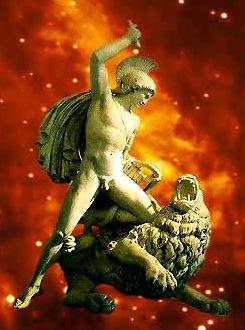
Hadrian gave Antinous a spear head made from diamond. Antinous both treasured it and used it to save the man he loved by killing a charging lion with that same spear head.

Carnelian - these lovely orange or light reddish brown stones are my favourite crystals I carry one with me always. They bring joy and vitality, energy but also ground you in the current reality. 

I have them in many forms and have just commissioned a new silver ring set with a Carnelian - the ring is the eternal snake of life forever eating its own tail. 

Anyway, Carnelian also invites abundance into your home (especially if you have a Carnelian near your front door). 

Since I have loved and cherished my Carnelians I have paid off the loan for my house, bought a much bigger 'new ' house (its Victorian) and have abundance of love, happiness and joy in my life."

Love and Light from my screen

MARTIN

To get more advice from Martin Campbell and to find out how to contact him CLICK HERE.

THE SACRED LION HUNT


ON the 21st of August, with the Sun in the final degrees of Leo the Lion, we commemorate the Sacred Lion Hunt ... when Hadrian and Antinous slew a man-eating lion in Egypt in August 130 AD.

Priests of Antinous celebrate the event in with ritual ceremonies at the Hollywood Temple of Antinous which also see worshipers participating live online from North and South America, Europe and Africa.

During the special ceremonies they also honor the Sacred Rosy Lotus of Antinous ... the pink waterlily said to have sprung forth spontaneously from the lion's blood as it splattered the banks of the Nile.


Flamen Antonius Subia relates in vivid detail the events of the Sacred Lion Hunt: The place is Egypt, somewhere in the rocky wilderness between the scattered oases southeast of Alexandria. 

The time is August of the Year 130 AD. The Sun is poised to enter the Sign of Leo. The Constellation of Aquila the Eagle is at its zenith in the nighttime sky ... just as it is now.

It is the constellation of the Emperor. And the Emperor and his Beloved are touring Egypt when they hear grisly accounts of a man-eating lion marauding the countryside on the edge of the cultivated land. The "Marousian Lion" it was called.

They lead a hunting expedition out into the wilderness. The whole expedition is rife with symbolism from the start since the Sun is in Leo in the daytime skies and the Eagle is soaring in the nighttime skies and the Ancients believed killing lions was tantamount to defeating death itself. Lion hunting was the sport of kings.

When at last the Imperial party flushes out the man-eater, the huntsmen and archers stand back and leave Hadrian to close in on the beast with his steed. Hadrian has just got off an arrow which wounds the animal when, all of a sudden, out of nowhere, young Antinous rides ahead, his reins in his left hand, an adamantine-tipped lance in his upraised right hand.

As the Imperial retinue looks on in horror, the snarling lion charges toward the boy, causing his panicked horse to whinny and wheel about in terror. But Antinous maintains his balance and, instantly judging distance and angle, sends his lance sailing towards the lion as it quickly closed the gap between them. 

The lance slams into its rear flank, inflicting a serious but not fatal wound. Enraged even more, the lion uses its fangs to pull out the lance and charges anew against the Boy who is fumbling with his quiver to ready a shot with his bow. But an arrow is already in the air from behind Antinous, and it whizzes past his ear and hit its mark in the throat of the lion.

It has been fired by Hadrian, who is approaching at full gallop and who, even while the first arrow was still in the air, had already readied a second arrow, which this time penetrates both lungs.

The lion spins about and collapses writhing in the dust, rage in its eyes, blood and saliva guttering from its fanged mouth, gasping for breath as it struggles to get to its feet — because Antinous has dismounted and is sprinting toward it with a drawn dagger.

Hadrian draws his steed to a halt and dismounts with an agility and  lightness befitting a man half his age, fueled by adrenaline and alarm for his Beloved Boy, who faces imminent peril from the mortally wounded lion, still capable of severing an artery with one swipe of its mighty paw.

Hadrian draws his hunting axe from his belt and holds it high as he  lunges onto the lion's back and dispatches the beast with one powerful blow which splits its skull in two with a frightening crack and a spurt of bright red blood which bathes both the older man, now panting and perspiring heavily, and the younger man who still shows no visible expression of concern, just a wild-eyed look of excitement in his eyes, as if he never realized the danger he had been in — as if he thinks he is immortal.

A cheer goes up from the coterie of onlookers when they realize the lion is dead, killed seemingly by a single blow from the Emperor's hand. Courtiers whose eyes are unskilled in the ways of hunting will later claim Hadrian had struck the lion dead with a club.

As soldiers and nervous bodyguards rush forward to make sure everything is all right, the emperor, his adrenalin-strength ebbing as quickly as it came, shakily wraps a blood-spattered arm around Antinous and plants his gilded, spike-soled sandal on the dead animal's neck and nods to Antinous to do the same.

There they stand, bathed in blood and bathed in the adulation of the Imperial coterie, each with one foot on the vanquished man-eater as the animal's blood spreads out and covers the surrounding rocks and sand and a few scrubby wildflowers growing from a crevice in a rock.

Even the flowers are splattered with blood. And these red blossoms  will be plucked by members of the entourage to take back as souvenirs to show to envious courtiers who had not been invited along.

THE SACRED LION HUNT was immortalized in poetry and in stone, with Hadrian adding medallions to the Arch of Constantine showing him and Antinous with feet on the lion's neck and also making sacrifice to the great lion-killer Hercules.


Soon legend would have it that scarlet-red lotus blossoms had sprung forth from the pool of the lion's blood, the lion which had been brought down by Antinous and which had been dealt its death blow by Hadrian — the SACRED RED LOTUS.

Under the Sign of Leo. And under the Constellation of the Eagle. 

Within a few short weeks, Antinous himself would be dead. The Sacred Lion Hunt is the last recorded event in His short life.

And some time afterward, grieving Hadrian would look up into the  nighttime skies with tear-filled eyes and his court astronomers would point out a New Star which had appeared in the southern part of the Constellation of Aquila the Eagle.

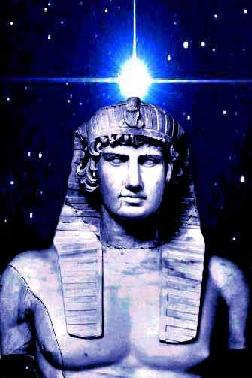
The New Star would be interpreted as a celestial sign that Antinous had been raised to the firmament, that the Constellation of the Imperial Eagle had been joined by the CONSTELLATION OF ANTINOUS. It was a sign that Antinous was now a God.

If you go outside tonight and peer out into the darkness with all its deep and hidden dangers, remember Antinous and how he peered out into the barren wilderness with all its deep and hidden dangers. 

He charged forth, his bridle-reins in his left hand and an adamantine-tipped lance in his right, and he faced death unafraid.

For Antinous knew he was immortal.

The Constellation of Antinous, still under the wing of the Imperial Eagle, will be right directly over your head tonight ... shining proof that Antinous is a God and that he is indeed immortal.


Don't look out into the darkness around you and be afraid. Instead, look up and remember the Beloved Boy, who was a fearless hunter, who stalked death itself, and who emerged victorious over it.

Friday, August 20, 2021

THE SACRED BAND OF THEBES
THE ARMY OF LOVERS


AUG. 20 the Religion of Antinous commemorates the Sacred Band of Thebes, the Army of Gay Lovers whose courage and valour have echoed down through the ages as an inspiration that Gay Love is a magical means of Conquering Fear and  Doubt.

The Sacred Band of Thebes, also called The Theban Band, was a battalion composed entirely of homosexual friends and lovers. This military unit, consisting of 150 male couples, was based on the belief that men fighting alongside their lovers would die rather than shame one another.

According to Aristotle, the Army of Lovers were sworn into military service at the Tomb of Iolaus, one of the many male lovers of Hercules. Iolaus had helped the god in the Twelve Herculean Tasks. 

He often acted as Hercules' charioteer and companion, and the closeness of their relationship was such that he was known as Heracles' symbomos (altar-sharer), since the two could be honored at one and the same altar — a very rare occurrence in ancient Greece, where each divinity would have his or her own altar.

Iolaus was called the eromenos (beloved boy) of Hercules, and was thus a Sacred Hero of same-sex love in Thebes. Hercules, Iolaus and Eros were often depicted together.

That is probably why the army of gay lovers was called the Sacred Band, since they took their oath of allegiance at the Sacred Tomb of Iolaus, which was at the same time a shared sacred altar to Hercules. In effect, the warriors were swearing that they would fight alongside their comrades the same way Iolaus and Hercules fought together — armed with the arrows of Eros.


You can see the parallels to Hadrian and his beloved boy Antinous, and later this week the parallels become even clearer when we commemorate the SACRED LION HUNT.

After that hunt in the Libyan desert in the summer of the year 130 AD, Hadrian and Antinous made sacrifice to the Great Lion Slayer Hercules — thus cementing the identification between Hadrian/Hercules and Antinous/Iolaus — and their affiliation with the Sacred Band of Thebes.

The great Theban gener
al and tactician Epaminondas is generally credited with establishing The Sacred Band, although some sources claim it was his "beloved friend" Pelopidas who was responsible for recruiting them. No matter — they both fought side-by-side at the head of The Sacred Band.

This corps d'elite first took to the battlefield against Sparta, which had dominated Greece since the fall of Athens in 404 BC. The Spartans were confident of victory, as they had never suffered a defeat on the battlefield — never ever.

Deploying the Sacred Band on his front left wing, "Epaminondas made his left wing fifty deep and flung it forward in the attack." 

The "extra weight" of this wing and the "fanatical bravery of the Sacred Band" broke the Sparta right wing, which contained their best warriors. In the ensuing hand-to-hand combat, the Spartan king was killed and their right gave way.

Witnessing this, the rest of the Spartan forces, who had not yet been engaged, fell back in disarray, running for their lives. Thus, Sparta suffered their first recorded defeat in more than 400 years — at the hands of an Army of Gay Lovers.

But the end came in 338 BC at the battle of Chaeronea when King Phillip II of Macedonia and his son Alexander (later called Alexander the Great) defeated the combined forces of Athens and Thebes-Boetia. Alexander confronted The Sacred Band of Thebes, the elite corps of 300 homosexual lovers who were by that time the most respected soldiers in the world.

But alas! They were no match for the Macedonians under Phillip and Alexander. It was a rout. The Athenian and Theban armies gave way and began retreating from the advancing Macedonians. Only The Sacred Band stood their ground — and died. Only a few were subdued and captured. Of those who died, it was found that not one had been wounded in the back — a sign that they had not turned away from the fight.

Alexander was so moved by their nobility and courage that he asked his father to bury them with honour and raise a monument in the form of a Sacred Lion over their mass grave. In 1881, the shattered fragments of this Lion Tomb were discovered, surrounded by the bones of 254 pairs of men with their weapons, arranged in a phalanx of seven rows, the battle formation of the Sacred Band.

In 1902 the fragments of the Sacred Lion were reconstructed and placed again over the tomb of The Sacred Band (depicted left) by the secret homosexual society known as the Order of Chaeronea, founded by gay-rights pioneer George Cecil Ives.

It reminds us once again of the Sacred Lion Hunt which we celebrate later this week.

So, what has all of this got to do with us in our daily lives? We're not soldiers. We're not brave and courageous. Like Dorothy Gale, we're meek and mild. Timid. We know that if we were on a battlefield, we would turn and run. We would hide and "play dead" and hope nobody found us.

We assume that the Army of Gay Lovers were all fearless. We think they were unafraid. We don't think of them as being scaredy-cats like us. We think they didn't mind the prospect of agonizing death. We think they were somehow above such mortal fears and doubts.

That's nonsense, of course. They were scared out of their wits. We can scarcely imagine how afraid they were. As they stood there alone against the mightiest army in the Ancient World, their emotions shifted beyond the mere terror of possibly being killed, to the actual horror of inescapable agony and death. It is one thing to be terrified — we all know the fears generated by terrorists who fly airliners into buildings. 

But the emotions experienced by those trapped in the planes or inside the burning buildings go far beyond mere terror to the actual horror of inescapable agony and death. That is the Mystery of Terror as opposed to the Mystery of Horror. We tend to forget the distinction!

The Army of Gay Lovers were not without fear. On the contrary, they were staring into the horror of impending pain and death. But they did not allow their fear to overwhelm them. 

Instead, they turned their fear "inside-out" and used it as a magical shield. The barbs of fear were no longer poking inward to themselves, but instead were pointing outward towards their foes.

And that is the Mystery Teaching of the Army of Gay Lovers. It was no doubt part of the initiation which the recruits underwent at the Tomb of Iolaus. They were schooled in magico-religious methods for handling fear. It's about learning to harness Mars energy. Mars is all about the double-edge sword of fear/bravery and how you can learn to wield that Sword of Mars.

It's not about being fearless. It's about being able to transform your fear into a mighty force which wins the battle of life. Mars Warrior Energy is not about death. It is about LIFE. It is about harnessing fear and doubt and turning them into useful energies in your daily life.

Life — from the time you are born until the time you die — life is just one constant battle. And if you give in, then you are lost. And if you give in to the fear and doubt that constantly confront you each and ever day, then you are lost. It's about using selfless love and transcendant awareness to transform fear and doubt into constructive energies which empower you to stand up and wade into the fray of daily life.


The Band of Thebes were initiated into Mystery Teachings which showed them how to transform fear and doubt into a magical force which made them invincible — capable of asserting their will and making their dreams become reality. 

And the catalyst was male-male love and devotion.

This is one of the deepest and most profound Mystery Teachings of the Religion of Antinous. 

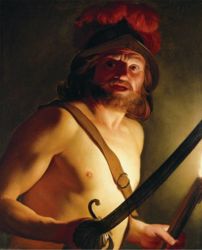
We are talking about the Mysteries of Antinous-Mars. This is why Flamen Antinoalis Antonius Subia has painted Antinous in the guise of the War God (above). 

Antinous is not just about gay male beauty. He is about gay male warrior energy.

Mars is a very important constituent aspect of Antinous. In Fixed Star Astrology, the STAR OF ANTINOUS is characterized by a mixture of Jupiter/Mars energy along with Venus energy — unique among Fixed Stars. To overlook Mars is to overlook a major component of what Antinous is all about.

Mars and his Alchemical Intelligence Graphiel and Daimon Barzabel (Deimos and Phobos) is much misunderstood by philosophers and occultists. 

The fiery Graphiel/Barzabel energies of the red planet ("terror" Deimos and "horror" Phobos) are often seen as frightful and horrific and destructive and warlike with no other qualities. This is a shallow analysis and one that should be discarded. Understanding your Martial nature — the Antinous-Mars warrior inside you — is essential to your survival and growth as a gay man. Terror and horror accompany us all our lives.

We are all afraid every day. We are all riddled with doubts every day. Look around you — most people are consumed with fear and doubt. Fear fuels their lives! But each of us can learn to turn our fears and doubts "inside-out" so that their barbs no longer point inward towards us, but instead so that these barbs of fear and doubt form a protective shield around us. 

It girds us with a constructive energy which helps us to advance through the Herculean travails which we face in our daily lives. Instead of being "fearfully" timid, we become "fearsomely" determined not to let life get us down.

Tomorrow, this transformational ability to turn fear "inside-out" will help us to understand how Antinous was able to charge the man-eater during the SACRED LION HUNT.

He must have been terrified. He was young and inexperienced and alone on his steed and armed only with an adamantine-tipped lance.

But through his loving bond with Hadrian/Hercules, Antinous/Iolaus was also magically armed with the "fearsomely strong" energies of the Sacred Band of Thebes. 


Flamen Antinoalis Antonius affirms: "We consecrate and honor their memory and call upon their strength and courage in our own hearts, that we may become the New Sacred Band."

Thursday, August 19, 2021

ASTRO FORECAST: AUGUST 19th—29th, 2021

Antinous is a Moon God. He is, of course, many other things and he wears many hats. But one of the ways he was worshiped in Antiquity was as ANTINOUS THE MOON GOD.

His worshipers looked skyward and saw His beautiful face perpetually turned towards the Earth. The Man in the Moon was actually the Blessed Boy in the Moon for the ancient priests and worshipers of Antinous. Swiftest and most youthful of all the Zodiacal deities, Antinous speeds through an entire year's worth of Astrological signs in just 28 days.

ANTINOUS THE MOON GOD represents our deepest personal needs, our basic habits and reactions, and our unconscious gay selves. Where Hadrian the Sun acts, Antinous the Moon REACTS. How do we instinctively react or respond to problems? What do we feel we need for a sense of security? Look to ANTINOUS THE MOON GOD for answers.

ANTINOUS THE MOON GOD is both our inner boy child and our inner lover. His ever changing phases, as he sweeps past all the other Planets in all the Signs, make us at turns responsive, receptive, and reflective. Eternally youthful, ANTINOUS THE MOON GOD represents our childlike spontaneous and instinctual reactions.

ANTINOUS THE MOON GOD beams down on us to make us imaginative, creative, intuitive, sentimental, adaptable, introspective, and protective. On the negative side, and depending on where he is in the Zodiac, he can make us moody, restless, and irrational.

Antinous Astrology Forecast


AUGUST 19th to 29th, 2021


THURSDAY, AUGUST 19th, 2021

This week, Mercury aligns in conjunction with Mars in Virgo. Mercury conjunction Mars creates a similarly explosive atmosphere, but with new issues. Bullies rattle sabers. Tempers flare. Drive carefully: Road Rage Rules! Some astrologers say this is when people sharpen their swords, but we prefer to say it is when people sharpen their tongues to use as weapons! Remember that lovely line from "The Importance of Being Earnest" by Oscar Wilde (who is a Saint of Antinous, by the way): "On an occasion of this kind it becomes more than a moral duty to speak one's mind. It becomes a pleasure." This is an aspect which encourages people to say vicious and intentionally hurtful things. People are overly persnickety and bitchy and downright mean. You'll be amazed how true this is.

Also this week, the Sun is in direct opposition to Jupiter, causing a sense of over-exuberance, over-exaggeration and over-exertion in all areas. Not that that's necessarily a bad thing ... but the coming weeks will show whether you bit off more than you can handle.

FRI-SATURDAY, AUG. 20th-21st, 2021

This weekend, both Mercury and Mars form powerful trine aspects with headstrong Taurus Uranus. First of all, you can expect surprise tidings from the other dimensions when Mercury is in a very conducive karmic-healing trine to Uranus. Mercury-trine-Uranus always creates optimal energies for breaking down encrusted old structures and for mentally visualizing bold new solutions.

Also this weekend, it is high time to break free of chains which have bound you for far too long when Virgo Mars forms a liberating trine aspect with Taurus Uranus. In Antinous Moon Magic we call this the "Stonewall Configuration" because the Stonewall Riots best demonstrate what can happen ... an explosive and wholly unexpected rebellion. Because both planets are in Earth signs, this aspect can spawn a sudden rupture or disruption of global consequences ... with long-lasting consequences. Mars in determined Virgo says it is time to break the chains, and Uranus in bull-headed Taurus says the chains must be broken with no regard for danger or peril.

SUNDAY, AUGUST 22nd, 2021

On Sunday, we come to the AQUARIUS FULL MOON. This is the summertime moon of generous gifts which we associate with Antinous/Vertumnus, the shape-shifting God of summertime bounty and generous gifts. We call this the DONUM MOON when magical rituals are performed for fortuitous gifts.

MON-TUESDAY, AUG. 23rd-24th, 2021

This week, diversity-minded Libra Venus forms a productive trine aspect with Aquarius Saturn. Venus trine Saturn helps you perceive whom you can trust for the long run and it helps you remember that business can be a pleasure.

WED-SUNDAY, AUG. 25th-29th, 2021

This week, Mercury opposite Neptune brings mental confusion and the potential for relationship problems due to miscommunication. Your perception of reality is clouded due to an inability to filter out the background noise or useless information. You are hearing and seeing the truth but also a lot of garbage and it is nearly impossible to tell the difference. This is a bad time for making important decisions, making plans or doing any detailed mental work. Business deals should be avoided and put off signing contracts if you can. If not, then make sure you get the advise of a professional in the field or someone you really trust.

Also this week, Mercury is in a positively profound trine with Pluto and the Star of Antinous that enables you to get down and dirty and show what is really inside of you ... deep ... down ... inside. This is a good time to grow beyond yourself ... shed your old shy image the way a snake sheds its skin ... and present your shining inner self to the world.

SNEAK PREVIEW OF NEXT WEEK:

Another exciting week lies ahead between August 30th and September 5th when ANTINOUS THE MOON GOD squares off against the Sun for the GEMINI THIRD QUARTER MOON which in Antinous Moon Magic is called the CONSOLATION MOON because it is the Lunar Archetypal energy of serendipity and fortuitous misadventures. You win the Silver Medal (but not the Gold). You win $20 in the lottery (but not the jackpot of $20 million). It is about finding $50 in an old wallet ... More details next time ....


FEDERICO GARCÍA LORCA
SAINT OF ANTINOUS


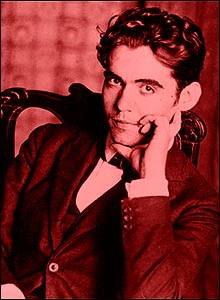
ON AUGUST 19th, the Religion of Antinous honors St. Federico García Lorca, who was openly gay and who is one of the greatest poets of the Spanish language. 
He was executed by the Fascists on this day, August 19th, during the Spanish Civil War in 1936.

García Lorca's central themes are love, pride, passion and violent death, which also marked his own life.


The Spanish Civil was just getting underway in August 1936 and García Lorca was seen by the right-wing forces as an enemy. The author hid from the soldiers but he was eventually found.

An eyewitness has told that he was taken out of a Civil Government building by guards and Falangists belonging to the "Black Squad". García Lorca was shot in Granada without trial. The circumstances of his death are still shrouded in mystery. He was buried in a grave that he had been forced top dig for himself. 

According to some sources, he had to be finished off by a coup de grâce. One of his assassins later boasted, that he shot "two bullets into his arse for being a queer".

It was the end of a brilliant career as a poet and dramatist who was also remembered as a painter, pianist and composer.

In the 1920s he was close friends with Luis Buñuel and Salvador Dalí, among many others who later became influential artists in Spain. Despite the accolades from artists and critics, he suffered from bouts of depression brought on largely by his inner conflict about his homosexuality.

He was tortured by the demands of being a celebrity in a homophobic society and the yearnings of his gay soul.

During his lifetime only a handful of close friends were allowed to read the collection of gay poems which would be published many years later as his Sonnets of Dark Love. Here is one of them, entitled Love Sleeps in the Poet's Heart:


You'll never understand my love for you,
because you dream inside me, fast asleep.
I hide you, persecuted though you weep,
from the penetrating steel voice of truth.
Normalcy stirs both flesh and blinding star,
and pierces even my despairing heart.
Confusing reasoning has eaten out
the wings on which your spirit fiercely soared:
onlookers who gather on the garden lawn
await your body and my bitter grief,
their jumping horses made of light, green manes.
But go on sleeping now, my life, my dear.
Hear my smashed blood rebuke their violins!
See how they still must spy on us, so near!


With the Catalan painter Salvador Dalí and the film director Louis Buñuel he worked in different productions.

Dalí and Lorca had met in 1923. From the beginning, Lorca was fascinated by the young Catalan's personality and looks. Also Dalí had admitted that Lorca impressed him deeply.

When Buñuel and Dalí made their famous surrealist short film Un Chien Andalou (1928), García Lorca was offended: he thought that the film was about him.

Lorca's friendship with Dalí inspired a poem, a defense of modern art and at the same time an expression of homosexual love. Dalí dedicated his painting of Saint Sebastian to his friend, who often compared himself to the tortured homoerotic martyr.

"Let us agree," Lorca wrote to Dalí, "that one of man's most beautiful postures is that of St. Sebastian."

"In my 'Saint Sebastian' I remember you," Salvador Dalí replied, ". . . and sometimes I think he IS you. Let's see whether Saint Sebastian turns out to be you."

García Lorca was capable only of a "tragic, passionate relationship," Dalí once wrote — a friendship pierced by the arrows of Saint Sebastian.


The Religion of Antinous honors this great artist who lived and loved tragically and passionately and who died tragically for being gay.

Wednesday, August 18, 2021

A POMPEII GREEK FREED MAN
WHO REFUSED TO BE CREMATED
LEAVES ARCHAEOLOGICAL LEGACY


A Greek freed slave who defied the Roman cremation custom and was mummified after death has provided archaeologists with the most remarkable tomb ever found at Pompeii.


The partially mummified remains of Marcus Venerius Secundio, including hair and bones, were found in a tomb at the necropolis of Porta Sarno, which was one of the main entrance gates into the city. 


The tomb is believed to date back to the decades before Pompeii was destroyed by the eruption of Mount Vesuvius in AD79.


What have been described as the best-preserved human remains ever discovered in Pompeii include Secundio's white hair and a partially visible ear. Initial tests show he died at about the age of 60.


Archaeologists said the discovery was unusual because deceased adults during Roman times were usually cremated. A glass urn with the name of a woman, Novia Amabilis, possibly Secundio's wife, was also found in the tomb.


"Pompeii never ceases to amaze," said Dario Franceschini, Italy’s culture minister.


Secundio was a slave and the custodian of ancient Pompeii's Temple of Venus. After being freed from slavery, he joined the ranks of the Augustales, a college of priests who were in charge of a form of emperor worship.


The fact that he was buried in a tomb proves he succeeded in achieving a good social and economic position.


Furthermore, an inscription dedicated to Secundio on a marble slab found at the top of the tomb makes references to theatre performances in Pompeii that were conducted in Greek. 


Gabriel Zuchtriegel, the director of Pompeii archaeological park, said the inscription was "the first clear evidence of performances at Pompeii in the Greek language."


"That performances in Greek were organised is evidence of the lively and open cultural climate which characterised ancient Pompeii," added Zuchtriegel.


Tuesday, August 17, 2021

NO WELL-GROOMED ROMAN MALE
WAS WITHOUT AN ANTINOUS BALSAMARIUM


"CLEANLINESS is next to Godliness" ... was Ovid's advice to young men setting out on amorous conquests in his poem Ars Amatoria.

A clean body and a well-groomed appearance was not only indispensable in the art of love, but was also considered a fundamental feature of Roman self-esteem, frequently contrasted with the uncleanliness and unkempt appearance of Barbarians living outside the borders of the Empire.

The third Friday in August is Men's Grooming Day and the ancient Romans apparently considered Antinous to be their role model because a BALSAMARIUM (bath unguent jar) in the form of the head of Antinous was hugely popular.


Any well-groomed Roman male owned an array of bathing implements, combs, strigilae, lamps, water-resistant flip-flops and other articles ... including a balsamarium to hold his bath oils or skin lotions.

Antinous balsamaria were exceedingly popular in Rome. Suitable for holding bath oils or moisturizers, an Antinous balsamarium suggested that its owner would emerge from the baths looking like a God. 

And we thought modern advertising came up with that gimmick!