Tuesday, August 20, 2024

THE SACRED BAND OF THEBES
THE ARMY OF LOVERS


AUG. 20 the Religion of Antinous commemorates the Sacred Band of Thebes, the Army of Gay Lovers whose courage and valour have echoed down through the ages as an inspiration that Gay Love is a magical means of Conquering Fear and  Doubt.

The Sacred Band of Thebes, also called The Theban Band, was a battalion composed entirely of homosexual friends and lovers. This military unit, consisting of 150 male couples, was based on the belief that men fighting alongside their lovers would die rather than shame one another.

According to Aristotle, the Army of Lovers were sworn into military service at the Tomb of Iolaus, one of the many male lovers of Hercules. Iolaus had helped the god in the Twelve Herculean Tasks. 

He often acted as Hercules' charioteer and companion, and the closeness of their relationship was such that he was known as Heracles' symbomos (altar-sharer), since the two could be honored at one and the same altar — a very rare occurrence in ancient Greece, where each divinity would have his or her own altar.

Iolaus was called the eromenos (beloved boy) of Hercules, and was thus a Sacred Hero of same-sex love in Thebes. Hercules, Iolaus and Eros were often depicted together.

That is probably why the army of gay lovers was called the Sacred Band, since they took their oath of allegiance at the Sacred Tomb of Iolaus, which was at the same time a shared sacred altar to Hercules. In effect, the warriors were swearing that they would fight alongside their comrades the same way Iolaus and Hercules fought together — armed with the arrows of Eros.


You can see the parallels to Hadrian and his beloved boy Antinous, and later this week the parallels become even clearer when we commemorate the SACRED LION HUNT.

After that hunt in the Libyan desert in the summer of the year 130 AD, Hadrian and Antinous made sacrifice to the Great Lion Slayer Hercules — thus cementing the identification between Hadrian/Hercules and Antinous/Iolaus — and their affiliation with the Sacred Band of Thebes.

The great Theban gener
al and tactician Epaminondas is generally credited with establishing The Sacred Band, although some sources claim it was his "beloved friend" Pelopidas who was responsible for recruiting them. No matter — they both fought side-by-side at the head of The Sacred Band.

This corps d'elite first took to the battlefield against Sparta, which had dominated Greece since the fall of Athens in 404 BC. The Spartans were confident of victory, as they had never suffered a defeat on the battlefield — never ever.

Deploying the Sacred Band on his front left wing, "Epaminondas made his left wing fifty deep and flung it forward in the attack." 

The "extra weight" of this wing and the "fanatical bravery of the Sacred Band" broke the Sparta right wing, which contained their best warriors. In the ensuing hand-to-hand combat, the Spartan king was killed and their right gave way.

Witnessing this, the rest of the Spartan forces, who had not yet been engaged, fell back in disarray, running for their lives. Thus, Sparta suffered their first recorded defeat in more than 400 years — at the hands of an Army of Gay Lovers.

But the end came in 338 BC at the battle of Chaeronea when King Phillip II of Macedonia and his son Alexander (later called Alexander the Great) defeated the combined forces of Athens and Thebes-Boetia. Alexander confronted The Sacred Band of Thebes, the elite corps of 300 homosexual lovers who were by that time the most respected soldiers in the world.

But alas! They were no match for the Macedonians under Phillip and Alexander. It was a rout. The Athenian and Theban armies gave way and began retreating from the advancing Macedonians. Only The Sacred Band stood their ground — and died. Only a few were subdued and captured. Of those who died, it was found that not one had been wounded in the back — a sign that they had not turned away from the fight.

Alexander was so moved by their nobility and courage that he asked his father to bury them with honour and raise a monument in the form of a Sacred Lion over their mass grave. In 1881, the shattered fragments of this Lion Tomb were discovered, surrounded by the bones of 254 pairs of men with their weapons, arranged in a phalanx of seven rows, the battle formation of the Sacred Band.

In 1902 the fragments of the Sacred Lion were reconstructed and placed again over the tomb of The Sacred Band (depicted left) by the secret homosexual society known as the Order of Chaeronea, founded by gay-rights pioneer George Cecil Ives.

It reminds us once again of the Sacred Lion Hunt which we celebrate later this week.

So, what has all of this got to do with us in our daily lives? We're not soldiers. We're not brave and courageous. Like Dorothy Gale, we're meek and mild. Timid. We know that if we were on a battlefield, we would turn and run. We would hide and "play dead" and hope nobody found us.

We assume that the Army of Gay Lovers were all fearless. We think they were unafraid. We don't think of them as being scaredy-cats like us. We think they didn't mind the prospect of agonizing death. We think they were somehow above such mortal fears and doubts.

That's nonsense, of course. They were scared out of their wits. We can scarcely imagine how afraid they were. As they stood there alone against the mightiest army in the Ancient World, their emotions shifted beyond the mere terror of possibly being killed, to the actual horror of inescapable agony and death. It is one thing to be terrified — we all know the fears generated by terrorists who fly airliners into buildings. 
But the emotions experienced by those trapped in the planes or inside the burning buildings go far beyond mere terror to the actual horror of inescapable agony and death. That is the Mystery of Terror as opposed to the Mystery of Horror. We tend to forget the distinction!

The Army of Gay Lovers were not without fear. On the contrary, they were staring into the horror of impending pain and death. But they did not allow their fear to overwhelm them. 

Instead, they turned their fear "inside-out" and used it as a magical shield. The barbs of fear were no longer poking inward to themselves, but instead were pointing outward towards their foes.

And that is the Mystery Teaching of the Army of Gay Lovers. It was no doubt part of the initiation which the recruits underwent at the Tomb of Iolaus. They were schooled in magico-religious methods for handling fear. It's about learning to harness Mars energy. Mars is all about the double-edge sword of fear/bravery and how you can learn to wield that Sword of Mars.

It's not about being fearless. It's about being able to transform your fear into a mighty force which wins the battle of life. Mars Warrior Energy is not about death. It is about LIFE. It is about harnessing fear and doubt and turning them into useful energies in your daily life.

Life — from the time you are born until the time you die — life is just one constant battle. And if you give in, then you are lost. And if you give in to the fear and doubt that constantly confront you each and ever day, then you are lost. It's about using selfless love and transcendant awareness to transform fear and doubt into constructive energies which empower you to stand up and wade into the fray of daily life.


The Band of Thebes were initiated into Mystery Teachings which showed them how to transform fear and doubt into a magical force which made them invincible — capable of asserting their will and making their dreams become reality. 

And the catalyst was male-male love and devotion.

This is one of the deepest and most profound Mystery Teachings of the Religion of Antinous. 

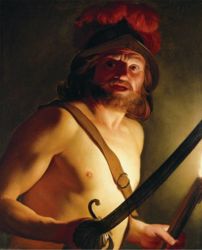
We are talking about the Mysteries of Antinous-Mars. This is why Flamen Antinoalis Antonius Subia has painted Antinous in the guise of the War God (above). 

Antinous is not just about gay male beauty. He is about gay male warrior energy.

Mars is a very important constituent aspect of Antinous. In Fixed Star Astrology, the STAR OF ANTINOUS is characterized by a mixture of Jupiter/Mars energy along with Venus energy — unique among Fixed Stars. To overlook Mars is to overlook a major component of what Antinous is all about.

Mars and his Alchemical Intelligence Graphiel and Daimon Barzabel (Deimos and Phobos) is much misunderstood by philosophers and occultists. 

The fiery Graphiel/Barzabel energies of the red planet ("terror" Deimos and "horror" Phobos) are often seen as frightful and horrific and destructive and warlike with no other qualities. This is a shallow analysis and one that should be discarded. Understanding your Martial nature — the Antinous-Mars warrior inside you — is essential to your survival and growth as a gay man. Terror and horror accompany us all our lives.

We are all afraid every day. We are all riddled with doubts every day. Look around you — most people are consumed with fear and doubt. Fear fuels their lives! But each of us can learn to turn our fears and doubts "inside-out" so that their barbs no longer point inward towards us, but instead so that these barbs of fear and doubt form a protective shield around us. 

It girds us with a constructive energy which helps us to advance through the Herculean travails which we face in our daily lives. Instead of being "fearfully" timid, we become "fearsomely" determined not to let life get us down.
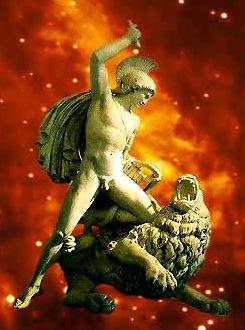
Tomorrow, this transformational ability to turn fear "inside-out" will help us to understand how Antinous was able to charge the man-eater during the SACRED LION HUNT.

He must have been terrified. He was young and inexperienced and alone on his steed and armed only with an adamantine-tipped lance.

But through his loving bond with Hadrian/Hercules, Antinous/Iolaus was also magically armed with the "fearsomely strong" energies of the Sacred Band of Thebes. 


Flamen Antinoalis Antonius affirms: "We consecrate and honor their memory and call upon their strength and courage in our own hearts, that we may become the New Sacred Band." 

Monday, August 19, 2024

THE AQUARIUS FULL MOON
THE DONUM MOON OF ANTINOUS


TONIGHT'S Aquarius Full Moon is the summertime moon of generous gifts which we associate with Antinous in his guise as Vertumnus, the shape-shifting God of summertime bounty and generous gifts.

This is the full moon of letting go, breaking out of restrictions, busting out of prisons, liberating yourself from the chains which restrain you.

It represents a boon (material or otherwise) which comes your way through generosity. It is an unexpected gift from someone else.

Or it is a gift you give to yourself. The Aquarius Full Moon is about philanthropic generosity

 In ANTINOUS MOON MAGIC we call this the DONUM MOON when magical rituals are performed for fortuitous gifts. 

Antinous/Vertumnus is the divine aspect of Antinous representing his gift-giving ability. He holds a symbolic gift of fresh-ripened fruit and summertime blossoms which he is eager to give to you without reservation.

It is yours. No questions asked. Take it.

Vertumnus also symbolizes his ability to morph and change bad luck into good luck. The Ancient Etruscans believed Vertumnus was a shape-shifter who could change his form at will. He brought gifts and bounty to those who had the "eyes" to perceive him in his many guises.

The Romans adopted Vertumnus and he became associated with the changing bounty of summertime, when fruit and vegetables materialized out of the ground and ripened and were ready for harvest ... the bountiful gifts of nature.

According to Ovid's Metamorphoses, Vertumnus was enthralled with Pomona, the goddess of orchard fruits, and desired to be one with her. But she spurned him.

He assumed many guises ... a fisherman, a soldier, a peasant, a reaper, etc. ... but she turned him away every time. Finally, he assumed the form of an old woman and was so aged and unattractive that Pomona let down her guard.

Thus, Vertumnus engaged her in conversation and they became inseparable ... which was what Vertumnus had wanted all along.

Ovid says that the moral of the tale of Vertumnus and Pomona is that you should never judge a gift by its outward appearances. Never reject the hand of friendship.

The Aquarius Full Moon is about philanthropic generosity. The Ancient Romans celebrated the feast day of Vertumnus ... the Vertumnalia ... during the cycle of the Aquarius Full Moon in early times (and on August 13th in later times) by giving each other baskets of fruit, flowers and other symbols of nature's bounty. The Aquarius Full Moon is associated with Antinous/Vertumnus in Antinous Moon Magic rituals.

Go outside tonight and look up at the full moon, with shooting stars cascading from all sides. This is the FULL MOON to wake up and break free of all mental, spiritual, political and ideological strictures. It is the gift of an opportunity.

The PERSEID METEORS (which reach their peak at this time of year) are symbolically aimed at you.

Antinous is aiming his gifts of new opportunity directly your way. All you have to do is reach out and grasp it ... and it's yours.

DIAMONDS FOR THE DONUM MOON
By Our Crystal Meditation Advisor Martin Campbell


OUR astrology adviser Hernestus has advised me that today is the Aquarius Full Moon which is the Donum Moon of Amtinous Vertumnus. 

Hernestus further advised me that crystals for any meditation today should have attributes which focus on the Aquarian ability to appreciate the bounty of life. 

It is about giving and being open to receiving gifts. 

With this in mind I would recommend that you meditate using the following crystals:

Cinnabar - this unusual red crystal (below right) can be quite expensive but it is worth considerings because of its appropriate attributes for today's focus on abundance. Cinnabar is known to attract abundance. This may be particularly via trade but it will only focus on trade which is positive and undertaken with no ill intent or aggression.

Diamond - you knew I was going to say that didn't you?! Hopefully you have one or know someone who has one. 

Maybe you have given one as a gift or may receive one as a gift. 

Whatever the circumstances they help you to manifest - attract - abundance into your life. This abundance will most often be in love, relationships or wealth. 

People have not given diamonds for millennia for no reason.  The givers were usually wealthy, the receivers usually delighted and loving in return. 

Hadrian gave Antinous a spear head made from diamond. Antinous both treasured it and used it to save the man he loved by killing a charging lion with that same spear head.

Carnelian - these lovely orange or light reddish brown stones are my favourite crystals I carry one with me always. They bring joy and vitality, energy but also ground you in the current reality. 

I have them in many forms and have just commissioned a new silver ring set with a Carnelian - the ring is the eternal snake of life forever eating its own tail. 

Anyway, Carnelian also invites abundance into your home (especially if you have a Carnelian near your front door). 

Since I have loved and cherished my Carnelians I have paid off the loan for my house, bought a much bigger 'new ' house (its Victorian) and have abundance of love, happiness and joy in my life."

Love and Light from my screen

MARTIN

To get more advice from Martin Campbell and to find out how to contact him CLICK HERE.

BEN PASTOR'S 'HORSEMAN'S SONG'
RIVETING GARCÍA LORCA MURDER MYSTERY


WE all know that Spanish poet (and saint of Antinous) Federico GarcĂ­a Lorca was murdered by Fascists on August 19th, 1936 ... or do we?

In a brilliant new thriller by author BEN PASTOR he was murdered twice ... once in 1936 and again in 1937 ... and it is up to a persistently thorough German Wehrmacht sleuth to find out what really happened ... and why.

Antinomaniacs are familiar with Ben Pastor for her richly researched historical novel THE WATER THIEF is about the search for the Lost Tomb of Antinous by Roman sleuth Aelius Spartianus. 

In that book, Spartianus not only discovers the whereabouts of the Beauteous Boy's tomb, but also uncovers a nefarious plot to bring down the Roman Empire.

Ben Pastor has written a series of Spartianus mysteries set in the days of the Roman Empire.

But the award-winning Italian-American historian and mystery writer is also the author of a series of novels about a World War II German military detective named Martin Bora who dodges mortar shells and Nazi intrigue to get to the bottom of baffling murders at the risk of life and limb. 


The new novel is entitled THE HORSEMAN'S SONG, a reference to GarcĂ­a Lorca's celebrated poem CanciĂłn del Jinete (The Horseman's Song) about a young rider galloping through darkness on a journey that ends in death.

Pastor skillfully works this symbolism into this tale of a young Scottish-German officer walking a tightrope of death between Spanish Fascists and Red Republicans ... all grimly intent on annihilating each other ... as German military intelligence spies lurk in the shadows. 

And along the way he must side-step booby-traps placed by envious officers, enamored gay comrades, jealous rebels ... and the love spells of an Aragon bruja witch.

As always with every book by Pastor, the historical research is immaculate and the writing is tight and fast-paced. You can't skip over a single sentence lest you miss a vital clue or insight into the solving of the riddle.

For those of you who have read her earlier Martin Bora novels, all set during World War II, this book is something of a prequel, introducing us to a Martin in his late 20s ... younger and more naive ... a young man galloping on his own journey through dark shadows of death.

It's a book everyone who is interested in Federico GarcĂ­a Lorca must read.

Sunday, August 18, 2024

DID ANTINOUS SEE CLEOPATRA'S TOMB
ON HIS LION-HUNTING EXPEDITION?


THE Lost Tomb of Antinous and the Lost Tomb of Alexander the Great capture the imaginations of archaeologists everywhere ... but imagine stumbling onto the Lost Tomb of Cleopatra?

One long-held theory is that her tomb could be hidden in a labyrinth beneath a Roman era fort in the desert west of Alexandria called Taposiris Magna.

Experts from Egypt and the Dominican Republic have discovered the temple's original gate on its western side. In pharaonic Egypt the temple was named Per-Usir, meaning "A place of Osiris."

Legend has it that when the god Seth killed Osiris he cut him into fourteen pieces and threw them all over Egypt. This is one of 14 temples said to contain one piece of the god's body.

The team also found limestone foundation stones, which would once have lined the entrance to the temple. 

One of these bears traces indicating that the entrance was lined with a series of Sphinx statues.

The team, led by Dr. Kathleen Martinez, began excavations in Taposiris Magna ten years ago in an attempt to locate the tomb of the well-known lovers, Queen Cleopatra VII and Mark Antony.

There is some evidence that suggests that Egypt's last Queen might not be buried inside the tomb built beside her royal palace, which is now under the eastern harbour of Alexandria.

The archaeologists have been exploring the underground labyrinth, turning up a bronze statue of the goddess Aphrodite, the alabaster head of a Cleopatra statue, a mask believed to belong to Marcus Antonius and a headless statue from the Ptolemaic era.

The location is of great interest to those of us who love Antinous because it is very likely that Hadrian and Antinous visited this temple site in August of the year 130 AD ... the final summer of the brief life of Antinous.

As we know, the imperial entourage was visiting Alexandria in the summer of the year 130, and we know that Hadrian and Antinous hunted and killed a man-eating lion which had been terrorizing the countryside. 

It was described as a "Libyan" lion, "Libya" being the term used in those days for everything west of Alexandria.

So it is highly possible (even likely) that the imperial hunting party passed by the temple at Taposiris Magna, which is less than 45 kms (30 miles) west of Alexandria. 

In the year 130 it was a vast complex of temples that included a Roman fortress. The name Taposiris comes from the legend that one of the relics of Osiris was enshrined there.

This is a very noteworthy site because it is the location of the only wholly Greek style temple (with columns) ever known to have been built in Egypt. 

And it is also a temple which was converted into a military fortress by the Romans.

In addition, it is the location of a unique stone tower overlooking the sea which is believed to have been a miniature replica of the Great Lighthouse at nearby Alexandria.

Only shattered walls and foundations are left to indicate the size of Taposiris Magna.

It is entirely conceivable that Cleopatra and Marcus Antonius, cornered by Octavian's advancing forces, might have sought refuge at this fortified temple complex with its tower suitable for use as an observation post.

It is also entirely possible that Cleopatra and Marc Antony were buried here.

Saturday, August 17, 2024

THE BIRTHPLACE OF ANTINOUS
IS THE HOME OF 'MAD HONEY'


TURKEY's hallucinogenic "Mad Honey" is produced when bees pollinate rhododendron flowers in the remote mountainside towns of the Black Sea region ... where Antinous was born and spent his childhood.

After his death and deification, Antinous was identified with ARISTAEUS (below right), the inventor of beekeeping, so it is likely that he knew about the effects of Bithynian "Mad Honey."

He must have seen beekeepers hauling their hives up the slopes of the mountains of his homeland until they reach vast fields of cream and magenta rhododendron flowers. 

Here, they unleashed their bees, which pollinated the blossoms and made a kind of honey from them so potent, it has been used as a weapon of war.

The dark, reddish "Mad Honey," known as "deli bal" in Turkey, contains an ingredient from rhododendron nectar called grayanotoxin ... a natural neurotoxin that, even in small quantities, brings on light-headedness and sometimes, hallucinations. 

Throughout the ages, Bithynia has traded this potent produce with Greece and Rome and (in later centuries) Western Europe, where the honey was infused with drinks to give boozers a greater high than alcohol could deliver.

When over-imbibed, however, the honey can cause low blood pressure and irregularities in the heartbeat that bring on nausea, numbness, blurred vision, fainting, potent hallucinations, seizures, and even death, in rare cases. 

Nowadays, cases of mad honey poisoning crop up every few years ... oftentimes in travelers who have visited Turkey.

Rhododendron flowers occur all over the world, and yet mad honey is most common in the Bithynia region ... the biggest honey-producing region in Turkey.

"There are more than 700 different species (of rhododendron) in the world, but according to our knowledge just two or three include grayanotoxin in their nectars," says SĂĽleyman Turedi, a doctor at the Karadeniz Technical University School of Medicine in Trabzon, Turkey, who studies deli bal's effects and has witnessed more than 200 cases of mad honey poisoning.

In Turkey, not only do the poisonous rhododendrons abound, but the humid, mountainous slopes where Antinous grew up provide the perfect habitat for these flowers to grow in monocrop-like swaths. 

When bees make honey in these fields, no other nectars get mixed in ... and the result is deli bal, potent and pure.

Although the product makes up only a tiny percentage of Bithynia's honey production, it has long held a strong Turkish following.

"People believe that this honey is a kind of medicine," Turedi says. “They use it to treat hypertension, diabetes mellitus and some different stomach diseases. And also, some people use deli bal to improve their sexual performance."

The honey is taken in small amounts, sometimes boiled in milk, and consumed typically just before breakfast, he adds ... not slathered on toast or stirred generously into tea the way normal honey would be.

Its value to customers has given beekeepers an incentive to keep visiting those rhododendron fields and producing it alongside their normal honey products.

Johnny Morris, a travel journalist from the United Kingdom, puts its Turkish predominance partly down to history, too. In 2003, for his popular travel column called "Grail Trail," he went to taste mad honey in Trabzon, a Turkish city that’s backed by mountains and faces the Black Sea.

"It’s got a long history in Turkey," he says. "It was used as a weapon of mass destruction for invading armies."

Indeed, in 67 B.C. Roman soldiers invaded the Black Sea region under General Pompey's command, and those loyal to the reigning King Mithridates secretly lined the Romans' path with enticing chunks of mad honeycomb. 

The unwitting army ate these with gusto, as the story goes.

Driven into an intoxicated stupor by the hallucinogenic honey, many of the flailing soldiers became easy prey, and were slain.

Mad Honey is still sold under the counter at shops in the area today. Turedi explains that Turks in the region have the know-how to consume it responsibly.

"Local people are able to distinguish mad honey from other honeys. It causes a sharp burning sensation in the throat and thus it’s also referred to as bitter honey," he says.

People who have tried is say that even a drop or two of it on the tongue has a numbing effect. Experts say deli bal retains its numbing, head-spinning traits because it is untreated, unprocessed, and essentially pure.

"We know that if you eat more than one spoonful of honey including grayanotoxin, you are at risk of Mad-Honey poisoning," Turedi says.

"In spring and summer, the honeys are fresh and may include more grayanotoxin than in other seasons." 

If that doesn’t dissuade the adventurous foodie, then Turedi says to limit intake to less than a teaspoon, "and if you feel some symptoms associated with mad honey, you should get medical care as soon as possible."

For adherents of Antinous on pilgrimages to the land of his birth, the dangerously sweet syrup retains its ancient mystery, tucked away in shops that are difficult to find.

Friday, August 16, 2024

NO WELL-GROOMED ROMAN MALE
WAS WITHOUT AN ANTINOUS BALSAMARIUM


"CLEANLINESS is next to Godliness" ... was Ovid's advice to young men setting out on amorous conquests in his poem Ars Amatoria.

A clean body and a well-groomed appearance was not only indispensable in the art of love, but was also considered a fundamental feature of Roman self-esteem, frequently contrasted with the uncleanliness and unkempt appearance of Barbarians living outside the borders of the Empire.

The third Friday in August is Men's Grooming Day and the ancient Romans apparently considered Antinous to be their role model because a BALSAMARIUM (bath unguent jar) in the form of the head of Antinous was hugely popular.


Any well-groomed Roman male owned an array of bathing implements, combs, strigilae, lamps, water-resistant flip-flops and other articles ... including a balsamarium to hold his bath oils or skin lotions.

Antinous balsamaria were exceedingly popular in Rome. Suitable for holding bath oils or moisturizers, an Antinous balsamarium suggested that its owner would emerge from the baths looking like a God. 

And we thought modern advertising came up with that gimmick!