MAGINATION is the key word. Just imagine the cramped artist's studio in London's Chelsea district and, with the help of the artist's images, you are there. It is December 1909. The solid-black walls of the apartment contrast starkly with the red-orange drapes.
Jamaican folk artefacts share space on a Victorian curio shelf with photographs of friends and relatives — a mother in Jamaica, a father in Brooklyn Heights, a famous actress in a West End production, Bram Stoker, W.B. Yeats. The jet-black walls form a void-like exhibition space which highlights the dazzling Caribbean art as well as the dozens of paintings and sketches which line the walls. Suffragette posters. Oil landscapes. But particularly watercolor illustrations of dreamscapes and fairy tales.
A brightly painted miniature theatre with ornate proscenium and cloth curtain stands proudly in one corner, with its cast of tiny cardboard cut-out "actors" waiting patiently for their entrances.
An enormous gramophone stands in the opposite corner, and Debussy's La Mer is playing at full volume, as it has been all morning. The neighbours have long since stopped complaining about the music.

The artist, Pamela Colman Smith, is a petite woman in her early 30s who sits in the middle of the studio with paint brush in hand, mixing watercolors, her eyes trance-like as the music envelops her. She is wearing a vividly hued kimono with broad sleeves made even more colorful by splotches of paint.
One of the two Japanese combs pinning back her long dark hair has loosened, causing her tresses to sag to one side, but she is oblivious. The paint is dripping from her brush, but she pays no mind, keeping her eyes firmly shut as Debussy transports her to a place she calls "the unknown country" of her artistic inner heart.
On the easel in front of her is a small canvas showing an androgynous person wearing a short kimono-like tunic with sleeves and an abstract floral design uncannily like the kimono she is wearing. The figure is striding to a precipice as a small white animal dances at his heels.
The painting is almost finished. The outline was done in pen. Only a few more brush strokes are needed for the hand-coloring. Debussy will provide the musical sunrise which will be the cue that the illustration is finished.
And then the small illustration will join all the others (about 80 in all, give or take one or two) which are carefully arranged on drying shelves around the studio. The printer is waiting. The cards must be delivered by the end of December.

She has been working on the Tarot card project for about a year, since Arthur E.A. Waite asked her to illustrate "his" new pack of Tarot cards in his long-running one-upsmanship feud with other occultists in London.
He had very strong ideas about the design of the 22 Greater Trumps but was unconcerned with the 56 Lesser Trumps. Only one other artist had ever illustrated all 78 cards, an unknown 15th Century artist whose dazzling cards were jealously guarded by the Sola Busca family of Italy.
The Sola Buscas had grudgingly permitted photographic copies of the cards to be put on view at the British Museum in 1908.
And so it was, that a petite 30-something sufragette took a tweedy advertising executive for the Horlick's bedtime powdered milk drink (Waite's "day job" when he wasn't doing occult spellwork) and dragged him to the British Museum and said she would do the job but only on condition that she illustrate all 78 cards with artistic license for design and color.
It had taken months of pain-staking work. "A big job for very little cash!" she would write to her friend and benefactor Alfred Stieglitz, who had made room in his famed New York photography gallery for exhibitions of some of her "Pictures in Music", watercolors she painted in a trance-like state while listening to her favorite composers, such as Mozart, Tchaikovsky and Debussy. On a visit to Paris, she had even been bold enough to introduce herself to Debussy and show him paintings she had done to his music. She was greatly flattered when he said she had captured the very essence of his music.

"You ask me how these pictures are evolved," she said. "They are not the music theme — pictures of the flying notes — not conscious illustrations of the name given to a piece of music, but just what I see when I hear music-thoughts loosened and set free by the spell of the sound."
She explained that, for example, "Often when I hear Bach I hear bells ringing in the sky, rung by whirling cords held in the hands of maidens dressed in brown."
Stieglitz had shown her music paintings to rave reviews in New York in 1907. The New York Sun critic wrote: "Pamela Colman Smith is a young woman with the quality rare in either sex — imagination."
Pamela — "Pixie" to her few close friends (mostly women) — had grown up in London and New York City, as well as in Jamaica. Her father was a globe-trotting businessman who spent little time at home. Her mother came from a long line of women poets and children's story-book writers. The details of her childhood are fuzzy. She had a dark complexion and facial features which prompted speculation that she had been adopted during her father's many trips to Jamaica. At any rate, she spent her formative years in Jamaica, where she learned the patois dialect perfectly and became a master story-teller of Jamaican tales of magic and wonder.

But when her mother died at an early age, little Pixie moved to Brooklyn Heights where she lived with her father and pursued art classes at the renowned Pratt Institute, a progressive school which encouraged students to explore new avenues of expression.
And when her father also died suddenly, she was shipped back to England to live with a troupe of actors who were friends of her eccentric father. She was relieved to be back in England, since her skin color had exposed her to racist discrimination in the States.
The rarified atmosphere of London's Leicester Square theatre district was an invigorating change. In New York she had been "a mulatto".
In London's West End she was simply exotic. She lived with the high-profile actress Ellen Terry, who became her mother, mentor and best friend. Sir Henry Irving, a leading thespian and empresario, became her ersatz father. The three of them toured Britain in productions when they weren't staging their own plays in the West End. Pixie lived in Irving's theatre. She learned set design, costume design (and how to mend costumes between acts) and she learned how the stage is the world-in-small.
A century on, it is hard for us to appreciate how mind-opening the theatre was. There was no radio, no television. Even the cinema was in its infancy. To see the world, you went to the theatre. Pamela didn't just go to the theatre. Surrounded by actors and directors 24 hours a day, she truly LIVED the theatre. She said it was the perfect place for a budding artist.

"Go and see all the plays you can," she advised young artists. "For the stage is a great school — or should be — to the illustrator — as well as to others."
She openly admitted she had learned more in the theatre than at her famous New York art institute.
"The stage has taught me almost all I know of clothes, of action and of pictorial gestures," she said, and her advice to other artists was to throw away the textbook and just open their eyes and ears. An artist should always have a sketch pad at hand. She even took her sketch pad to the ballet to see Nijinsky dance.

"Learn from everything, see everything, and above all feel everything! And make other people when they look at your drawing feel it too!"
She was dismissive of painters who are interested only in their medium and who shun other liberal arts.
"Keep an open mind to all things," she said. Even though you are a painter, listen to music, go to the ballet.

"Hear all the music you can, for sound and form are more closely related than we know."
And she dismissed turn-of-the-century painters who strove only for beauty, ignoring ugliness.
"For through ugliness is beauty sometimes found," she observed. She recalled having seen a very dark and brutal stage production which in a way reminded her of the gritty beauty of poverty-stricken Jamaica.
"All through that play I thought that ugly things may be true to nature, but surely it is through evil, that we realize good. The far-off scent of morning air, the blue mountains, the sunshine, the flowers, of a country I once lived in, seemed to rise before me — and there on the stage was a woman sitting on a chair, her body stiff, her eyes rolling, a wonderfully realistic picture of a fit."
Through Ellen Terry and Henry Irving, Pamela made friends with literary luminaries such as "Dracula" author Bram Stoker, "Peter Pan" playwright J.M. Barrie and and poet/playwright W.B. Yeats.
In fact, "Sherlock Holmes" was her uncle — because her real-life great uncle was the actor William Gillette, who brought Holmes to the stage in London and on Broadway. It was Gillette who introduced many of the mannerisms and props (the deerstalker cap, the meerschaum pipe) which have been intrinsically associated with Sherlock Holmes by succeeding generations. Her Uncle Bill even saw to it that Pamela illustrated the programs for his Holmes productions.

Pamela became well-known for her afternoon literary teas, at which Yeats, Stoker and other luminaries would gather in her studio while she put on the costume of a Jamaican wise woman and sat cross-legged on the floor, relating Jamaican folk tales in dialect.
She used a miniature theatre and tiny cardboard characters to illustrate her hugely delightful tales.
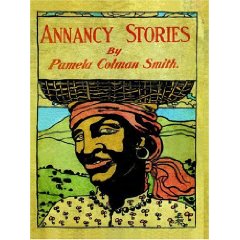
Her literary friends encouraged her to publish and illustrate the stories under her own name, which she did. The book is still in print.
 One frequent male visitor described one such literary evening, saying, "The door was flung open, and we saw a little round woman, scarcely more than a girl, standing in the threshold. She looked as if she had been the same age all her life, and would be so to the end. She was dressed in an orange-colored coat that hung loose over a green skirt, with black tassles sewn all around over the orange silk, like the frills on a Red Indian's trousers. She welcomed us with a little shriek. She was very dark, and not thin, and when she smiled, with a smile that was peculiarly infectious, her twinkling gypsy eyes seemed to vanish altoghether. Just now, at the door they were the eyes of a joyous, excited child."
This was shortly after the turn of the 20th Century, and she had perfected her artistic style and was busy as a book and magazine illustrator. While publishers mandated style to some extent, Pamela Colman Smith advocated the Arts and Crafts style, also known as the Secession style or, in the US, as the Craftsman or, especially in California, called the Mission style.
The Arts and Crafts Movement was a style which dominated in the years before World War I, and which was between the Art Nouveau style of the 1890s and the Expressionist style which would revolutionize art after the Great War. The Arts and Crafts Movement was an attempt to reject superfluous Victorian "wedding cake" adornment and to simplify things to the basics of simple lines and solid colors, in defiance of bourgeouis homeowners who wanted clutter.
For one brief moment, in the cosy years before the war, idealistic artists such as Pamela depicted a magical world in which machines did not dominate humankind. They were artists who sought to recreate pre-industrial, even primitive styles in art, architecture and decoration. Lines were simple. Colors were bold and earthy.

Pamela's generation of artists saw that a world driven by steam pistons was heading blindly, full-steam ahead for collision with the cold and immutable forces of nature. The Titanic disaster in 1912 was only a symbolic inevitable disaster waiting to happen, as far as these artists were concerned.
The Arts and Crafts Movement flourished in the first decade of the 20th Century, and Pamela managed to get by financially with her illustrations in that style. She also provided illustrations and even wrote articles for Gustav Stickley's "The Craftsman" magazine which was a leading purveyor of the style.
Not surprisingly, her Tarot cards are an enduring monument to the Arts and Crafts Movement and its philosophy which holds that a return to timeless styles in the Arts can help the human race return to timeless virtues and ageless wisdom. She was seeking to create a world in which racist thought and moral hypocrisy would vanish along with high-button shoes and celluloid shirt collars. She wanted everyone to sit on the floor, cross-legged, and discover the childlike magic of just being alive.
The cards were published with very little fanfare in December 1909. Only a few occultists took notice, and most of them were engaged in feuds with each other. The general public did not notice. Tarot cards were considered to be "French". The only Tarot cards hitherto available were from France, and they were considered only slightly less objectionable than saucy French porn postcards. Pamela was keenly aware that her cards were not going to make inroads into popular culture.

"Oh, the prudishness and pompous falseness of a great mass of intelligent people!" she wrote in an article for Stickley's "The Craftsman". It was an article aimed at inspiring young artists. "Lift up your ideals, you weaklings, and force a way out of that thunderous clamor of the steam piston, the hurrying herd of blind humanity, noise, dust, strife, seething toil!"

Those 78 cards are a veritable map of the place which she called "the unknown country" within an artist's heart. Many of her book illustrations are variations on that theme, such as "The Hill of Heart's Desire" at left.
To look at each card in succession is to take a trip through a magical land where cosmic wisdom and virtue prevail. You can spot recurring landmarks, such as castles, bridges and towers, which recur from different vantage points throughout the "journey". This magical land is peopled by beings who at times wear Renaissance clothing and at other times wear chitons and togas. The whole magical world is a place beyond linear time and space.

Waite never adequately acknowledged her work. In the book accompanying the cards he failed to mention her by name, saying only that a "young woman artist" had illustrated them on his instructions.
But in fact, Pamela had been a member of the Order of the Golden Dawn along with Stoker and Waite. In a way it was only natural since the English-speaking world's first esoteric book store, Watkins, had just opened its doors a few steps away from the Leicester Square theatre district.
Pamela never wrote about her initiation into occult mysteries. But the very first card in the deck, The Magician, is graphic proof that she was privy to occult knowledge of the most secret sort. In 1909 only a handful of people had read a badly translated copy of Das Buch Abramelin, a 15th Century German-language grimoire written by a German-Jewish sorcerer who claimed to have been initiated into ancient mysteries by a master living in a desert cave on the banks of the Nile.
Even now, a century after Pamela painted that card, very few people have read the Book of Abramelin, certainly not in the original German. To this day there is no full English translation. Those few who have read it immediately realize that The Magician card is a very precise portrait taken straight from the ancient book.
In it, the novice magician is instructed to wear a clean white tunic bound at the waist by a symbolic ouroboros serpent. He is to wear a crimson mantle over the tunic while standing before a simple wooden table upon which are his magical tools. The book then says that, for best results, the magician's magical work space should look out over a witch's garden of flowers and magical herbs.
Whatever Waite thought of "his" cards — and he was very vague in saying what their purpose should be other than clearly to aggrandize himself — Pamela knew they were tools not for TELLING the future, but for SHAPING the future through ancient Abramelin magical spells. That occult secret, sealed in the colorful symbolism of her cards, was destined to die with her — to be rediscovered a century after she created the cards by priests of ANTINOUS THE GAY GOD.

With that first card, The Magician, and with Renaissance alchemical symbolism throughout the deck, Pamela shows she was highly knowledgeable in the occult arts.
The rest of her story is quickly told. The Titanic sank but the age of the steam pistons did not go down with it. Instead, the First World War swept aside the lofty dreams of Pamela's generation of artists. The Arts and Crafts Movement was the first casualty. By 1915 Gustav Stickley's "The Craftsman" magazine ceased publication and his design company went bankrupt.
Pamela's illustration assignments dried up. By the mid-1920s she was unable to get even one job a year. When a distant uncle died and left her a modest nest egg, she took the money and left London, buying a village cottage at the far western tip of England — not far, in fact, from the fictional location of Baskerville Hall, which had figured so prominently in Uncle Bill's Broadway-hit Sherlock Holmes plays.

She lived in isolation with a woman companion. She died penniless at age 72 on September 18, 1951. The cottage and all her possessions were auctioned to pay back taxes, leaving her companion with nothing.
In December 1909 she had told her New York gallerista friend Alfred Stieglitz that she would send him a pack of the Tarot cards which she said were being "printed in color lithography (probably very badly) as soon as they are ready" and that she would also "send over some of the original drawings as some people MAY like them." By "some people", she meant "buyers". But the original art work has never surfaced. Not one of the 78 originals is known to exist.
The printed card decks vanished into obscurity for decades until the American playing card connoisseur Stuart R. Kaplan resurrected them in about 1970. It is largely thanks to him that anyone knows anything about this extraordinary artist, who created a single work which is ageless and timeless and which continues to appeal to new generations.
The final word belongs to Pamela Colman Smith, and it is a statement of inner strength which could just as easily be the catch-phrase of The Fool card in her Tarot:
"Banish fear, brace your courage, place your ideals high up with the sun, away from the dirt and squalor and ugliness around you and let that power that makes the 'roar of the high-power pistons' enter into your work — energy — courage — life — love. Use your wits. Use your eyes. Perhaps you use your physical eyes too much and only see the mask. Find eyes within, look for the door into the unknown country."